LuxEtVeritas
Bluelighter
it appears the oral potency is at least not too distant from the smoked potency
anyone try this SubL
anyone try this SubL




N&PD Moderators: Skorpio
You are using an out of date browser. It may not display this or other websites correctly.
You should upgrade or use an alternative browser.
Legality of THC-Analogues
LuxEtVeritas
Bluelighter
it appears the oral potency is at least not too distant from the smoked potency
anyone try this SubL



fastandbulbous
Bluelight Crew
It is the simple 1-hexyl that I've tried. 5mg via smoked or oral seems to be theupper realms of dosage (I've seen/heard of people exceeding 10mg and scaring the shit out of themselves - & can understand why1)
BTW - less synthetic discussion or it's bedtime for this thread
Last edited:
LuxEtVeritas
Bluelighter
Does anyone have the CB1 Ki value of the aforementioned 1-Hexyl-NI as i can not find it in the literature anywhere
the 1-pentyl is Ki= 9nM and is widely discussed, but i see nary a mention of a 1-hexyl or derivative anywhere
TIA

Schnitzalted
Bluelighter
gabbachris said:
That, naphthoylindole cannabinoid you speak of, Is deadly. It has literely reduced some people to tears. The tiniest amount, in a pipe, like 4 - 10 mg is a heavy high to say the least. It proper fucks you up. It does however feel very clean but that does not make you feel much better when you are under the influence. Most hardend smokers would not try it a second time although you do get the odd brave one. It is truly amazing but watch out.
I did feel really stoned still the next day for about half the day.
Reviving a thread as this struck me. There is a new product out in the similar line as spice gold and all those mimics that is supposedly very powerful and creates a bit different effects. I don't know if I can link to other forums where it is discussed, but the name of the product is Chillin XXX I think...I feel dirty for even typing a ridiculous name like that heh. The point is, if this product is so much stronger as in "reduced some to tears", wouldn't it support the argument that these smoking blends are just laced with a cannabinoid? Maybe they accidently put too much in the new product? Just a thought...

Ham-milton
Bluelighter
From what I can tell, it looks like they contain Baybean, which apparently contains L-Betonicine.

I haven't confirmed that yet, but hopefully in the next week or two I will.
Schnitzalted
Bluelighter
I've heard mention of L-Betonicine possibly being the active ingredient, along with speculation as to what part of the baybean actually contains the most of it along with trials of smoking various parts to various degress of success, but none coming close to the actual effects of the smoking mixes. To me if that was the case some sort of extraction/purification of the appropriate part of the plant must have taken place, so I will be very interested in what you find out about it!
Also do you know if the structure of L-Betonicine is related to any other psychoactives? I really need to catch up on my reading, if only there were time 
Ham-milton
Bluelighter
Actually, after talking to the guy who did the testing on it, now that he's had some time to think about it, doesn't think that he's right. I don't really either, especially after talking to someone this afternoon who's tried it.
He still suspects that it contains a very pure baybean extract, but only for synergism.
He suspects that it may be due to 1-alkyl-2-aryl-4-(1-naphthoyl)pyrroles, though. I haven't had a chance to look at the synthesis of these, but I suppose it's possible.
Personally, I think that the 1-(naphthoyl)indoles are more likely.
Does anyone know what other structures will work- I mean, how many 1-(naphthoyl)XXXXXX's will we find that work as CB1 agonists?

dorothyperkins
Bluelighter
Hit the jackpot with Bioorg and med chem!
http://download.yousendit.com/7672B6A55A406E10
It seems that the alkyl chain on the indole N can be 4-6 carbons long with similar affinity for CB1 (~9nmol) and varying affinity for CB2 (pentyl (3.1 ratio CB1:2) > hexyl (1.8 ) > butyl (0.23)). What subjective effect is this likely to have? Is high or low CB2 affinity likely to be better?
Using 1-(4-Ethylnaphthoyl) rather than naphthoyl gives almost 10 times higher affinity, beating win 55-212-2!
2-methoxy, chloro and bromo phenylacetyl seem viable replacements for the naphthoyl, giving similar affinity to the pentyl,naphthoyl parent at CB1 but lower affinity at CB2. (CB1:CB2 ratio < 1)
Lastly the benzene ring of the indole seems unimportant, similar binding affinity being obtained with a substituted pyrrole.
Last edited:
Ham-milton
Bluelighter
Lastly the benzene ring of the indole seems unimportant, similar binding affinity being obtained with a substituted pyrrole.
Don't you mean that the benzene ring is important? Or are you saying that you can change the 6-sided ring out for a 5-sided ring and retain activity?
That seems odd, no?
dorothyperkins
Bluelighter
No, it's a pyrrole rather than an indole. Check the paper.
Ham-milton
Bluelighter
I'm really sick today, so maybe that's why, but I'm not sure what you mean.
Indole refers to a 2-ringed compound, pyrrole a one ringed compound... Are you saying that you have the benzene ring fused to a pyrrole ring, or a pyrrole ring replacing the benzene?
Oh, you're saying no benzene at all, and a pyrrole ring instead?
It seems odd that you have a similar binding affinity while removing that whole ring.
dorothyperkins
Bluelighter
No, a pyrrole instead of an indole, ie. chop off the benzene ring of the indole you're left with a pyrrole. You only need the pyrrole ring of the indole for it to bind. Download it, 4 papers, 1.2MB!
Ham-milton
Bluelighter
yeah, that's what I said (no benzene at all, just a pyrrole ring instead).
dorothyperkins
Bluelighter
Hehe, sorry im getting confused!
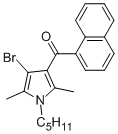
Its this. Talking about replacing the benzene with a pyrrole makes me think of two pyrroles fused together! The indole has been replaced with a pyrrole or the benzene ring has been removed.
dorothyperkins
Bluelighter
So is CB2 bad in any way, is it only good to have low affinity for CB2 so more can get to CB1 perhaps? It seems unlikely it would cause adverse effects since THC has similar affinity to both.
Ham-milton
Bluelighter
I don't think it's bad, but you don't really want high CB1 affinity, either. At least not for a full agonist. THC is a weak partial agonist, right?
dorothyperkins
Bluelighter
Im not sure, i assumed they were partial like the WIN-xxx they're derived from. I didn't see anything in the papers though except affinity.
