• N&PD Moderators: Skorpio

Kinetics of non-alkylated tryptamines

Deleted member 170540

Bluelight Crew
Joined
Nov 4, 2010
Messages
1,901
Location
Northern Europe
Tryptamine-14C was administered to rabbits pretreated with the monoamine oxidase inhibitor pheniprazine. The disposition and metabolism of the radioactive amine was studied. Tryptamine-14C was found to be present in highest concentration in lung and in lowest concentration in heart and brain. The tissue levels of tryptamine-14C declined exponentially with a half-life of 35 minutes. Three hours after the administration of tryptamine-14C, kidney, plasma and duodenum had the highest levels of total radioactivity. In lung, over 50% of the total radioactivity was present as tryptamine. in marked contrast to other tissues examined. Polar basic metabolites were present in highest concentrations in duodenum, kidney and spleen. When reserpine (1 mg/kg i.m.) was administered one hour after tryptamine-14C, less radioactivity was found in all tissues except kidney and ileum, when compared to control rabbits. Reserpine decreased the tryptamine and polar basic metabolite concentration in several tissues while markedly increaing the levels of polar acidic metabolites in kidney and ileum. 6-Hydroxytryptamine was isolated chromatographically from homogenates of kidney and ileum as well as from urine. The presence of 6-hydroxytryptamine in these biologic materials was increased by enzymatic hydrolysis of its conjugates with sulfatase and β-glucuronidase. In addition, 6-hydroxyindoleacetic acid, the major metabolic product of 6-hydroxytryptamine. was isolated from urine by chromatographic techniques.

So, at least when dosed with a MAOI, it doesn't seem that tryptamine is metabolically destroyed quickly enough to have no effect. I don't think it's likely that a rabbit metabolizes it much slower than a human. A different question is whether it has too much sympathomimetic side effects compared to the psychedelic effect to be of any use.

Mexamine (5-methoxytryptamine) seems to have a 5-HT2A affinity pretty much equal to DMT, when you look at the tables in Wikipedia. Shulgin reported an experiment where tryptamine was given as a slow injection and it caused some hallucinogenic symptoms.
 
Last edited:

Tryptamine-14C was found to be present in highest concentration in lung and in lowest concentration in heart and brain.

I would expect that most of the effects from tryptamine would be peripheral, not centrally mediated then. I would imagine between a low concentration in the brain + low affinity for 5HTrs + metabolism via other pathways (indole dioxygenase, hydroxylation etc) would make for a poor drug.

I would also imagine that if tryptamine were a psychedelic, even via IV or with MAOI (a la DMT) it would have been documented thoroughly by now, and possibly also scheduled like DMT.

N-methyltryptamine is another one that has poor activity IIRC, I was under the impression that you really need to either have 2 N substituents or an alpha-alkyl group.
 
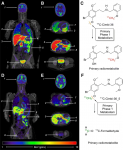
Here's an image of the distribution of 11C-labeled 25B-NBOMe 40 minutes after injection dose.

21266


So that compound also seems to go mostly to the liver and much less in the brain. Whether this example is relevant in the case of tryptamine, I don't know. It's true that not many people would be interested in tryptamine or mexamine even if they are effective psychedelics to some degree. Maybe someone who has a cluster headache and is desperate to find a legal alternative for shrooms or LSD.
 
Mexamine (5-methoxytryptamine) seems to have a 5-HT2A affinity pretty much equal to DMT

Old post I know, but I haven't seen these mexamine reports mentioned on BL.

The individual effects of 5-MT on me are euphoria, a mood lift, feeling of energy flowing through the body, increased heart rate, attention to detail, focus, intensification of thoughts (to a level where I'm thinking faster than my conscious mind can keep up with) and introspective thinking. On the downside there is rising anxiety whenever I am inactive, rash decision-making and often speech becomes too fast for others to always comprehend. The effects last 5-6 hours.

(with 40mg, insufflated) Similar to 15mg dose. However, the effects lasted about 8 hours, with sudden rushes of euphoria and slight visuals. There seems to be a synergy between this substance and Cannabis, acts as a subtle enhancer for other chemicals. Like tea compared to Arabian coffee in strength. Very gentle. The 'drunk' feeling of Alcohol was also enhanced.

(with 150mg, insufflated) Possibly up to a plus 1 (+) or higher. Lasts a VERY long time. Become slightly tired at this dosage level. Sleep at 12 hours was very easy. At this dosage, comparable to Melatonin in drowsiness. Enhanced the effects of Cannabis to the point where 8 hours after smoking 2 bowls, I still perceived a 'stoned' feeling. Had several friends assay 10mg doses, but only minimal observed effects. A female remarked that the sky was very beautiful and it was strange that she was noticing that fact.

In summary, this appears to be a chemical with no known human experimentation that is producing above baseline effects.
 
4-hydroxytryptamine (psilocin without n-methyl groups) is said to be "metabolically stable" and bind to 5-HT2A, but doesn't cause hallucinations. Mayby it's like the bromo-LSD compound that is used for Horton's neuralgia.

Strange that mexamine has that long duration of effect. Looks like it could be some metabolite of it what's causing the intoxication.
 
It seems more likely than not to me that mexamine would be active with sufficient MAOI dosage. Although it is of course is no perfect measure (not a bad one either tbf) of psychedelic activity, it seems that mexamine was able to produce HTR. Whether or not mexamine would produce an enjoyable or even classically psychedelic experience is definitely up in the air. It is a little crazy to me that no one seems to have tried a mexamine + MAOI combo before, although I definitely don't blame people's hesitance to combine MAOIs with compounds that have essentially zero history of use in humans.
 
It makes me curious how active mexamine would be intravenously, the only things I could find was that it reduced mortality when exposed to radiation.
It's very plausible that mexamine (and other non-methylated tryptamines) forms active metabolites like polymath mentioned, no MAOI necessary since MAO plays a necessary role. There will be a book discussing this soon.

Strange that mexamine has that long duration of effect. Looks like it could be some metabolite of it what's causing the intoxication.
 
Last edited:
It seems more likely than not to me that mexamine would be active with sufficient MAOI dosage. Although it is of course is no perfect measure (not a bad one either tbf) of psychedelic activity, it seems that mexamine was able to produce HTR. Whether or not mexamine would produce an enjoyable or even classically psychedelic experience is definitely up in the air. It is a little crazy to me that no one seems to have tried a mexamine + MAOI combo before, although I definitely don't blame people's hesitance to combine MAOIs with compounds that have essentially zero history of use in humans.
I think wikipedia links to some MAOI + Mexamine animal studies. Scarily enough it also stated that its 25- 400- x more selective for 5ht2b over 2a and 2c…
 
Top