




Just How Much The War On Drugs Impacts Our Overcrowded Prisons, In One Chart
by Kathleen Miles
03/10/2014
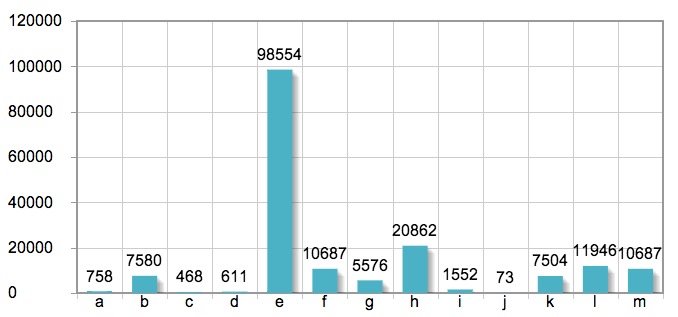
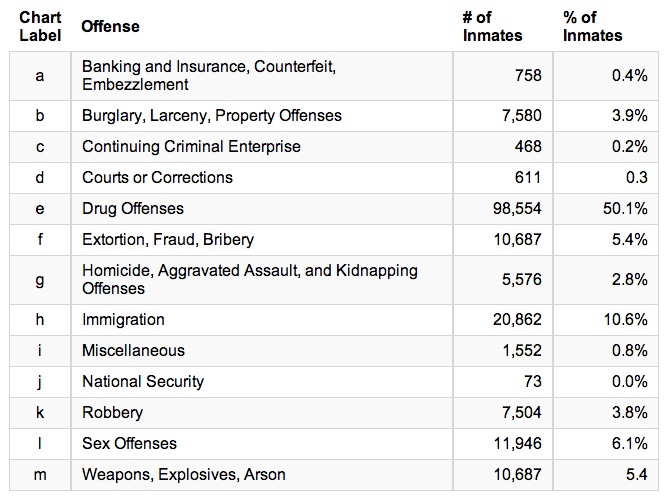
U.S. Prison Population As Of Jan. 25, 2014
America's prisons are dangerously overcrowded, and the war on drugs is mainly to blame.
Over 50 percent of inmates currently in federal prison are there for drug offenses, according to an infographic recently released by the Federal Bureau of Prisons (see chart below). That percentage has risen fairly consistently over decades, all the way from 16 percent in 1970.
The second-largest category, immigration-related crimes, accounts for 10.6 percent of inmates. This means that people convicted of two broad categories of nonviolent crimes -- drugs and immigration -- make up over 60 percent of the U.S. prison population.
And what was the drug of choice for those convicted of drug offenses? Marijuana, according to the U.S. Sentencing Commission (see chart below).
Between October 2012 and September 2013, 27.6 percent of drug offenders were locked up for crimes related to marijuana, followed by powder cocaine (22.5 percent), methamphetamine (22.5 percent), crack cocaine (11.5 percent), heroin (8.8 percent) and other (7.2 percent), according to the Sentencing Commission.
As the number of people convicted of drug offenses has gone up, the federal prison population has increased -- almost 790 percent since 1980, when there were only about 25,000 inmates, according to a 2012 Congressional Research Service report. Today, there are more than 215,000 inmates in federal prison, the BOP reports.
The facilities haven't caught up. They're so crowded that it's endangering the lives of inmates and corrections officers, BOP Director Charles Samuels Jr. recently testified. To manage this population, the bureau is putting two or three bunks in a cell, and converting television rooms and open bays into sleeping quarters. Still, “challenges remain as the inmate population continues to increase,” Samuels said.
In recent months, the Obama administration has portrayed the country's tough drug policies as unjust and pledged to seek early release or lighter initial sentences for low-level, nonviolent drug offenders. Lawmakers in the House and Senate have introduced identical bills that would cut the length of mandatory prison sentences for certain drug crimes -- now set at 5, 10 and 20 years -- in half.
In December, President Barack Obama commuted the sentences of eight federal inmates who were convicted of nonviolent crack cocaine offenses. Six of them were serving life sentences.
America's "war on drugs" has aimed to eradicate drug abuse through strict laws and harsh enforcement within and beyond U.S. borders. The policies date back a century, though the term was only coined in 1971. And for years now, that war on drugs has been considered a failure. Illegal drugs have become cheaper and more concentrated, which suggests the world supply is actually increasing. According to United Nations estimates, global consumption of opiates, cocaine and marijuana increased by 35 percent, 27 percent and 9 percent, respectively, between 1998 and 2008.
27 Reasons Why U.S. Shouldn't Lead War On Drugs Slide Show Here > http://www.huffingtonpost.com/2014/0...#slide=3176788
Because Most Americans Are Unenthusiastic About It
Only 7 percent of Americans think the United States is winning the war on drugs, and few Americans are interested in throwing down more money to try to win, according to a Rasmussen Reports poll released in 2012.
Because the U.S. Won't Control The Flow Of Guns Into Latin America
Mexican authorities seized almost 70,000 weapons of U.S. origin from 2007 to 2011. In 2004, the U.S. Congress declined to renew a 10-year ban on the sale of assault weapons. They quickly became the guns of choice for Mexican drug cartels.
Some 60,000 people have died in Mexico since President Felipe Calderón launched a military assault on the cartels in 2006.
Because the United States Leads The Hemisphere In Drug Consumption
Americans have the highest rate of illegal drug consumption in the world, according to the National Survey on Drug Use and Health.
Because The U.S. Ignores Latin American Calls For A Rethinking Of Drug Policy
Several current and former Latin American presidents, like Fernando Henrique Cardoso, have urged the United States to rethink its failed war on drugs, to no avail.
Because Of The Fast And Furious Scandal
In an attempt to track guns as they moved across the U.S.-Mexico border, the Bureau of Alcohol, Tobacco and Firearms allowed smugglers to purchase weapons. The ATF lost track of the guns and they wound up in the hands of drug cartels -- even as far south as Colombia.
Because American Politicians Refuse To Candidly Lead A Debate On Reforming Our Laws
Though the subject of marijuana legalization regularly ranks among the most popular at the digital town halls President Obama takes part in, he declines to address the issue or give it a thoughtful answer.
Incidentally, a younger Obama supported marijuana decriminalization and a rethinking of the drug war.
Because The U.S. Tortures Detainees In Cuba
Almost 800 prisoners accused of terrorism have have been held at the U.S. military prison of Guantánamo, Cuba, where they are detained indefinitely without facing trial. The United States has drawn international criticism from human rights defenders for subjecting the detainees there to torture and other cruel treatment. The Cuban government opposes hosting the U.S. naval base on its soil.
Because The U.S. Has The World's Largest Prison Population
The United States has the world's largest prison population by far -- largely fed by the war on drugs -- at 500 per 100,000 people.
Because The U.S. Jails Undocumented Immigrants Guilty Of Civil Violations
Because the United States imprisons roughly 400,000 immigrants each year on civil violations.
Because The Border Patrol Kills Kids Who Throw Rocks
The U.S. Border Patrol has come under fire for killing minors who were throwing rocks.
Because The U.S. Recognized An Illegal Government In Venezuela
When opponents of leftwing Venezuelan President Hugo Chávez briefly ousted him in 2002, the United States not only failed to condemn the coup, it praised the coup leaders.
In Colombia
When Colombia demobilized the largest rightwing paramilitary organization in 2006, if offered lenient sentences to those who would offer details on the atrocities the AUC committed. But rather than facing justice in their home country, Colombia has extradited several paramilitary leaders to the United States to face drug trafficking charges -- marking it harder for people like Bela Henríquez to find out the details surrounding the murders of their loved ones.
"More than anger, I feel powerless," Henriquez, whose father, Julio, was kidnapped and killed on the orders of one defendant, told ProPublica. "We don't know what they are negotiating, what conditions they are living under. What guarantee of justice do we have?"
Because The U.S. Helped Create Today's Cartels
The U.S funded the Guatemalan military during the 1960s and 1970s anti-insurgency war, despite awareness of widespread human rights violations. Among the recipients of U.S military funding and training were the Kaibiles, a special force unit responsible for several massacres. Former Kaibiles have joined the ranks of the Zetas drug cartel.
Military Dictatorship That Killed 30,000 People
The rightwing military dictatorship that took over Argentina in 1976 "disappeared" some 30,000 people, according to estimates by several human rights organizations. They subjected countless others to sadistic forms of torture and stole dozens of babies from mothers they jailed and murdered. The military junta carried out the so-called "Dirty War" with the full knowledge and support of the Nixon administration.
Because The U.S. Helped Topple The Democratically Elected Government Of Salvador Allende
When it became clear that socialist Salvador Allende would likely win the presidency in Chile, U.S. President Richard Nixon told the CIA to "make the economy scream" in order to "prevent Allende from coming to power or to unseat him," according to the National Security Archive.
Augusto Pinochet overthrew Allende in a bloody coup on Sept. 11, 1973, torturing and disappearing thousands of his political rivals with the backing of the U.S. government.
Because the U.S. Backed A Military Coup In Brazil In 1964
The Brazilian military overthrew the democratically elected government of João Goulart in 1964, with the enthusiastic support of President Lyndon Johnson, ushering in two decades of repressive government.
Because The U.S. Funded A Terrorist Group In Nicaragua
The Reagan administration funded the Contra rebels against the Marxist Sandinista government in Nicaragua. Regarded by many as terrorists, the Contras murdered, tortured and raped civilians. When human rights organizations reported on the crimes, the Reagan administration accused them of working on behalf of the Sandinistas.
Because The U.S. Helped Finance Atrocities In Colombia
Through Plan Colombia, the U.S. has pumped over $6 billion into Colombia's military and intelligence service since 2002. The intelligence service has been disbanded for spying on the Supreme Court and carrying out smear campaigns against the justices, as well as journalists, members of Congress and human rights activists. The military faces numerous allegations of human rights abuse, including the practice of killing non-combatants from poor neighborhoods and dressing them up as guerrillas to inflate enemy casualty statistics.
Because The U.S. Maintains A Trade Embargo Against Cuba Despite Opposition From The Entire World
For 21 years, the U.N. has condemned the U.S. embargo against Cuba and for 21 years the United States has ignored it.
Some 188 nations voted against the embargo this year, with only the U.S. itself, Israel, Palau opposing.
Because The U.S. Engineered A Coup Against The Democratically Elected Government Of Guatemala In 1954
At the behest of United Fruit Company, a U.S. corporation with extensive holdings in Central America, the CIA helped engineer the overthrow of the Guatemalan government in 1954, ushering in decades of civil war that resulted in the loss of hundreds of thousands of lives.
Because The U.S. Backed The Salvadoran Military As It Committed Atrocities In The 1980s
El Salvador's military committed atrocities throughout the 1980s with U.S. funding.
Because The U.S. Invaded Haiti and Occupied It For Almost 20 Years
Woodrow Wilson ordered the Marines to invade and occupy Haiti in 1915 after the assassination of the Haitian president. The troops didn't leave until 1934.
Because The U.S. Invaded Haiti Again In 1994
One invasion wasn't good enough. The U.S. military returned in 1994.
Because The U.S. Trained Military Leaders Who Committed Atrocities In Latin America
The School of the Americas in Ft. Benning, Georgia, trained soldiers and generals responsible for massacres and torture of tens of thousands of Latin Americans, according to Al Jazeera.
Because The U.S. Backed Dictator Rafael Trujillo
Rafael Trujillo Sr. (Photo by Hank Walker//Time Life Pictures/Getty Images)
Because The U.S. Invaded Cuba And Undermined The Island's Independence
The so-called "Spanish-American War" began in 1868 with the first of a series of three wars for Cuban independence. In 1898, the U.S. got involved, invading Cuba and occupying the island after forcing Spain to give it. The United States then forced Cuba to accept the odious Platt Amendent to its Constitution, which allowed the United States to intervene in the country militarily and established the U.S. military base at Guantánamo.
Because The U.S. Colonized Puerto Rico
As long as you're invading Cuba, why not take Puerto Rico as well? The United States invaded in 1898 and the island remains a U.S. territory today.
http://www.huffingtonpost.com/2014/...sons-infographic_n_4914884.html#slide=3176788
by Kathleen Miles
03/10/2014
U.S. Prison Population As Of Jan. 25, 2014
America's prisons are dangerously overcrowded, and the war on drugs is mainly to blame.
Over 50 percent of inmates currently in federal prison are there for drug offenses, according to an infographic recently released by the Federal Bureau of Prisons (see chart below). That percentage has risen fairly consistently over decades, all the way from 16 percent in 1970.
The second-largest category, immigration-related crimes, accounts for 10.6 percent of inmates. This means that people convicted of two broad categories of nonviolent crimes -- drugs and immigration -- make up over 60 percent of the U.S. prison population.
And what was the drug of choice for those convicted of drug offenses? Marijuana, according to the U.S. Sentencing Commission (see chart below).
Between October 2012 and September 2013, 27.6 percent of drug offenders were locked up for crimes related to marijuana, followed by powder cocaine (22.5 percent), methamphetamine (22.5 percent), crack cocaine (11.5 percent), heroin (8.8 percent) and other (7.2 percent), according to the Sentencing Commission.
As the number of people convicted of drug offenses has gone up, the federal prison population has increased -- almost 790 percent since 1980, when there were only about 25,000 inmates, according to a 2012 Congressional Research Service report. Today, there are more than 215,000 inmates in federal prison, the BOP reports.
The facilities haven't caught up. They're so crowded that it's endangering the lives of inmates and corrections officers, BOP Director Charles Samuels Jr. recently testified. To manage this population, the bureau is putting two or three bunks in a cell, and converting television rooms and open bays into sleeping quarters. Still, “challenges remain as the inmate population continues to increase,” Samuels said.
In recent months, the Obama administration has portrayed the country's tough drug policies as unjust and pledged to seek early release or lighter initial sentences for low-level, nonviolent drug offenders. Lawmakers in the House and Senate have introduced identical bills that would cut the length of mandatory prison sentences for certain drug crimes -- now set at 5, 10 and 20 years -- in half.
In December, President Barack Obama commuted the sentences of eight federal inmates who were convicted of nonviolent crack cocaine offenses. Six of them were serving life sentences.
America's "war on drugs" has aimed to eradicate drug abuse through strict laws and harsh enforcement within and beyond U.S. borders. The policies date back a century, though the term was only coined in 1971. And for years now, that war on drugs has been considered a failure. Illegal drugs have become cheaper and more concentrated, which suggests the world supply is actually increasing. According to United Nations estimates, global consumption of opiates, cocaine and marijuana increased by 35 percent, 27 percent and 9 percent, respectively, between 1998 and 2008.
27 Reasons Why U.S. Shouldn't Lead War On Drugs Slide Show Here > http://www.huffingtonpost.com/2014/0...#slide=3176788
Because Most Americans Are Unenthusiastic About It
Only 7 percent of Americans think the United States is winning the war on drugs, and few Americans are interested in throwing down more money to try to win, according to a Rasmussen Reports poll released in 2012.
Because the U.S. Won't Control The Flow Of Guns Into Latin America
Mexican authorities seized almost 70,000 weapons of U.S. origin from 2007 to 2011. In 2004, the U.S. Congress declined to renew a 10-year ban on the sale of assault weapons. They quickly became the guns of choice for Mexican drug cartels.
Some 60,000 people have died in Mexico since President Felipe Calderón launched a military assault on the cartels in 2006.
Because the United States Leads The Hemisphere In Drug Consumption
Americans have the highest rate of illegal drug consumption in the world, according to the National Survey on Drug Use and Health.
Because The U.S. Ignores Latin American Calls For A Rethinking Of Drug Policy
Several current and former Latin American presidents, like Fernando Henrique Cardoso, have urged the United States to rethink its failed war on drugs, to no avail.
Because Of The Fast And Furious Scandal
In an attempt to track guns as they moved across the U.S.-Mexico border, the Bureau of Alcohol, Tobacco and Firearms allowed smugglers to purchase weapons. The ATF lost track of the guns and they wound up in the hands of drug cartels -- even as far south as Colombia.
Because American Politicians Refuse To Candidly Lead A Debate On Reforming Our Laws
Though the subject of marijuana legalization regularly ranks among the most popular at the digital town halls President Obama takes part in, he declines to address the issue or give it a thoughtful answer.
Incidentally, a younger Obama supported marijuana decriminalization and a rethinking of the drug war.
Because The U.S. Tortures Detainees In Cuba
Almost 800 prisoners accused of terrorism have have been held at the U.S. military prison of Guantánamo, Cuba, where they are detained indefinitely without facing trial. The United States has drawn international criticism from human rights defenders for subjecting the detainees there to torture and other cruel treatment. The Cuban government opposes hosting the U.S. naval base on its soil.
Because The U.S. Has The World's Largest Prison Population
The United States has the world's largest prison population by far -- largely fed by the war on drugs -- at 500 per 100,000 people.
Because The U.S. Jails Undocumented Immigrants Guilty Of Civil Violations
Because the United States imprisons roughly 400,000 immigrants each year on civil violations.
Because The Border Patrol Kills Kids Who Throw Rocks
The U.S. Border Patrol has come under fire for killing minors who were throwing rocks.
Because The U.S. Recognized An Illegal Government In Venezuela
When opponents of leftwing Venezuelan President Hugo Chávez briefly ousted him in 2002, the United States not only failed to condemn the coup, it praised the coup leaders.
In Colombia
When Colombia demobilized the largest rightwing paramilitary organization in 2006, if offered lenient sentences to those who would offer details on the atrocities the AUC committed. But rather than facing justice in their home country, Colombia has extradited several paramilitary leaders to the United States to face drug trafficking charges -- marking it harder for people like Bela Henríquez to find out the details surrounding the murders of their loved ones.
"More than anger, I feel powerless," Henriquez, whose father, Julio, was kidnapped and killed on the orders of one defendant, told ProPublica. "We don't know what they are negotiating, what conditions they are living under. What guarantee of justice do we have?"
Because The U.S. Helped Create Today's Cartels
The U.S funded the Guatemalan military during the 1960s and 1970s anti-insurgency war, despite awareness of widespread human rights violations. Among the recipients of U.S military funding and training were the Kaibiles, a special force unit responsible for several massacres. Former Kaibiles have joined the ranks of the Zetas drug cartel.
Military Dictatorship That Killed 30,000 People
The rightwing military dictatorship that took over Argentina in 1976 "disappeared" some 30,000 people, according to estimates by several human rights organizations. They subjected countless others to sadistic forms of torture and stole dozens of babies from mothers they jailed and murdered. The military junta carried out the so-called "Dirty War" with the full knowledge and support of the Nixon administration.
Because The U.S. Helped Topple The Democratically Elected Government Of Salvador Allende
When it became clear that socialist Salvador Allende would likely win the presidency in Chile, U.S. President Richard Nixon told the CIA to "make the economy scream" in order to "prevent Allende from coming to power or to unseat him," according to the National Security Archive.
Augusto Pinochet overthrew Allende in a bloody coup on Sept. 11, 1973, torturing and disappearing thousands of his political rivals with the backing of the U.S. government.
Because the U.S. Backed A Military Coup In Brazil In 1964
The Brazilian military overthrew the democratically elected government of João Goulart in 1964, with the enthusiastic support of President Lyndon Johnson, ushering in two decades of repressive government.
Because The U.S. Funded A Terrorist Group In Nicaragua
The Reagan administration funded the Contra rebels against the Marxist Sandinista government in Nicaragua. Regarded by many as terrorists, the Contras murdered, tortured and raped civilians. When human rights organizations reported on the crimes, the Reagan administration accused them of working on behalf of the Sandinistas.
Because The U.S. Helped Finance Atrocities In Colombia
Through Plan Colombia, the U.S. has pumped over $6 billion into Colombia's military and intelligence service since 2002. The intelligence service has been disbanded for spying on the Supreme Court and carrying out smear campaigns against the justices, as well as journalists, members of Congress and human rights activists. The military faces numerous allegations of human rights abuse, including the practice of killing non-combatants from poor neighborhoods and dressing them up as guerrillas to inflate enemy casualty statistics.
Because The U.S. Maintains A Trade Embargo Against Cuba Despite Opposition From The Entire World
For 21 years, the U.N. has condemned the U.S. embargo against Cuba and for 21 years the United States has ignored it.
Some 188 nations voted against the embargo this year, with only the U.S. itself, Israel, Palau opposing.
Because The U.S. Engineered A Coup Against The Democratically Elected Government Of Guatemala In 1954
At the behest of United Fruit Company, a U.S. corporation with extensive holdings in Central America, the CIA helped engineer the overthrow of the Guatemalan government in 1954, ushering in decades of civil war that resulted in the loss of hundreds of thousands of lives.
Because The U.S. Backed The Salvadoran Military As It Committed Atrocities In The 1980s
El Salvador's military committed atrocities throughout the 1980s with U.S. funding.
Because The U.S. Invaded Haiti and Occupied It For Almost 20 Years
Woodrow Wilson ordered the Marines to invade and occupy Haiti in 1915 after the assassination of the Haitian president. The troops didn't leave until 1934.
Because The U.S. Invaded Haiti Again In 1994
One invasion wasn't good enough. The U.S. military returned in 1994.
Because The U.S. Trained Military Leaders Who Committed Atrocities In Latin America
The School of the Americas in Ft. Benning, Georgia, trained soldiers and generals responsible for massacres and torture of tens of thousands of Latin Americans, according to Al Jazeera.
Because The U.S. Backed Dictator Rafael Trujillo
Rafael Trujillo Sr. (Photo by Hank Walker//Time Life Pictures/Getty Images)
Because The U.S. Invaded Cuba And Undermined The Island's Independence
The so-called "Spanish-American War" began in 1868 with the first of a series of three wars for Cuban independence. In 1898, the U.S. got involved, invading Cuba and occupying the island after forcing Spain to give it. The United States then forced Cuba to accept the odious Platt Amendent to its Constitution, which allowed the United States to intervene in the country militarily and established the U.S. military base at Guantánamo.
Because The U.S. Colonized Puerto Rico
As long as you're invading Cuba, why not take Puerto Rico as well? The United States invaded in 1898 and the island remains a U.S. territory today.
http://www.huffingtonpost.com/2014/...sons-infographic_n_4914884.html#slide=3176788




