-
Neuroscience & Pharmacology Discussion Welcome Guest
Posting Rules Bluelight Rules Recent Journal Articles Chemistry Mega-Thread FREE Chemistry Databases! Self-Education Guide -
N&PD Moderators: Skorpio
You are using an out of date browser. It may not display this or other websites correctly.
You should upgrade or use an alternative browser.Isoquinoline opioid
- Thread starter haribo1
- Start date


Ham-milton
Bluelighter
- Joined
- Jul 20, 2007
- Messages
- 5,738
Does it have a name? What papers are you citing? This is the first opioid I've seen that looks like this.
Ham-milton
Bluelighter
- Joined
- Jul 20, 2007
- Messages
- 5,738
^ I don't think so, the structure is quite different, for one, the N isn't located on the ring in morphinans.
I'm not a 1/4 the opioid expert Haribo is, so maybe someone can enlighten me: is this opioid one covered under the analogue act?
fastandbulbous
Bluelight Crew
Actually looks like a papervine derivative rather than a morphinan type of structure, but there are plenty of active, stripped down morphinan type of structure knocking about.
Without wanting to hijack a thread, does anybody have the ref for the paper concerning the SAR of thiambutene derivatives as mu agonists? I remember reading it many years ago, but can't remember where (it details N-substituents altering activity, such as with dimethylthiambutene & the diethyl compound. Apparently the pyrrolidyl derivative is active - probably the piperidine & morpholine as well) and it's becoming a bit annoying... def getting the beginnings of 'grumpy old man' syndrome; I've even found myself shouting at the television on a few occasions 8)mad_scientist
Bluelighter
- Joined
- Apr 20, 2006
- Messages
- 619
Ham-milton said:^ I don't think so, the structure is quite different, for one, the N isn't located on the ring in morphinans.
I'm not a 1/4 the opioid expert Haribo is, so maybe someone can enlighten me: is this opioid one covered under the analogue act?
Pretty sure that one won't be covered under the analogue act, doesn't look substantially similar to any opioids I'm familiar with.
Will be an analogue of methopholine from the look of it, and thats not scheduled.
http://en.wikipedia.org/wiki/Methopholine
Cite some references haribo1, we all want to know where you are finding these gems!fastandbulbous said:Without wanting to hijack a thread, does anybody have the ref for the paper concerning the SAR of thiambutene derivatives as mu agonists? I remember reading it many years ago, but can't remember where (it details N-substituents altering activity, such as with dimethylthiambutene & the diethyl compound. Apparently the pyrrolidyl derivative is active - probably the piperidine & morpholine as well)
J. Pharm. Pharmacol. 8: 860 (1956)
Some substituted thiambutenes:
dimethylamine - 1.07x morphine
methylethylamine - 1.7x
methylpropylamine - 0.1x
methylisopropylamine - 0.3x
diethylamine - 1.0x
pyrrolidine - 0.7x
piperidine - 1.1x
(CH2)6N- (i guess the seven membered version of piperidine, azacycloheptane) - 1.3x to 1.8x
All values in rats.
---
There is an entire chapter on the isoquinoline analgetics in the book Analgetics. Apparently they chose Methopholine for clinical trials instead of the nitro analogue as they found it wasn't addictive. (yeah right..)Last edited:A drug as potent as H is not something to be sneered at, if it was only 2 x codeine then i would be a bit more prejudiced against it. I havent a clue where the source code for this came from, my guess is that if the info is correct then it'd be worth hitting up. One cant say how it would function as a licensed phamaceutical but a few grams wouldn't be too much of a grave issue.
Canis aureus
Bluelighter
- Joined
- Nov 25, 2005
- Messages
- 930
That is pretty pretty interesting, if it has the quality of being 20 X codeine. What is its name?
hussness
Bluelighter
What's the stereochemistry?
haribo1
Ex-Bluelighter
- Joined
- Nov 29, 2006
- Messages
- 4,822
The most appealing looking method for production is via the Bischler-Napieralski reaction but how do you reduce the C=N bond in the thing? I would appear to be quite an easy synth, but of course yield may be LOOWWWWW. Both isomers are active, so no need to resolve...Last edited:
fastandbulbous
Bluelight Crew
J. Pharm. Pharmacol. 8: 860 (1956)
Some substituted thiambutenes:
You've made an old man very happy (& not in a 'now wash yourself thouroghly' sort of way )
)
kidamnesiac
Bluelighter
- Joined
- Oct 19, 2006
- Messages
- 533
haribo1 said:The most appealing looking method for production is via the Bischler-Napieralski reaction but how do you reduce the C=N bond in the thing? I would appear to be quite an easy synth, but of course yield may be LOOWWWWW. Both isomers are active, so no need to resolve...
this bischler is cake, i did it by the high-throughput as an undergrad.
if you can't think of a way to reduce an imine...
a heck rxn would also be fun
ps-look to southeast asia
Reminisant B
Greenlighter
- Joined
- Nov 3, 2005
- Messages
- 401
why is it being compared to codeine as opposed to morphine?
Is it in the same realms as in pro-drug or possessing an upper limit?
haribo1
Ex-Bluelighter
- Joined
- Nov 29, 2006
- Messages
- 4,822
^That is something I don't know. One would think a phenol would add to binding, but why 2 methoxys? Things I do know - You cannot replace the N-methyl with N-anything else and retain activity. You need SOMETHING at the 4 position on the benzene ring. Potency is: NO2>F>Cl>Br. Dependence liability of the chlorine analog is described as 'low'.
If it were a prodrug, would one or both of those methoxys lose the ether?
Looking at the other compounds tested, the - isomer of the Cl was inactive so they just tested (+-) from then on. So, (+-) Nitro was x20. Can anyone suggest an optically active synthesis? If the (+) if the nitro would be 40x codeine, putting it on par with things like hydromorphone.
40x codeine = 7.5x morphine, making it as portent as, say, hydromorphone. It was trialed in post operetive pateints
A.Brossi, H, Bessindorp, L.A. Perk & A. Reheiner Jr. in: Analgesics, (G.Destevens ed) page 281, Academic Press, New York 1965.
If anyone DOES find this paper, then please PLEASE put it on-line somewhere so we can all check it out.Last edited:
fritzy
Bluelighter
- Joined
- Nov 26, 2007
- Messages
- 248
What do you mean by "BP" -- "boiling point", or something else?
Retrosynthetically:
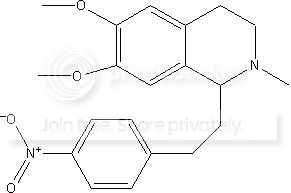
6,7-dimethoxy-2-methyl-1-(4-nitrophenethyl)-1,2,3,4-tetrahydroisoquinoline <=(N-methylation via reductive amination) 6,7-dimethoxy-1-(4-nitrophenethyl)-1,2,3,4-tetrahydroisoquinoline;
6,7-dimethoxy-1-(4-nitrophenethyl)-1,2,3,4-tetrahydroisoquinoline <= (C=N bond reduction) 6,7-dimethoxy-1-(4-nitrophenethyl)-3,4-dihydroisoquinoline;
6,7-dimethoxy-1-(4-nitrophenethyl)-3,4-dihydroisoquinoline<=(cyclization/dehydration) N-(3,4-dimethoxyphenethyl)-3-(4-nitrophenyl)propanamide;
N-(3,4-dimethoxyphenethyl)-3-(4-nitrophenyl)propanamide<=(condensation) 3-(4-nitrophenyl)propanoic acid + 2-(3,4-dimethoxyphenyl)ethanamine
Take a look at GB 926493, and also Helv. Chim. Acta. 1963, 46, 1131.
haribo1
Ex-Bluelighter
- Joined
- Nov 29, 2006
- Messages
- 4,822
Maybe we should have a shared (off site) area that we can put all that stuff into? That way, Bluelight is in the clear. It IS a problem not being able to simply upload whole articles. Would this be allowable? I mean, this is the Serious Chemistry part, and we cannot discuss routes.
I mean, I understand WHY BL won't have the stuff, but maybe if we compile something along the lines of Rhodium. I've got the time to build and maintain it...
What do people think?haribo1 said:Maybe we should have a shared (off site) area that we can put all that stuff into? That way, Bluelight is in the clear. It IS a problem not being able to simply upload whole articles. Would this be allowable? I mean, this is the Serious Chemistry part, and we cannot discuss routes.
I mean, I understand WHY BL won't have the stuff, but maybe if we compile something along the lines of Rhodium. I've got the time to build and maintain it...
What do people think?
That is a splendid idea. Better still the hivelike synthesis of things can be discussed there too.