• N&PD Moderators: Skorpio

Isopropanol 99,5%

Shaal

Bluelighter
Joined
Mar 2, 2014
Messages
293
Hi, I don't know if this is the right forum to post in, so move my thread if necessary. :)

I have access to 70% or 99,5% isopropanol.

I'd prefer to use the 99,5% purity, since with the 70%, I guess the rest is water, which would probably not make the extractions as efficient...

In the 99,5% isopropanol, what do you reckon the 0.5% could be? Could it be something used to break the azeotrope with water, such as benzene is used to make pure ethanol? Apparently the azeotrope gives a composition of 91% vol. isopropanol (source wikipedia).

Even if there are traces of something harmful like benzene in there, you would get rid of everything upon complete evaporation, right? I don't wanna poison myself...

Thanks!

EDIT: I think I found the information myself, apparently "Pure (anhydrous) isopropyl alcohol is made by azeotropic distillation of the wet isopropyl alcohol using either diisopropyl ether or cyclohexane as azeotroping agents" (wikipedia).

Still leaving this here as it could be useful for someone else.

:)
 
The remainder of isopropanol is usually water. The 95% and 70% grades are sold because it doesn't need to be dried azeotropically and can save time and energy if you're rubbing it on skin. Concentrated alcohol will dry fat or skin out leaving it dry and cracked with repeated use and shareholder profit is everything.
 
It probably matters what kind of extraction you are doing. I recently did a mushroom extraction and read somewhere that water could possibly activate enzymes that could break down alkaloids. So I got pretty anal about not wanting any water in my alcoholic extraction solvents. Upon careful consideration small amounts of water like this shouldn't be enough to facilitate enzymes... so it probably matters a lot less than I initially thought.

So my point is, it helps to understand what is going on with the particular extraction you are talking about... and the solubility of your actives in water play a role, if not other more complicated interactions.

And yeah, isopropanol was one of the two solvents I tried :)
 
It probably matters what kind of extraction you are doing. I recently did a mushroom extraction and read somewhere that water could possibly activate enzymes that could break down alkaloids. So I got pretty anal about not wanting any water in my alcoholic extraction solvents. Upon careful consideration small amounts of water like this shouldn't be enough to facilitate enzymes... so it probably matters a lot less than I initially thought.

So my point is, it helps to understand what is going on with the particular extraction you are talking about... and the solubility of your actives in water play a role, if not other more complicated interactions.

And yeah, isopropanol was one of the two solvents I tried :)

Thanks for your answer, yeah I saw the post about your mushroom extraction. :)

I also have access to solvents from my lab (including pure ethanol) but I don't trust them for safety, a lot of people use them, anyone could have pipetted directly in the bottle, who knows what contaminants may be in there (plus add the fact that the security sucks at my lab, some people do silly stuff, e.g. someone [in charge of security, a technician] threw out a lot of vials of DMF in the glass bin, they broke up and everyone including me breathed the solvent... hope I'm not gonna have testicular cancer in 20 years...)... That's why I wanna buy all my solvents myself.

Also I consider the possibility of pure ethanol containing possible traces of benzene (apparently used to break the aeotrope with water).

Initially I was thinking about a solvent to extract lactucin and lactucopicrin, so I was thinking ethanol, but I would need pure, then methanol, but it seems hard to find where I live, so then IPA... which doesn't seem as polar as acetone. I don't know if those two would make a difference.
 
Last edited:
Also I consider the possibility of pure ethanol containing possible traces of benzene (apparently used to break the aeotrope with water).

this is a distinct possibility. iirc its either codistilled with benzene to break the azeotrope, or they distill it as an azeotrope and then use sodium metal to dry it. if i had to guess i would say they probably use the latter method more nowadays because of the extreme carcinogenicity of benzene, but who knows.
 
Most ethanol sold commercially is 95% ethanol with 5% water, the common azeotrope of commerce. I believe it's derived from fermentation, or maybe hydration of ethylene? Either way, "pure" ethanol should be explicitly marked as denatured alcohol if it contains traces of benzene. If it's commercial 95% alcohol it should not contain any benzene at all and should be safe for limited human consumption.

Absolute ethanol is the 100% totally dry stuff, it's usually made by drying ethanol azeotropically with benzene or toluene or in CGMP facilities, dried with molecular sieves, magnesium, or sodium metal. Generally absolute ethanol is not sold commercially because it needs to be stored in such a manner to avoid any contact with humid air, or it will rehydrate quite rapidly. It's just too expensive to store and transport, and is only used in niche applications where the end user can dry it themselves anyway.

Cross contamination in a shared lab is always a concern though, you can avoid this by just cracking a fresh bottle of solvent wherever possible.

Also, I wouldn't be super concerned about breathing DMF vapours. DMF has a high vapor pressure anyway, considering it has a bp of like 177C? So unless you are literally drinking the stuff, you are exposed to more carcinogens inhaling car exhaust when walking near a busy road, or absorbing background radiation from concrete. Don't lose sleep over a little spilled DMF.

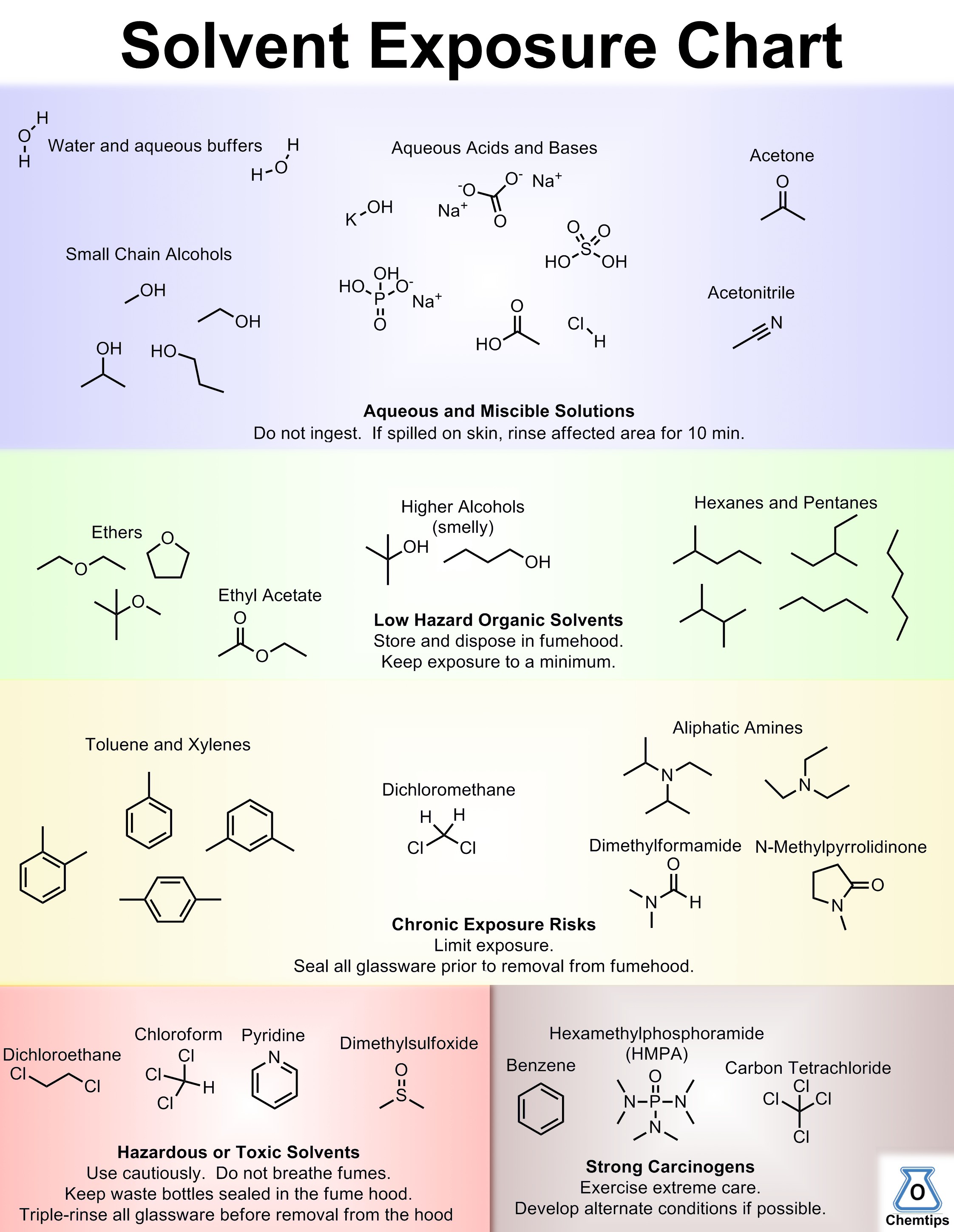
Now if it was HMPTA, benzene, or carbon tetrachloride, you should have moved the waste bin to a fume hood. People generally avoid using these wherever possible, though.

See below for a handy solvent risk chart.
NSFW:
solvent-exposure-chart-1-1.jpg


Note: although DMSO is classified as hazardous, it's not the DMSO that is the problem. Rather, any dissolved compounds in the DMSO can be easily transported throuh skin, meaning you can e.g. ingest chromium or other heavy metals if you spill DMSO waste on your skin. People use pure refined DMSO as a topical skin preparation with no problems and in fact pure DMSO is relatively nontoxic, being related to the food "supplement" methylsulfonylmethane.

Also: Acetone is actually more polar than IPA is. But isopropanol is protic (can donate hydrogens to form hydrogen bonds), whereas acetone is aprotic. So they behave a little differently.
 
Wow, thanks for the exhaustive answer sekio! And I now feel better about having breathed DMF. :)

Edit: Thanks to you too Roger&Me!
 
Last edited:
Top