



-
Neuroscience & Pharmacology Discussion Welcome Guest
Posting Rules Bluelight Rules Recent Journal Articles Chemistry Mega-Thread FREE Chemistry Databases! Self-Education Guide -
N&PD Moderators: Skorpio
You are using an out of date browser. It may not display this or other websites correctly.
You should upgrade or use an alternative browser.I Like to Draw Pictures of Random Molecules
- Thread starter nuke
- Start date
- Status
- Not open for further replies.



Dresden
Bluelighter
- Joined
- Feb 2, 2010
- Messages
- 3,211
SAM: 4-methylamphetamine
BILLY: 4-methylmethamphetamine
SAMANTHA: 4-methylethamphetamine
Ok, so this series is pretty much too strongly intoxicating to play around with, except for *maybe* SAMANTHA, the N-ethyl one. (N-ethylamphetamines tend to be more forgiving). Getting FUBAR does have its time and place, however. So if you're gonna go that route, tread lightly and be forewarned. Less toxic alternatives include JERRY (N-propylamphetamine) and EVELYN (N-ethylamphetamine), both great for non-stop stim/sleep cycles. As far as all night dance parties go, though, there is no substitute for TONY (non-Darzen condensed MDMA).
* * *
An Addendum:
As far as I can tell, I was not in the Garden of Eden, did not eat from the Tree of Knowledge of Good and Evil, and know about as much about original sin (namely, zero) as does your pet goat, for example. Human beings' constant judging of each other (and me) is beyond me. I may be bizarre, but I am not evil. See Frederick Nietzsche ("Beyond Good and Evil") and Prometheus (historical figure) for further reading.
* * *
Back on topic,
VISHNU's (meth) manifestations include but are not limited to SATAN/YAMA (4-nitro-meth) and KRISHNA (mescaline). When he is in his meth form, which is usually, VISHNU can be defeated by EVELYN (eth), because 'ethyl tricks methyl.' And, by homologous chemical/logical extension, JERRY (N-propylamphetamine) can defeat EVELYN (N-ethylamphetamine). Everything in paragraph can be conjured up from over the counter almond oil btw, except for mescaline. The haoma gets weaker with every new chemical age, just as the great ages get worse with time, and eventually the process repeats.
This process [the ending of time?]--which as of late has been unfurling before our very eyes--doesn't seem to have any real beginning or end, and I would say we are right in the middle of it.
In related news, MTV is playing music videos again.Last edited:This is the structure of the new antiviral drug being launched this year in Japan & hopefully next year in the U.S. One dose of this drug kills the flu virus by inhibiting an enzyme that it needs to replicate. The current medication for flu, Tamiflu, you need to take over 5 days.
The compound shown is a prodrug. The red part of the structure (a carbonate mixed ester) gets clipped off by an enzyme once the molecule gets inside the cells.
 Last edited:
Deleted member 290563
Greenlighter
That looks like a tca and some sort of old generation antiosychitic ...crazy looking drugYes it is. I had to download a 425-page U.S. Patent Application & go through 700 or so structures to confirm this one. Interesting molecule . It inhibits the enzyme endonuclease that the flu virus needs to multiply. Shionogi has licensed this to the big Swiss pharma company Roche to market outside Japan & Taiwan. Since their Tamiflu has gone generic they need this new flu drug to make up for the loss in profits. I'll bet this one will be expensive for that one dose. Ten caps of generic Tamiflu cost me over $100, so you can expect this one to be much more than that. And most Medicare Plan D drug insurance programs don't pay for most expensive new drugs.
The cost to manufacture this stuff is going to be high as it is multi-step chiral chemistry.
The chiral separation part is interesting. The molecule has 2 chiral atoms so there would result a mixture of diasteriomers that could be separated readily via recrystalization.
I had only found a grainy image of this molecule in a pay site & had to go through all of those structures to find the correct one. The empirical formula agrees with the one in the Wikipedia article: https://en.wikipedia.org/wiki/Baloxavir_marboxilLast edited:aspiringdrugdesign
Bluelighter
- Joined
- Jul 5, 2017
- Messages
- 67

Potent CB1 agonist. Interesting open structure without connecting rings - terpenoid coupled to an aromatic.
In the cyclohexanone group at the top left, what are those dashed lines? Is that part of skeletal diagrams?The dashed lines are C-C bonds with C atoms at the center & ends of the 2 lines in the center. The synthesis involves coupling the alkynyl resorcinol (right half of molecule) with the bicyclic terpene nopinone. See attached structure of nopinone. In this drawing the bonds are solid lines. Just compare the 2. The drawing of AM1703 is just a different way of drawing a crowded molecule. The full nomenclature for nopinone is bicyclo[3.1.1]heptan-2-one, 6,6-dimethyl-. It is found in the aroma of certain flowers & is used in perfumery.

Here is another way of looking at this bicyclic structure:
 Last edited:
adder
Bluelighter
- Joined
- Mar 28, 2006
- Messages
- 2,849
In the cyclohexanone group at the top left, what are those dashed lines? Is that part of skeletal diagrams?
The dashed lines here symbolize that the bonds are below the plane of the drawing, however, one should never use dashed lines to represent bonds below the plane, such use is very unfortunate as in some cases it might create ambiguity as to what was meant by the author. Dashed lines are used to represent weak interactions due to electrostatic attraction such as hydrogen bonds, so using them to represent stereobonds is a bad idea. Honestly speaking, it amazes me why there may still be any debate on how to represent stereobonds and you run into structures drawn like this. Bonds below the plane are correctly represented by a hashed wedged bond starting from an atom in the plane of the drawing at the narrow end of the wedge, just like bonds over the plane are represented by a solid wedged bond (although for some reason for hashed bonds some advocated to use them the other way around, that is starting from an atom in the plane at the wide end; it will make sense of course if you apply appropriate logic, but it looks very ugly in my opinion when placed on the same atom on which a solid wedged bond is placed as well, it looks kind of ugly to me no matter what, but more importantly it lacks consistency). Compare structures below and decide for yourself what makes the most sense and what is the most elegant:
 Last edited:
Deleted member 290563
Greenlighter
The dashed lines here symbolize that the bonds are below the plane of the drawing, however, one should never use dashed lines to represent bonds below the plane, such use is very unfortunate as in some cases it might create ambiguity as to what was meant by the author. Dashed lines are used to represent weak interactions due to electrostatic attraction such as hydrogen bonds, so using them to represent stereobonds is a bad idea. Honestly speaking, it amazes me why there may still be any debate on how to represent stereobonds and you run into structures drawn like this. Bonds below the plane are correctly represented by a hashed wedged bond starting from an atom in the plane of the drawing at the narrow end of the wedge, just like bonds over the plane are represented by a solid wedged bond (although for some reason for hashed bonds some advocated to use them the other way around, that is starting from an atom in the plane at the wide end; it will make sense of course if you apply appropriate logic, but it looks very ugly in my opinion when placed on the same atom on which a solid wedged bond is placed as well, it looks kind of ugly to me no matter what, but more importantly it lacks consistency). Compare structures below and decide for yourself what makes the most sense and what is the most elegant:
i feel like the "most correct way" is less correct than the one in the blue box. And i always see it like the blue box, never really seen it like the green. The green box (by drawing stereochemistry on the alcohol) implies that the other three bonds are running all on the same plane, which isn't the case
adder
Bluelighter
- Joined
- Mar 28, 2006
- Messages
- 2,849
The blue box certainly looks nicer to the eye and is all right to be used of course. But the green box doesn't imply that the other three bonds are running all on the same plane just as all the plain bonds representing the cyclohexane ring alone don't imply that the structure is flat. Drawing a solid wedged bond between C3 and OH is enough to define what the stereochemistry at C3 is and that's what the solid wedge is here for, using a hashed wedged bond between C3 and ethyl is not necessary. The blue box does not represent what the molecule looks like in 3D either after all.aspiringdrugdesign
Bluelighter
- Joined
- Jul 5, 2017
- Messages
- 67
Thanks for the explanation guys, I had only ever seen the wedge/hash bonds to represent that concept before.

Knowing that thiophene can possibly act as a bioisostere to benzene, would this be of any practicality? Would it be much more difficult to synthesize?Deleted member 290563
Greenlighter
The blue box certainly looks nicer to the eye and is all right to be used of course. But the green box doesn't imply that the other three bonds are running all on the same plane just as all the plain bonds representing the cyclohexane ring alone don't imply that the structure is flat. Drawing a solid wedged bond between C3 and OH is enough to define what the stereochemistry at C3 is and that's what the solid wedge is here for, using a hashed wedged bond between C3 and ethyl is not necessary. The blue box does not represent what the molecule looks like in 3D either after all.
the cyclohexane isn't all on the same plane, but every single two bonds coming from each carbon (3 points) are all on the same plane, this breaks down on the green drawing. I 've been doing chemistry for about 11 years and never seen it like that until now.aspiringdrugdesign
Bluelighter
- Joined
- Jul 5, 2017
- Messages
- 67
Genetics has been inspiring me --
Caffeine is a xanthine. Xanthosine triphosphate is a thing. Adenosine triphosphate is a thing, and caffeine is an adenosine antagonist -- giving it some of its stimulant effects. Would the body have any use for a caffeine analog of xanthosine triphosphate? I'm assuming that the three methyl groups are gonna muck this up, but here is a few pictures of my ideas: tautomers and ethyl/methyl bridge versions. I wasn't sure if the ribose would form an ethyl bridge or a methyl bridge because of caffeine's structure.
My bad on the messy structures, the ribose triphosphate was a little tricky to draw


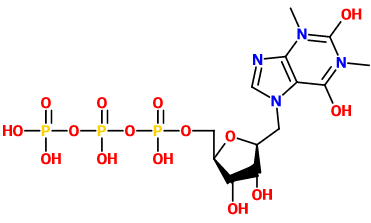
Also, what would this be called? Caffeinosine triphosphate sounds a little goofy
adder
Bluelighter
- Joined
- Mar 28, 2006
- Messages
- 2,849
the cyclohexane isn't all on the same plane, but every single two bonds coming from each carbon (3 points) are all on the same plane, this breaks down on the green drawing. I 've been doing chemistry for about 11 years and never seen it like that until now.
GRAPHICAL REPRESENTATION OF STEREOCHEMICAL CONFIGURATION
OK, so I checked it with IUPAC recommendations to be fair. The paragraph on tetrahedral configuration starts on p. 1910 in the linked document if anyone is interested. First of all, based on IUPAC recommendations the original green box structure in my previous post is actually rather incorrect because there is a pair of plain bonds separated by 180 degrees, while if the green box style is to be used (i.e. only one stereobond), each pair of plain bonds should be separated by less than 180 degrees and ideally by exactly 120 degrees, except for specific cases where drawing a pair of plain bonds at 180 degrees is unavoidable (see p. 1913 in the linked document).
Both the green box and the blue box styles are correct though, however depending on the situation one may be preferred over another. If the blue box style is used, it is recommended that the bisects of plain bonds and stereobonds are collinear (top structure in the blue box), although it is not mandatory. In this particular case of this cyclohexanone analogue that I've given the blue box style should be preferred based on IUPAC recommendations (and for aesthetic purposes too, I agree), the green box style is correct too but is preferred for chiral atoms in fused and bridged systems.
I have redone the image and added the original green box structure into the red box, although I'm not sure if treating it in the same way as the other three depictions in the red box is the right thing to do. Reading the structure drawn this way should not be ambiguous to any chemist and it doesn't bring in any inconsistency like using dashed lines does for instance, on the other hand for aesthetic purposes it should be avoided.

Bcos it is unstable and breaks to a phenol, an acetaldehyde and an ammoniaI'm curious as to the possible bioactivity of these & related amphetamine analogs:

The sulfur compound is known but I could not find anything on the oxygen. In any event, nothing on bioactivity for either.
sekio
Bluelight Crew
Yes, that is what is known as a hemiaminalaspiringdrugdesign
Bluelighter
- Joined
- Jul 5, 2017
- Messages
- 67
Why doesn't cathinone form imine polymers if they have ketones and primary amines? Is there something about the bulkiness preventing imine formation?- Status
- Not open for further replies.


