



-
Neuroscience & Pharmacology Discussion Welcome Guest
Posting Rules Bluelight Rules Recent Journal Articles Chemistry Mega-Thread FREE Chemistry Databases! Self-Education Guide -
N&PD Moderators: Skorpio
You are using an out of date browser. It may not display this or other websites correctly.
You should upgrade or use an alternative browser.I Like to Draw Pictures of Random Molecules
- Thread starter nuke
- Start date
- Status
- Not open for further replies.
 I meant to have the double bond there, but I couldn't manage to find a way to name it on Opsin. I have a feeling removal of the indole system will still retain activity to an extent.
Anyway, if the double bond is needed for activity, what does that say about how the molecule interacts with the pocket? Even a small conformational change results in a massive drop in potency, implying that the rigid structure which LSD takes is crucial to not only binding to, but also activating it. Yet however other 5HT2a agonists which have a similar backbone to LSD (like DMT for example) are very active of course, only at 2 or 3 orders of magnitude higher. With that being said, would dihydro-LSD and lumi-LSD be active when administered in much higher doses?
On to a different question, is there a structural link I am missing between the 2C-X series and tryptamine series as they both hit the same receptors.
apparently the indole NH is REQUIRED for agonist activity . Removing it decrease 5ht2a binding DRAMTICALLY (will post some sar when time permitted but you can run a quick search on http://ncbi.nlm.nih.gov .
Nagelfar
Bluelight Crew
methylphendate ..fully oxidized cousin piperidine=> pyridine .. US legal? its not piperidine ..UK for sure.. more potent than MPH! nice logP faster onset of action. Nootropic working on that..
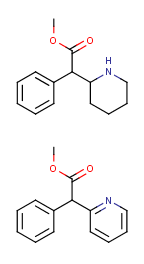
Good idea:
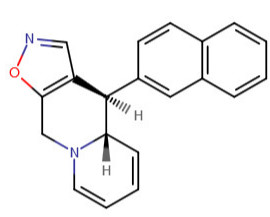
Restrict rotation, phenyl to naphthyl, bioisostere at the restricted descarbmethoxy place.
or:
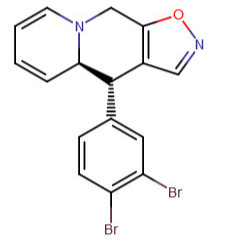
Di-bromo; higher potency.
(P.S. I was supposed to be at a "retreat" of sorts, but am not. I learned the hard way that no-body here in the pharm. @ BL reads posts at The Lounge section; or anyone anywhere else on this board, for that matter.)
pharmakos
Bluelighter
i saw that thread, actually =pGood idea:
Restrict rotation, phenyl to naphthyl, bioisostere at the restricted descarbmethoxy place.
or:
Di-bromo; higher potency.
(P.S. I was supposed to be at a "retreat" of sorts, but am not. I learned the hard way that no-body here in the pharm. @ BL reads posts at The Lounge section; or anyone anywhere else on this board, for that matter.)
It might work @nagelfar except (naphthalene or dibromophanyl) are too lipophilic. high lipophilic => high non specific protein binding => slow distribution => slow to reach brain = no rush. Plus isoxazole biosteric will not metabolize easily like the carboxylic ester. consequence: ultra long half-life (especially with the dibromo since an alternative metabolic site is now blocked. I mean first-pass para-hydroxylation of unsubstituted phenyls). Now I dont even ask how you go about synthesizing that! would cost you lot$..(but shhttt....
PS: dibromo or naphthalene derivatives (ie the more lipophilic the group at the phenyl binding site) tend to be more serotonergic SERT inhibitor than DAT/MET so you might end up with MDMA-like with less stim ..could be a good thing: MDMA with 2-3 weeks half-life! the Lounge section? am I missing something? ..I like to draw molecules..
pharmakos
Bluelighter
how does the dibromo sub affect toxicity of related compounds?Good question! you mean neurotoxicity, right? as far I can tell there is no similarly halogenated compound to compare to. But correct me if I am mistaken. The closest I think will be 3-CPP:
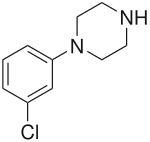
or 5-BromoDMT

My guess dibromo-piperazines shouldn't be very different in term of neurotoxicity.. but caution as always!
aced126
Bluelighter
- Joined
- May 18, 2015
- Messages
- 1,045
how does the dibromo sub affect toxicity of related compounds?
The parahalogenated amphetamines are neurotoxic. If 3,4-dibromobenzylpiperazine works in a similar fashion, I would expect it to display signs of neurotoxicity.
Nagelfar
Bluelight Crew
It might work @nagelfar except (naphthalene or dibromophanyl) are too lipophilic. high lipophilic => high non specific protein binding => slow distribution => slow to reach brain = no rush. Plus isoxazole biosteric will not metabolize easily like the carboxylic ester. consequence: ultra long half-life (especially with the dibromo since an alternative metabolic site is now blocked. I mean first-pass para-hydroxylation of unsubstituted phenyls). Now I dont even ask how you go about synthesizing that! would cost you lot$..(but shhttt....
PS: dibromo or naphthalene derivatives (ie the more lipophilic the group at the phenyl binding site) tend to be more serotonergic SERT inhibitor than DAT/MET so you might end up with MDMA-like with less stim ..could be a good thing: MDMA with 2-3 weeks half-life! the Lounge section? am I missing something? ..I like to draw molecules..
Restricted rotation, if MPH (i.e. methylphenidate) SAR trend is anything like PT (i.e. phenyltropane) then " decreased conformational flexibility" = better binding. (forgot to mention as much in my original post, as per: cited page 25, end of left column)
paroxetine (pg. 22) + benztropine in a phenyltropane,
a la:

Reminds me of (check third one down; honeycomb benzene side-chain)
@aced126: It seems the neurotoxicity of para-Halo-amphetamines (p-halo-PEAs in general and even the rat-aphrodisiac para-chloroPhenylalanine) is because they are potent irreversible inhibitors of Aromatic Amino Acid hydroxylase. the enzyme that convert phenylalanine into tyrosine and further to dopamine and to NE. also Tryptophan to 5HTP to serotonin...etcThe parahalogenated amphetamines are neurotoxic. If 3,4-dibromobenzylpiperazine works in a similar fashion, I would expect it to display signs of neurotoxicity.
Blocking this enzyme => build-up dangerous level of precursors => kill neurons especially serotonergic. Question is: would para-halobenzyl-Piperazines also act as AAH inhibitors? IMHO probably not since a phenyethylamine(arylethylamine) skeleton will be required for AAH enzyme recognition else lots of drugs containing halophenyl would have similar neurotoxicities..one Bromopipearzine 2C-B-BZP seems to be fine ..but who knows?

aced126
Bluelighter
- Joined
- May 18, 2015
- Messages
- 1,045
@aced126: It seems the neurotoxicity of para-Halo-amphetamines (p-halo-PEAs in general and even the rat-aphrodisiac para-chloroPhenylalanine) is because they are potent irreversible inhibitors of Aromatic Amino Acid hydroxylase. the enzyme that convert phenylalanine into tyrosine and further to dopamine and to NE. also Tryptophan to 5HTP to serotonin...etc
Blocking this enzyme => build-up dangerous level of precursors => kill neurons especially serotonergic. Question is: would para-halobenzyl-Piperazines also act as AAH inhibitors? IMHO probably not since a phenyethylamine(arylethylamine) skeleton will be required for AAH enzyme recognition else lots of drugs containing halophenyl would have similar neurotoxicities..one Bromopipearzine 2C-B-BZP seems to be fine ..but who knows?
Interesting hypothesis. Do you have a source for this? I can see why they could be potentially reversible AAAH inhibitors, but how can they irreversibly inhibit the enzyme? The only possible thing that could happen is a nucleophilic residue attacking the aromatic carbon and the halogen leaves; unlikely seeing as there are no EWGs to stabilise the intermediate. Maybe there are downstream cellular changes which cause irreversible inhibition. Lastly, why is inhibition of AAAH more neurotoxic to 5HT neurons?
With these thoughts in mind, I have the following questions: why are 3-haloamphetamines less selective for 5HT neurons?
Would this be a potent SRA and neurotoxin:
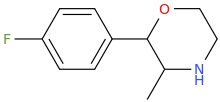
I'm not fully sure whether 3-FPM itself is a releasing agent or simple a reuptake inhibitor.
Are there any examples of reuptake inhibitors with a high affinity for SERT causing the typical physiological changes that are observed with SRAs like MDMA (empathy mainly)?
Finally, to what extent do reuptake inhibitors like methylphenidate enter neurons? Is it that a small proportion of them do actually get transporter into the neuron through DAT but then cannot either cause DA vesicle release or DAT reversal?
roi
Bluelighter
- Joined
- Sep 2, 2013
- Messages
- 1,545
Fluorinated amphetamines aren't neurotoxins. Same should apply to fluorinated phenmetrazines. And 3-FPM, just like phenmetrazines itself, is a releasing agent. 4-MPM is somewhat selective for serotonin (by far not as much as MDAI though), 4-FPM should be a slightly more balanced releaser. It's sold in Sweden, but apparently it's not very good and also less potent than 3-FPM.
aced126
Bluelighter
- Joined
- May 18, 2015
- Messages
- 1,045
Fluorinated amphetamines aren't neurotoxins. Same should apply to fluorinated phenmetrazines. And 3-FPM, just like phenmetrazines itself, is a releasing agent. 4-MPM is somewhat selective for serotonin (by far not as much as MDAI though), 4-FPM should be a slightly more balanced releaser. It's sold in Sweden, but apparently it's not very good and also less potent than 3-FPM.
Where is your source for fluoroamphs being non-neurotoxic?Nothing beats an actual source, but I wanna mention that 4-FA was tested along with 4-CA (pCA) and 4-IA (pIA) and found to have very limited potential as serotonergic neurotoxin (which seems to be the type the fuss of halogenated amps and also 4-MA has always been about: their extreme affinity for serotonergic transporters IIRC and lasting damage done to them). Whether that potential is still any bit significant for 4-FA I don't know, what it means for one time use, frequent use, or doses considered safe. I'm too lazy to get the source for that study but it's been discussed many times - unless i am mistaken the consensus was that 4-FA neurotoxicity wasn't comparable to the serious and concerning 4-CA.
When going from 4-FA to 3-FA and 2-FA, I think the affinity for SERT drops in favor of DAT (if not others) and the assumption is that the neurotoxicity is kinda relying on that high SERT affinity - and a similar toxic mechanism for DAT or NET would be something I never even heard of before.
Are super agonists for DAT neurotoxic?
I believe all that is on the opposition of the fluoroamp neurotoxicity concern? My impression that is what makes roi kinda confident about the matter.Last edited:
Incunabula
Bluelighter
- Joined
- Dec 10, 2010
- Messages
- 1,861
Hasn't the flourinated amphetamines (aswell as the meth analogues too) been available as RC's for ages? I don't take that stuff, but I'm sure I've been seeing vendors stocking it for a long time now.Yes, for an RC stim 4-FA has been around for quite a while (even been sold in smartshops next to methylone in my country - no idea about that currently). Then after a while 2-FA als became available and 3-FA as well as 4-FMA and 2-FMA. Don't know about others and never seen 3-FMA.
Availability doesn't inherently say anything about safety or toxicity. A history of availability at the most would show a good sign, if on the whole people have not noticed acute or correlated chronic health effects that they link to it. Often RC users don't stick to one compound, but 4-FA pretty much went mainstream here.
Still, it doesn't really prove anything technically.
I don't think that serotonergic neurotoxicity is usually noticed as a side-effect during the main effects of the drug, it's noticed afterwards as problems with mood and certain functionalities - even personality on some level, something also observed after chronic cocaine abuse, but different probably. 4-MA sounds scary like that ^ from a few reports. Never heard much about fluorinated amps, but if damage is subtle enough people may not notice it enough to make the link to begin with (not enough damage to induce a disorder or real dysfunction..).
Personally I'm very interested to hear about any problems from 4-CMC or 4-BMC solely. It's claimed they are not toxic like the amps.
There's always a few people who start abusing insanely. A close friend of mine had a 4-FA problem, but alas no clear case there.
Sorry for not drawing random molecules - moderate as you see fit of course?
Hey... are 3,4-chlorophenyl pea based stims dangerous? That seems to be such a typical moiety like in AH-7921 or U4 (I think), and the methylphenidate analogue. (Ah.. I see DCA is neurotoxic also) - So DCFPM would be a pretty tricky plan : P So, make the para a fluoro then - 3-chloro-4-fluorophenmetrazine.Last edited:
Nagelfar
Bluelight Crew
THIS IS IT!!! THE MOLECULAR MASCOT FOR BL.RU!!!!
=

9,10-Diphenylanthracene + MDMA
It's literally blue light, with a methylenedioxy, and an amphetamine tail. ;-P
The parahalogenated amphetamines are neurotoxic. If 3,4-dibromobenzylpiperazine works in a similar fashion, I would expect it to display signs of neurotoxicity.

??- Status
- Not open for further replies.


