



-
Neuroscience & Pharmacology Discussion Welcome Guest
Posting Rules Bluelight Rules Recent Journal Articles Chemistry Mega-Thread FREE Chemistry Databases! Self-Education Guide -
N&PD Moderators: Skorpio
You are using an out of date browser. It may not display this or other websites correctly.
You should upgrade or use an alternative browser.I Like to Draw Pictures of Random Molecules
- Thread starter nuke
- Start date
- Status
- Not open for further replies.



Incunabula
Bluelighter
- Joined
- Dec 10, 2010
- Messages
- 1,861
lol, Yeah, probably. Snorted mephentermine powder was damn close to amphetamine in effects, I know that much. How that translates to a beta-ketone with a 4-methyl would probably have to be assayed in vivo for us to know. But yeah, chances of it being close to mephedrone are slim, I guess.
I don't take stimulants or empathogens any more, so I don't really care. It was just a funny thought I had, and I thought I'd share it. I'd rather bet my money on this one being more worthwhile, than that mexedrone fail. (not that I've treid that one either, it's not my thing really)
sekio
Bluelight Crew
The phenethylamine/amphetamine open chain compounds have been investigated: they have effects on blood pressure but aren't hallucinogenic.

Incunabula
Bluelighter
- Joined
- Dec 10, 2010
- Messages
- 1,861
You forgot the ketone on your methylenedioxy-many-many-mexe-phenethylamine
Incunabula
Bluelighter
- Joined
- Dec 10, 2010
- Messages
- 1,861
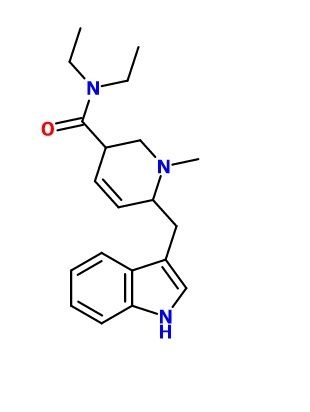
Yeah. How about something like this? Could be interesting. Would it be easier to synth than LSD?
Midnight Sun
Bluelighter
I bet this has been drawn before, but does anyone know if open chain LSD analogues have been evaluated?

If you're trying to increase potency I think it's a better bet to mess around with constraining the basic tryptamine amide ala 4-ho-mpmi and/or indazole substitutions in lieu of indole
pretty sure the pocket of 5ht2a that LSD's diethylamide docks in is rather unreasonable to try and reach with an open chain (would be just too floppy)
I'd really like to know what the rationale was that led to the discovery of 4-HO-MPMI cause it sure would be enlightening!Last edited:
pharmakos
Bluelighter
Yeah. How about something like this? Could be interesting. Would it be easier to synth than LSD?
add a ketone on that methyl bridge, and tack a pentyl group onto the indolic nitrogen, and you'd have a potential cannabinoid
aced126
Bluelighter
- Joined
- May 18, 2015
- Messages
- 1,045
If you're trying to increase potency I think it's a better bet to mess around with constraining the basic tryptamine amide ala 4-ho-mpmi and/or indazole substitutions in lieu of indole
pretty sure the pocket of 5ht2a that LSD's diethylamide docks in is rather unreasonable to try and reach with an open chain (would be just too floppy)
I'd really like to know what the rationale was that led to the discovery of 4-HO-MPMI cause it sure would be enlightening!
I wasn't really trying to improve potency. In fact the reason why LSD is so potent itself is probably because it is in a rigidified conformation.
Idk, dimethyl > pyrrolidine is a pretty obvious modification lol; I'm sure they synthesised molecules with much more complex modifications.Last edited:The phenethylamine/amphetamine open chain compounds have been investigated: they have effects on blood pressure but aren't hallucinogenic.
I think conformal rigidity might be an issue. The alkyls on the amide appear to be required for space-filling since some secondary amides also work. It's that N lone-pair that is the important bit. The NBOMe class overlays the O of the benzyl-methyl ether so I would look at the directions of the lone-pairs. Just a thought - I could be miles out.Yeah but with the NBOMe class, IIRC even 25-NBOMe - the 2C-H analogue - is apparently just nasty and adrenergic let alone free phenyl or mono/dimethoxyphenyls (in terms to tolerating less substitution on the ring). Hans Meyer in PD is testing NDEPA compounds on himself that are based on more classical psychedelic PEAs with often a 2,4,5 substitution pattern. They apparently DO work, anecdotally.
Without a fully constrained lysergamide structure nor such a phenyl substitution pattern on a non-constrained open chain compound you are apparently missing too many binding sites incl. on both ends, for the molecule to both fit on the receptor AND activate it by doing something to the conformation of the receptor protein. An uncanny likeness on one side of the molecule but not the other just makes the above structures remote meth / stim neurotransmitter cousins that apparently are generic enough to do the job as a sympathomimetic drug.Last edited:
sekio
Bluelight Crew
Dunno if it would be active as a hallucinogen, the 9,10 double bond is needed for psychedelic activity

But it's been made though, refs
Horii et al. Chemical and Pharmaceutical Bulletin, 1966 , vol. 14, p. 1227-1234
Bulletin de la Societe Chimique de France, 1968 , p. 4463
Apparently it has oxytocic activity, so presumably it hits some of the serotonin receptors ?Last edited:
aced126
Bluelighter
- Joined
- May 18, 2015
- Messages
- 1,045
Dunno if it would be active as a hallucinogen, the 9,10 double bond is needed for psychedelic activity
But it's been made though, refs
Horii et al. Chemical and Pharmaceutical Bulletin, 1966 , vol. 14, p. 1227-1234
Bulletin de la Societe Chimique de France, 1968 , p. 4463
Apparently it has oxytocic activity, so presumably it hits some of the serotonin receptors ?
I meant to have the double bond there, but I couldn't manage to find a way to name it on Opsin. I have a feeling removal of the indole system will still retain activity to an extent.
Anyway, if the double bond is needed for activity, what does that say about how the molecule interacts with the pocket? Even a small conformational change results in a massive drop in potency, implying that the rigid structure which LSD takes is crucial to not only binding to, but also activating it. Yet however other 5HT2a agonists which have a similar backbone to LSD (like DMT for example) are very active of course, only at 2 or 3 orders of magnitude higher. With that being said, would dihydro-LSD and lumi-LSD be active when administered in much higher doses?
On to a different question, is there a structural link I am missing between the 2C-X series and tryptamine series as they both hit the same receptors.- Status
- Not open for further replies.


