
Fair enough. Think I was mainly focussed on "i can see small cell-like transparent images" which would be floaters, as far as I can tell. Black dots that remain fixed in place and move with the eye could well be something entirely different.







So you think the "targets" that you believe were undoubtedly the result of psychedelics use originated in the retinal ganglion cells? I know the retina does a lot more communicating with the brain than once believed, but are you suggesting psychedelics directly or indirectly impact the RG network, too? That would be interesting. Aside from pupil dilation I didn't think they affected the eyes.Cool post...hadn't heard of the blue light entoptic phenomenon before.
I haven't had any spots in my visual field for a while, but I have had them in the past, and they are undoubtedly related to psychedelic use. The spots that I experienced were not black dots though. Rather, they were very small targets. While it makes sense to assume these are due to changes in the visual cortex where there are an abundance of 5-HT2A receptors, I think the event causing the misperception may be misfiring of a neuron downstream from a retinal ganglion cell if not the RG cell itself.
Retinal ganglion cells are responsible for edge detection (detection of contrast) in visual perception. They achieve this through a center-surround response, which makes use of on center and off center retinal ganglion cells. These two types of cells respond differently to a light stimulus. The on center RG cell is stimulated when light hits the center of its receptive field. When stimulated, it simultaneously causes lateral inhibition of adjacent RG cells. The off center RG cell responds in the exact opposite manner.
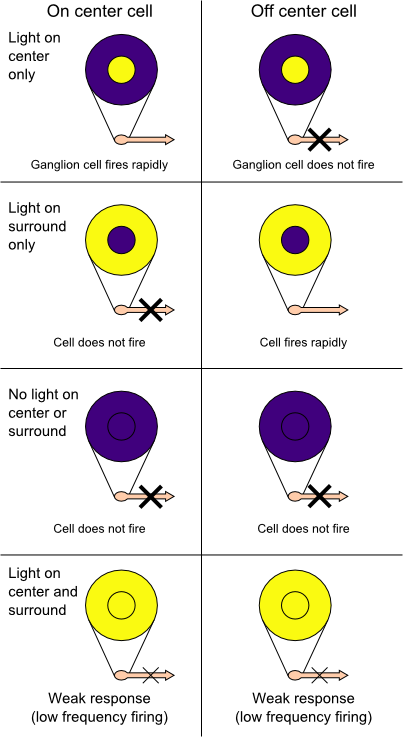
The targets I see are exactly what I would expect if an RG cell or its downstream neuron were to depolarize in the absence of a light stimulus.
As for my vision, I now experience auras around bright lights at night and I can say without a doubt that the saturation of color in my vision is slightly increased. Neither is a significant distraction, and I often perceive the latter as an enhancement in my visual perception.
I've had floaters since I was a kid, almost as far back as I can remember. Used to spend hours looking at them against the sky. I suppose in a way they were my first encounter with psychedelic effects.

Cool post...hadn't heard of the blue light entoptic phenomenon before.
I haven't had any spots in my visual field for a while, but I have had them in the past, and they are undoubtedly related to psychedelic use. The spots that I experienced were not black dots though. Rather, they were very small targets. While it makes sense to assume these are due to changes in the visual cortex where there are an abundance of 5-HT2A receptors, I think the event causing the misperception may be misfiring of a neuron downstream from a retinal ganglion cell if not the RG cell itself.
Retinal ganglion cells are responsible for edge detection (detection of contrast) in visual perception. They achieve this through a center-surround response, which makes use of on center and off center retinal ganglion cells. These two types of cells respond differently to a light stimulus. The on center RG cell is stimulated when light hits the center of its receptive field. When stimulated, it simultaneously causes lateral inhibition of adjacent RG cells. The off center RG cell responds in the exact opposite manner.
The targets I see are exactly what I would expect if an RG cell or its downstream neuron were to depolarize in the absence of a light stimulus.
As for my vision, I now experience auras around bright lights at night and I can say without a doubt that the saturation of color in my vision is slightly increased. Neither is a significant distraction, and I often perceive the latter as an enhancement in my visual perception.


