• Psychedelic Drugs Welcome Guest
    View threads about
    Posting RulesBluelight Rules
    PD's Best Threads Index
    Social ThreadSupport Bluelight
    Psychedelic Beginner's FAQ
  • PD Moderators: Esperighanto | JackARoe |

Halogenated Tryptamines

ToxicFerret

Bluelighter
Joined
Apr 14, 2004
Messages
1,484
Location
Chitown
Has anyone ever heard anything about tryptamines with a halogen sitting at the 4 or 5 position? Shulgin likened the 5th position I believe on the tryptamines being analogous to the 4 position on the phenethylamine as far activity goes so while I know its not going to be exactly correlated I wonder what would happen if you took some 4- or 5-bromo-n,n-dimethyltryptamine
 
5-fluoro-DMT, and both 5-fluoro-AMT and 6-fluoro-AMT are all known, have been tested by humans and are reportedly psychedelic - though thats not to say they are safe, 5-fluoro-AMT at least is also a potent MAOI. 5-chloro-DMT and 5-bromo-DMT have been synthesized but never heard of them being bioassayed, and 4-chloro-DMT is probably also active based on SAR, but not sure if its even been made. And again, toxicity is an unknown given how little testing has been done. 6-fluoro-DET was reportedly inactive, and 4-fluoro-5-methoxy-DMT is a potent 5HT1A agonist (i.e. not psychedelic, and probably unpleasant) - so its really hard to say what they will be like!
 
Last edited:
I tested 5-chloro-DMT. Up to 10 mgs via smoking, no psychoactivity found. I still have the sample, but I doubt there is any reason to go higher than that. For simple DMT is very active at that dose, not talking about 5-MeO. If this one is inactive at 10 mgs then I doubt there would be anything revarding even at 100.
 
I am not especially interested in these substitutions..though I have been wondering for quite some time, if dimethoxy phenethylamines have alkyl groups or single halogens as equal, interchangeable uh things..from 2C to 2C, DOx to DOx, et cetera..could not there be such a compound as Dichlorotryptamine? Propylbromotryptamine? Iodomethyltryptamine?

I would think if so, these possibilities would obviously have been looked into long ago. It seems I am looking for an explanation as to why halogens and alkyl groups are (for lack of an acceptable term) "equally exchangeable" in psychedelic phenethylamines and not tryptamines. Steric hindrances or some such concept that is as of yet beyond me? Any clarification is appreciated. I apologize for my teenaged ignorance.
 
Merged. Also:

C6H6 said:
5-F-aMT is supposedly very active and a confirmed 5-HT2A agonist.

Riemann Zeta said:
5-Fluoro-AMT meaning 5-fluoro-alphamethyltryptamine? I don't think that this particular compound would be all that different from AMT. I have nothing against AMT (I have never tried it, so I can't really speak of its effects), but a number of people seem to dislike it. Generally, people seem to like (+)-AET quite a bit more, as it has less of a pressor effect. Thus, it might be interesting to investigate 5-fluoro-AET. Also, I am not sure about the 5- position on indoles being a target for monoamine oxidase. I always assumed that the nitrogen was the primary locus of attack, considering that DMT and 5-MeO-DMT are inactive orally due to MAO activity, but DiPT and 5-MeO-DiPT ("Foxy Methoxy") are.

Don't know about the 6. What kind of a place is that anyway for a substitution? I should check the vice link.
 
I believe that there are 6-subbed tryptamines found in sea life. Shulgin's TIHKAL chapter "DMT is Everywhere" talks about them.
 
The 5-fluoro comopounds are more active than the 6-subtitiuted derivatives in inducing spontaneous locomotion when administered to reserpinized white mice. Both 6-F-DET and DET exerted peripheral activity when tested in humans, but only the fluorine-free compound seemed to bear hallucinogenic qualitities. These reults may be explained by change in the metabolic pathway of the tryptamine substituted at the 6-position in the indole nucleus.
[....]
5-F-AMT and 6-F-AMT were tested on mice using reserpine-induced ptosis reversal and activity cage tests. In these tests, 5-F-AMT acted like the parent compound (AMT) but there was a marked decrease in activity especially in the locomotor test with the 6-fluoro derivative.

The effect of 6-F-DET was compared with DET in six patients and one normal volunteer. Both drugs were given intramuscularly in 1mg/kg doses. DET produced sympathomimetic autonomic symptoms, perceptual disturbances, hallucinations, mood changes, and difficulaties thinking and speaking. 6-F-DET in the same persons produced the autonomic symptoms and mood changes without the perceptual and thinking disturbances characteristic of hallucinogenic drugs.

in the urine of patients treated with DET, various amounts of 6-HO-DET could be found (4.5 to 20.3% of administered DET dose). In the case of the 6-fluoro analog the urine instead contained large amounts of unchanged 6-F-DET and no detectable 6-HO-DET.

These reults indicate that the 6-fluoro substitution of the indole ring may represent an important structural change resulting in a different metabolic pathway, and quite possibly in a different physical and pharmacological action of the compound.


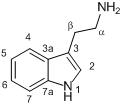
For those confused about where the substitutions go -
Pt9qdGr.png


neat
 
Last edited:
Top