• N&PD Moderators: Skorpio

GABA-A Alpha Subunit Subtypes and the Ligands they Love

seep

Bluelighter
Joined
Nov 28, 2008
Messages
1,347
I want definitive answers to these questions.

Damnit.

There are a handful of alpha subunit subtypes, and the search is on for an anxiolytic ligand that is not addictive and not sedating: one that is either a partial agonist or (ideally) a highly-selective agonist. One of the reasons this is possible is that we've assigned qualities to each alpha subunit subtype. Hence, in theory, we can alter the benzodiazepine skeleton to select or deselect certain effects: anxiolysis, sedation, euphoria, ataxia, anticolvusia (not a word). Theory: the more selective the benzo, the more efficient utilization of the receptors. Lower percentage occupancy = lower disruption of inhibitory circuits = lower physical dependence.

But then I keep reading different interpretations about which alpha subunit subtype does what. Like I guess I was mistaken that alpha-1 is primarily responsible for sedation. This is 2006:

The anxioselective agent 7-(2-chloropyridin-4-yl)pyrazolo-[1,5-a]-pyrimidin-3-yl](pyridin-2-yl)methanone (DOV 51892) is more efficacious than diazepam at enhancing GABA-gated currents at alpha1 subunit-containing GABAA receptors.

By the chemical name,
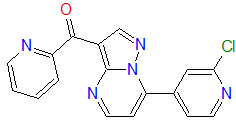
Dov51892.png


Which is an obvious play on the Z-drug skeleton.

So is the alpha-subunit-subtype assembly-line-like division-of-labor theory wrong?

I like to dream, every once in a while, that in 2020 I won't be taking thrice-daily alprazolam.

 
I'm not sure what your question is, to be honest :)

But I recall reading of selective alpha ligands that may interest you. There are ones with isoquinoline structure (yes, as in Harmaline analogues!), and then you also have this novel drug... Tofisopam I believe it is called... that is a highly-modified benzo structure that is purported to be non-addictive and actually stimulating, yet just as anxiolytic as other benzos. This is one drug I'd love to try, personally, as someone who suffers from legit Anxiety and Panic.
 
I'm not sure what your question is, to be honest :)

Yeah I gotta work on that.

The 2,3-bnzodiazepines usually are ampa-antagonists from what I've read. It'd be interesting to see what kind of GABA affinity they have.

My question (puzzlement really) is about the relationship between structure and function at the different GABA-A alpha subunit subtypes. Benzos dock between the alpha and gamma subunits on GABA-A, but not all GABA-A receptors are the same. There are 6 different sequences that express themselves as alpha subunits in humans. alpha-1 is the more abundant, I think, and I had thought that it was mainly responsible for BZD sedation, especially after highly-selective alpha 3 ligands were found to be almost exclusively anxiolytic. And alpha 5 had the distinction of actually being nootropic when dosed with an inverse agonist (imagine an anti-Alzheimer's benzo).

So I had assumed designing an nth generation benzo would be as simple as formulating for subunit-subtype-selectivity.

But the Poles who authored the study say Nie!
 
Benzos bind, most primarily in the alphaXgamma2 pocket. As I recall, they'll bind to GABAA receptors composed of other gamma subtypes, but gamma2 is definitely the most common expressed.

I'd stop looking at benzos, since they're not very selective. Lots of non-benzo BZD-pocket agonists are selective in ways that 1,4-BZDs can't compare to.

I still don't understand what the point of this is. As you've said, the alpha3-selective ligands are almost exlusively anxiolytic in nature, lacking much of the effects thought as recreational. They'll still produce dependence though.
 
the alpha3-selective ligands are almost exlusively anxiolytic in nature, lacking much of the effects thought as recreational. They'll still produce dependence though.

Actually, Hammilton, since I know this is an area you're especially interested in, do you know if there's a reliable source on the absolute and region-specific abundance of the different alpha subtypes? I'm just now learning how to wade through the protein data banks.

If it's too much work, don't worry about it.

Thanks.
 
pubmed / chem.

there are usually citations associated, sometimes lots and lots associated with any specific pdb file. These are a good place to find specific references.

regional differences in expression will explain much of the pharmacological differences, I'm willing to bet.

However, regional differences in drug distribution may explain the differences between similar drugs, too, though.
 
I know this is a bit of an old thread, but seeing as this post is so far down my alley, I thought I could chuck in some words of wisdom.

The original papers that claim to show the alpha1 vs alpha2 : sleep vs anxiolytic are largely a con IMHO. If you're interested, and you don't believe me, check out Rudolph et al., 1999 Nature, where they never test the sedative action of benzos, or Löw et al., 2000 Science, where figure 2 (which I dont believe) shows there alpha2 mutant is 50% as sensitive as the wildtype, yet magically benzos now have NO effect on anxiety. All of the papers were either done by drug companies or by groups heavily involved with drug companies.

Moreover, if they really could make sedative free anxiolytics by targetting the alpha2 subunit, I think these drugs would already be on their way to the clinic. Instead they're focusing on alpha5 inverse agonists for cognition.

Theory: the more selective the benzo, the more efficient utilization of the receptors. Lower percentage occupancy = lower disruption of inhibitory circuits = lower physical dependence.
I'm not sure if I agree with your logic. Lets just assume there are two populations of benzos for the sake of argument, lets use the oldschool BZ1 and BZ2 terminology. If a drug was 100% selective, it would have no affinity for, lets say, BZ2. Hence, it's occupancy at any given concentration would be asymptotically close to 0. However, that doesn't mean it doesn't mess with inhibitory circuits. 1) we could imagine that BZ1 is expressed preferentially on interneurons. Hence acting at either BZ1 or BZ2 would mess with the inhibitory circuits in completely different manners. 2) BZ2 could actually be expressed at vastly lower titres, or in a very restricted area, hence, acting selectively at BZ1 would not really be very different from acting non-selectively

Most importantly, the question of dependence has nothing to do with that. A drug can act at a vast array of targets, the question of whether or not you get dependence has to do with what the drug does to the receptors once it's bound. The dependence caused by benzos is poorly understood, but if we assume it is caused by some re-jigging of the subunits that make up synaptic GABAA receptors, then we just need to find a ligand that doesn't induce this change in the receptor.


If you want info on how these subunits are distributed, you want the papers by Wisden, Peter Seeburg and Hannah Monyer (who used to be quite a fox by all accounts). It was done in 1992, but no ones done a better job since.

http://senduit.com/b4dee2

P.S. This upload will expire in a week. So if someone knows a place that you can upload shit and it stays there indefinitely, and you don't have sign up for porn to download it, then they should put it there.
 
Last edited:
I'm not sure if I agree with your logic.

Yeah, it's flawed. I imagine it's categorically wrong to assume that there are discrete neural networks for the attenuation of stress responses. Inter-neuron involvement is something I tend to ignore (also I had forgotten to say that the more selective the drug, the less strain on the archtecture of the GABA complex--which is something I'm paraphrasing from one of your old posts).

Thanks for the input and for the reading, which I'm gonna hit up once I finish finals.

If you happen to pop back by and if you (or anyone else) can see something to any of these (mostly) selective alpha-2,3 or 5 anxiolytics (or if you've run into any of them before), I'm curious. They can be found as stubs at the usual place, and a lot of them were just recently put up there--either that or wiki just deleted their category page). Sorry for the gallery:

220px-ELB-139.png
ELB-139
220px-Etifoxine.svg.png
Etifoxine
250px-L-838%2C417.svg.png
L-838,417


220px-TP-003.png
TP-003
220px-TP-13.png
TP-13
220px-TPA-023.png
TP-023


220px-Captodiame.svg.png
Captodiame
250px-SB-205384.png
SB-205,384
220px-Y-23684.svg.png
Y-23684
 
Top