
Well, did you read the full paper? I'm pretty sure this has been crystallised before. I'll try to find more information. Anyway, on this basis the classification would at least make some sense.Hmmm... I can't find any other papers discussing this secondary allosteric mechanism for ketamine. I'm not convinced on the strength of one paper from 1997.




-
Neuroscience & Pharmacology Discussion Welcome Guest
Posting Rules Bluelight Rules Recent Journal Articles Chemistry Mega-Thread FREE Chemistry Databases! Self-Education Guide -
N&PD Moderators: Skorpio
You are using an out of date browser. It may not display this or other websites correctly.
You should upgrade or use an alternative browser.Explanation of the PCP site
- Thread starter Lightning-Nl
- Start date


 This is from a more recent review about ketamine's pharmacology. They talk about the binding sites in the last paragraph, but I thought some people might appreciate the other information presented here as well.
Mechanisms of Action
Ketamine neuropharmacology is complex. Ketamine essentially acts on glutamate binding sites, NMDA (N-Methyl-D-Aspartate), and non-NMDA receptors [70]. The antagonism of NMDA receptor is responsible for the specific ketamine properties (amnesic and psychosensory effects, analgesia, and neuroprotection). There are also other glutamate-independent mechanisms.
Glutamate-Independent Mechanisms
Ketamine interacts with many binding sites such as opioid, mono-aminergic, cholinergic, nicotinic, and muscarinic receptors.
c-Amino-butyrique acid (GABA) is the most prevalent inhibiting neurotransmitter, responsible for an increase of chlorine conductance. Like other anesthetic agents, ketamine potentializes the GABA inhibition (GABA-A complex) [71] but this interaction does not really account for the analgesic effects. A ketamine agonism on spinal GABA receptors, which plays a role in spinal analgesia, is established, but only for high concentrations (more than 500 lM) that are much more higher than those obtained in human practice [72].
Ketamine binds to mu, delta, and kappa opioid receptors. The affinity of S(+)-ketamine for opioid receptors is two to three times higher than that of the R( )isomer, but this interaction is not really responsible for its analgesic effect: in humans, this analgesic effect is not antagonized by naloxone [73]. However, some psychic effects may involve kappa opioid receptors [73].
The action on the monoaminergic system is clearly essential. With the stimulation of noradrenergic neurons and the inhibition of catecholamines uptake, ketamine provokes a hyperadrenergic state (release of norepinephrine, dopamine, and serotonin).
Inhibition of norepinephrine uptake is stereo specific: R( ) isomer only inhibits its neuronal uptake, while S(+) isomer also inhibits extra-neuronal uptake. There is a prolonged synaptic action, leading to an increased transfer of norepinephrine in the circulation
[70]. Alpha-2 agonists are able to decrease this hyperadrenergic state, but also psychic phenomena induced by ketamine [74]. Because of its interfaction with the serotonin transporter [75], ke-tamine also inhibits dopamine and serotonin uptake [76]. Moreover, ketamine emetic properties are inhibited by ondansetron, which suggests a serotoninergic mechanism. These interactions involving noradrenergic neurons are partially implicated in the hypnotic, psychic, and analgesic effects of the molecule.
In the hippocampus and in the striatum, cholinergic neurons control the liberation of acetylcholine. In prefrontal cortex, these cholinergic neurons could be activated by nicotinic and musca-rinic receptors. Ketamine has a direct inhibiting effect on these receptors, which plays an important role in the occurrence of psychic phenomena. Thus, an anticholinesterasic agent, physostig-mine, is able to reverse the central anticholinergic effects and also antagonize ketamine hypnotic effects [77]. In this way, Balmer and Wyte have demonstrated, while injecting a ketamine perfusion (50 lg/kg/min) and physostigmine (0.5 mg) afterward, that the latter molecule antagonized ketamine sedative and hypnotic effects but respected its analgesic effects [78]. Ketamine could also facilitate acetylcholine liberation in the hippocampus, because of a dopamine increase. However, at clinical efficient concentrations, ketamine could, in some models, inhibit acetylcholine liberation initiated by NMDA receptors [70]. Ketamine, for clinical efficient concentrations (2.8 0.6 mM), inhibits nicotinic receptors [79].
It has an antagonist activity on muscarinic receptors [80], S(+)ke-tamine affinity being two times greater than that of the R( ) enantiomer.
Some ketamine effects involve the purinergic system, like toxic effects on the urinary tract [81].
Ketamine also has other effects because of its interactions with sodium channels (local anesthetic properties), L-type calcium channels, and potassium channels.
Some psychodysleptic effects, which can be antagonized by ni-modipine, could be initiated by L-type calcium channels [82]. The inhibition of sodium currents in the cardiac parasympathic neurons in nucleus ambiguus would be another explanation for the tachycardia induced by ketamine [83]. An antagonism on sodium channels is linked to local anesthetic properties [84]. Ketamine is similar to lidoca€ine in terms of pKa and molecular weight. It may bind to the same site inside the sodium channels as local anesthetics [85] and is efficient as a local analgesic agent used in topical application [86]. Ketamine inhibits neuron potassium channels
[87]: this mechanism could explain a part of (S)+isomer neuropro-tective properties [88].
Glutamate-Dependant Mechanisms
NMDA Receptor
The NMDA receptor, blocked by ketamine for concentrations between 2 and 50 lM, is responsible for ketamine's most important pharmacological properties. Glutamate is the most prevalent amino acid in the central nervous system (CNS), involving glut- aminergic synapses. Its liberation activates several pre- and post-synaptic receptors located on ion channels. Ionotropic glutamate receptors are usually classified as NMDA (specifically activated by N-methyl-D-aspartate) and non-NMDA [89] (such as AMPA [alpha-amino-3-hydroxy-5-methyl-4-isoxazole-propionic acid] and KA [kainate]) receptors. NMDA receptors are present on nearly all the cells of the CNS, particularly in the structures implicated in nociception, such as primary afferents or spinal dorsal horn. When glutamate is released in the synaptic cleft, there is an activation of the postsynaptic ionotropic receptors, which leads to the opening of ion channels, and is then responsible for a membrane depolarization [90]. Permeable to sodium-potassium exchanges, the NMDA receptor is especially remarkable for its cal-cic conductance. Some have a presynaptic location. Like the AMPA receptor, the NMDA receptor is a heteromeric multimer. The most likely structure is tetrameric, the basic structure being constituted by two subunits (dimers of dimers). Most of the NMDA receptors of the CNS are constituted by two NR1 subunits and by two NR2 subunits. They are anchored in the plasmic membrane (Figure 3A) through the PSD-95 protein (postsynaptic density 95). The subunits, which share common sequences with those of the AMPA and kainate receptors, are of three types: NR1, NR2, and NR3, also called GluN1, GluN2, and GluN3. These subunits possess four hydrophobic segments (M1 to M4) in their central region, with an arrangement in three transmembrane domains (M1, M3, and M4). The M2 segment that faces the cytoplasm represents the ionic channel of the receptor (Figure 2). Two wide domains are extracellular: the NTD N-terminal extremity (N-terminal domain) and the ABD domain (agonist-binding domain), which allows, on NR2, the glutamate binding and, on NR1, glycine binding. These two domains, NTD and ABD, have a spatial clam structure (Figure 2).
Agonists and competitive antagonists bind in the slot of this structure [91]. Seven subcategories of NR1 subunit exist (h-g). The NR2 subunits, incorporated into NR1/NR2 heteromeric complex, seem to play an important role in pathological processes associated with abnormal NMDA channel function [91], including schizophrenia. Four subtypes, designated by the letters from A through D, determine the type of receptor. A and B types are the most common. NR2A subtype is ubiquitous. The NR2B subtype is particularly located in the limbic system, the place for emotions and memory. It is found in the anterior part of the brain, particularly the cingulate cortex, but also in the hippocampus, the amyg-dala, and the olfactory bulb. NR2B type also participates in the transmission of pain messages to the thalamus, spinal cord, and extrasynaptic locations, for example, at the level of primary affer-ents. Spinal cord is also rich in NR2D type and cerebellum in NR2C type. NR2 subunit plays a fundamental role in the spontaneous opening probability (independent of ligands) of the channel. The N-terminal domains of the NR2A and NR2B subunit control the opening of the channel. This extracellular portion controls the sensitivity of the receptor to its endogenous inhibitors (especially zinc and protons) and has the property of binding allo-steric inhibitors [91].
The activation of NMDA receptors is rather complex, involving multiple agonists interacting in cooperation and regulatory mechanisms, which, on the contrary, favor the closed state of the channel. NMDA receptors have a binding site for glutamate, which is located on the ABD area of the NR2 unit (Figure 3A). This is the site that is selectively activated by N-methyl-D-aspartate. Receptor activation requires the simultaneous binding of one glycine molecule at a separate site in the ABD area on NR1 unit. Glutamate and glycine are thus described as "coagonists" of the system (Figure 3A).
Magnesium Channel Block
The main regulatory mechanism that opposes the opening of the channel is the voltage-dependent magnesium block of the NMDA receptor [92]. At the resting membrane potential (approximately 70 mV), extracellular Mg2+ blocks the receptor-associated channel, even if the coagonists (glutamate and glycine) are bound to their respective sites. The binding site of Mg2+ is located quite low in the intracellular channel side (Figure 3B). The dissociation constant of magnesium is an exponential function of membrane voltage. In the case of neuronal depolarization, the negative electrostatic forces that fasten ion Mg2+ at the NR2 subunit collapse, and the cation is released. This ejection of the plug allows, under the action of the coagonists, a calcium influx linked to the importance of the depolarization (Figure 3C). Although magnesium administered alone does not seem to reduce postoperative pain, these phenomena could explain lesser amounts of propofol required for narcosis and some antihyperalgesic effects of magnesium [93]. In addition, ketamine and magnesium have a synergistic effect [94].
Receptor Phosphorylation
Phosphorylation of the NMDA receptor plays a fundamental role in its activation. These phosphorylation mechanisms are the basis of long-term potentiation but also of hyperalgesia and morphine interactions with NMDA receptors [95]. Two phosphoproteins also modulate the NMDA receptor: phosphatase protein type I (PP1) and cAMP-dependent protein kinase (PKA). These two regulatory proteins are attached to the NR1 unit by another anchor protein called Yotiao (Figure 3A). This type of control (simultaneous presence of a kinase and a phosphatase that control the phosphorylation of a receptor) is typical of many ion channels [96,97].
Allosteric Inhibitors
Allosteric sites of the NR2 subunit also allow positive or negative modulation of the activity of the NMDA receptor. Some ions play an important role in the regulation of the channel opening by altering the spatial conformation of the receptor. These are protons and zinc ion (Zn2+).
Protons (H+ ions) are potent non-competitive inhibitors of NMDA receptors [98]. We do not know precisely the location of the proton detector, but it is known that protons act by stabilizing the closed state of the channel, independently of membrane polarization. Thus, tissue acidosis that accompanies ischemia or epileptic discharges reduces damage to neurons [99]. Receptors composed of NR2A or NR1a subunits have an intermediate reactivity to pH with an IC50 (concentration inhibiting 50% of the receptors) of 6.9 pH units, while the NR2C units provide the receptor with virtual insensitivity. In contrast, receptors composed of NR1a/NR2B or NR1a/NR2D dimers are extremely sensitive to pH. Their IC50 close to pH 7.40 explains that, under normal conditions, half of these receptors are under the influence of a tonic inhibition of opening by protons. Thus, even moderate changes in pH can participate in the opening of these NMDA channels, which illustrates an additional pejorative aspect of alkalosis.
The NTD domain of NR2A and NR2B subunits also plays an important role in NMDA receptor function modulation by selectively binding to non-competitive antagonists.
For the moment, only the zinc ion, often coreleased with glutamate in synaptic vesicles, has been identified as a ligand for NR2A and NR2B subunits [100] (Figure 3A). Zn2+ binds to the opening area of the NTD clam-shaped domain with an IC50 of 15 nmol and causes its closure. This closure relaxes a tension in the connections between the ABD and NTD domains, which in turn causes the separation of the interface between the two ABD domains of the receptor. This separation relaxes a stress exerted on a membrane segment, and this conformational change allows, with the bond to a proton, the closure of the channel. Zinc thus potentiates the channel closure, regulated by protons. It is possible that these mechanisms explain part of the pathophysiology of near-death experiences (NDE). In situations of cerebral ischemia or hypoglycemia, the NMDA channel is opened by neuronal depolarization and would hypothetically be modulated by zinc ions or protons. Prodils such as ifenprodil selectively inhibit NMDA receptors containing the NR2B subunit by binding in the slot of NTD domains, a site that partially overlaps with that of zinc binding [101]. Some synthetic compounds highly selective for the NTD domain of NR2B subunits, as traxopro-dil, besonprodil, or radiprodil and other more recently described compounds, are used as pharmacological tools and may, in the future, become therapeutic agents as analgesics (including for chronic pain), neuroprotective agents, anticon-vulsants, antidepressants or treatments for Parkinson's disease, and other neurodegenerative diseases. In the same way as zinc, they promote occlusion of the NMDA channel under the influence of protons. They are promising in the sense that they inhibit the receptor most involved in pathological phenomena, but also because they are much more active when the channel has been previously opened.
Polyamines: Endogenous Allosteric Activators
Polyamines, putrescine, spermine, and spermidine, are basic aliphatic amines, positively charged at normal pH. They are synthesized from ornithine, a metabolite in the urea cycle, and spread throughout the body. They are released in neurons in a calcium-dependent manner. Without being critical, they potentiate channel opening under the joint action of glutamate and glycine (Figure 3A). Polyamine deprivation has an analgesic effect in some animal models [102].
Other endogenous substances may allosterically modulate NMDA receptors; it is the case of neurosteroids, such as pregneno- lone sulfate. The release of these substances can be triggered by stress.
Consequences of the Opening of the NMDA Channel
The increase in intracellular calcium concentration is the starting point for the synthesis of second and third messengers, prosta-glandins and nitric oxide (NO), which facilitate the presynaptic release of glutamate, thus initiating the amplification of a vicious circle.
Binding protein PSD-95 appears to be essential to the sequence, which links the increased synthesis of NO and calcium influx [103]. The NR2 unit, rich in tyrosine residues on the cytoplasmic side, is linked to an intracellular tyrosine kinase of the Src family, by means of the anchoring PSD-95 protein (Figure 3A). A major function of Src in the adult CNS is to regulate glutamatergic transmission and synaptic plasticity [104]. PSD-95 is also linked to other intracellular enzymes, in particular NO-synthase [105].
The increase in intraneuronal calcium causes secondary activation of kinases that regulate the activity of receptors and modulate downstream early gene expression like c-fos. These transcriptional processes support long-term memory.
Because of an increase of intracellular calcium, the NMDA receptor stimulation by glutamate liberated in the nociceptive afferents leads to the activation of a neuronal NO-synthase (NO-s) and the production of NO from L-arginine [106]. NO stimulates the synthesis of cyclic guanosine monophosphate 3'5' (c-GMP), which plays a role in the central transmission of pain messages ("nitroxidergic" transmission) [107]. It has been demonstrated that NO and c-GMPc participate in the central sensitization and hyperalgesia processes, after a peripheral inflammation for example [108].
Mechanism of Action of Ketamine at the NMDA Receptor Level
Ketamine and other NMDA receptor non-competitive antagonists (PCP, MK801, dextromethorphan, and memantine [109]) are fastened to an intrachannel site called phencyclidine site (Figure 3D). Ketamine intrachannel binding decreases the channel opening time. Ketamine decreases the amplification of the response to a repeated stimulation (stimuli summation called "wind up", considered as an elementary form of sensitization of the CNS) [110,111]. The antagonism is more important if the NMDA channel has been previously opened by the glutamate fixation. This "use dependence" concept can explain why ketamine analgesic properties are efficient if the pain is important or chronic [112].
Fixing of ketamine at a second site located in the hydrophobic domain of the NMDA receptor decreases the frequency of channel opening [113]. Ketamine is also an allosteric antagonist of the receptor, with a marked tropism for NR2B unity, particularly involved in the phenomena of emotional perception and memory of pain. Independently of its action on NMDA receptors, ketamine might directly inhibit NO-synthase, which could act in its analgesic and anesthetic effects [114].
S(+)-ketamine affinity for the PCP site could be three times higher than that of R( )-ketamine [94], which confers to S(+)-ke-tamine a strong analgesic and anesthetic effect, at least two times stronger compared to the racemic mixture [115].
Source: Ketamine Pharmacology: An Update (Pharmacodynamics and Molecular Aspects, Recent Findings) (pages 370–380)
Georges Mion and Thierry Villevieille
Article first published online: 10 APR 2013 | DOI: 10.1111/cns.12099
THe following images are from the same article:
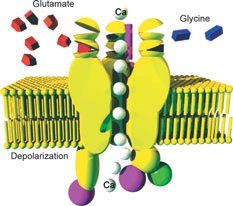
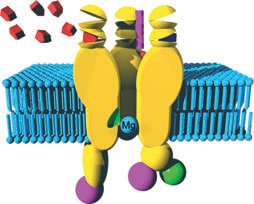
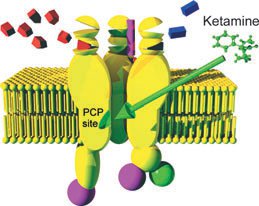
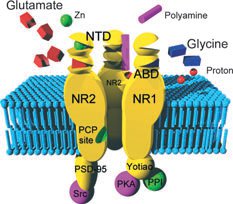
The NMDA receptor is anchored in the membrane (sky blue) by the PSD-95 protein, linked to the Src tyrosine kinase. The four sub-units (2 NR1 and 2 NR2) form an NMDA receptor channel selective for the cathions, which is shown open in (A). (A) The binding site of glutamate (red polyhedron), selectively activated by NMDA, is in ABD clam shaped NR2 subunit. The site for glycine (dark blue polyhedron), which acts as a co-agonist of glutamate, is located in the ABD area of the NR1 subunit. We do not know exactly where polyamines (magenta cylinder) bind, but certainly in close connection with one or the other clam-form fields in NR2 unit. Zinc ion (green spheres) binds to the NTD domain of NR2 subunit. Protons (red sphere) are an essential regulator mechanism that promotes closed state of the channel. The site of the proton detector is unknown, but it is assumed that it is ane area near ABD domain. Protein phosphatase type I (PP1) and cAMP-dependent protein kinase (PKA) are attached to the NR1 subunit by an anchor protein named Yotiao. (B) When the membrane is not depolarized, even when agonists occupy ABD sites, the channel is blocked by Mg2+ ion (sky blue sphere). The binding site of magnesium is near the intracellular part of the receptor. (C) In contrast, a membrane depolarization (phospholipids represented in yellow) causes the departure of the Mg2+ ion (voltage-dependent block) and allows a massive influx of calcium (white spheres), if the two coagonists occupy their binding site. (D) The molecule of ketamine or other derivatives of phencyclidine inactivate the receptor by binding to the intraductal PCP site (green slot), which partially covers the magnesium binding site.
EDIT: Just read this:
Lol wtf man, that wasn't the reason why I didn't post it. I didn't have the time. I'm not even allowed to post it for copyright reasons, yknow?SwampFox56 said:Just because "the study" isn't up to date, is a pretty piss poor reason not to post it.Last edited:
sekio
Bluelight Crew
It's been split to a new thread.