Ham-milton
Bluelighter
- Joined
- Jul 20, 2007
- Messages
- 5,738
I'm sorry if there's another thread by this title, I'm new (well, technically I've been a member for a year or two, but for some reason was never able to post) but a daily reader.
I'm a avid member over at Opiophile, but over time I've been less interested in answering "will snorting vicodin make it stronger" and more interested in the theoretical, SAR-stuff, and the chemistry.
Anyway, a few of us over at the Opiophile have been discussing forming a test group a little, and have been talking about what chems we might consider tasting. We haven't gotten past that yet, but a couple of the chems we've discussed are interesting enough that I thought I'd mention them over here and see what you guys had to say.
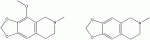
One of them is Hydrocotarnine and the other is hydrohydrastinine. These are their chemical structures, but I forget which is which because I'm silly.
http://forum.opiophile.org/attachment.php?attachmentid=1854&stc=1&d=1177354608
http://forum.opiophile.org/attachment.php?attachmentid=1855&stc=1&d=1177354608
Anyway, you can obviously see the relationship to MDMA and the other known entactogens. They're incredibly interesting in my mind, but I can't find much information on human testing.
Apparently they're chemicals lightly watched by the DEA (unknown source) but if they know about them, they do a good job hiding it.
I talked with Nichols, a professor at purdue (? I forget) who published a report in 1994 (again, not entirely sure) that tested some "non-neurotoxic MDMA analogues" one of which had a structure almost exactly like hydrocotarnine.
I believed it substitued in like 80-ish percent of rats trained to discriminate MDMA. That's pretty good, imo.
Does anyone here have any actual knowledge, experience about these chemicals, or has any ideas about them, I'd really appreciate.
This site is a bit more theoretically and technically oriented, and your members are top-notch, so I'd greatly appreciate your assistance.
Hammilton
I'm a avid member over at Opiophile, but over time I've been less interested in answering "will snorting vicodin make it stronger" and more interested in the theoretical, SAR-stuff, and the chemistry.
Anyway, a few of us over at the Opiophile have been discussing forming a test group a little, and have been talking about what chems we might consider tasting. We haven't gotten past that yet, but a couple of the chems we've discussed are interesting enough that I thought I'd mention them over here and see what you guys had to say.
One of them is Hydrocotarnine and the other is hydrohydrastinine. These are their chemical structures, but I forget which is which because I'm silly.
http://forum.opiophile.org/attachment.php?attachmentid=1854&stc=1&d=1177354608
http://forum.opiophile.org/attachment.php?attachmentid=1855&stc=1&d=1177354608
Anyway, you can obviously see the relationship to MDMA and the other known entactogens. They're incredibly interesting in my mind, but I can't find much information on human testing.
Apparently they're chemicals lightly watched by the DEA (unknown source) but if they know about them, they do a good job hiding it.
I talked with Nichols, a professor at purdue (? I forget) who published a report in 1994 (again, not entirely sure) that tested some "non-neurotoxic MDMA analogues" one of which had a structure almost exactly like hydrocotarnine.
I believed it substitued in like 80-ish percent of rats trained to discriminate MDMA. That's pretty good, imo.
Does anyone here have any actual knowledge, experience about these chemicals, or has any ideas about them, I'd really appreciate.
This site is a bit more theoretically and technically oriented, and your members are top-notch, so I'd greatly appreciate your assistance.
Hammilton