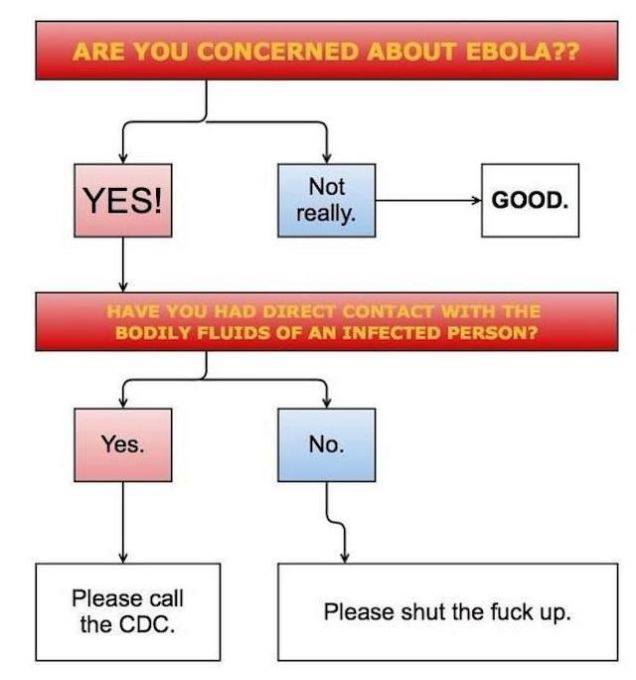
It spreads through close contact, with bodily fluids, mainly blood, as there is so much of it being splattered around via coughing, and bleeding out through eyes, ears, nose, mouth, arse and any other bodily orifices, including puncture sites from I.Vs and injection sites.
The fatality rate depends upon the strain, ebola quickly kills infected hosts but has a latent infectious host period. ebola zaire being the most deadly, ebola sudan is somewhat less lethal but still downright nasty, same goes for tai forest strain and the ugandan strain. There is a latent infection period of up to 20-something days during which the person shows no symptoms of infection but is still highly infectious.
Then there is the Reston strain, which was discovered first in a shipment of lab monkeys in an american bioscience facility. This does not kill humans, it does however, infect them. And worryingly, it is airborne. All it would take to create an airborne deadly strain of the virus would be for the two to infect a host at the same time and transfer some genes in the cells of the unfortunate host, that would result in the birth of a hybrid between the infecting deadly strain, zaire, sudan, tai forest etc. and ebola reston.
Interestingly, it is thought that reston may represent an asian filovirus population, whereas the other known strains of ebola, and of marburg virus are known to be african in origin, zoonotic viruses meaning they have an animal reservoir, in the case of ebola, it is bats. Possibly other animals as well but the primary host appears to be bats. I'm not certain about marburg but there have been cases where visitors to kitum cave in kenya contracted marburg, some fatal cases. Again, whilst the marburg virus hasn't afaik been isolated from kitum, it has been found in ugandan fruit bats.
One wonders, what other such nasties may be around in asia, if there is one, nonlethal strain of ebola present, are there more dangerous strains around, or other filoviruses unrelated to ebola and marburg, which thus far are the only two known species in the genus.