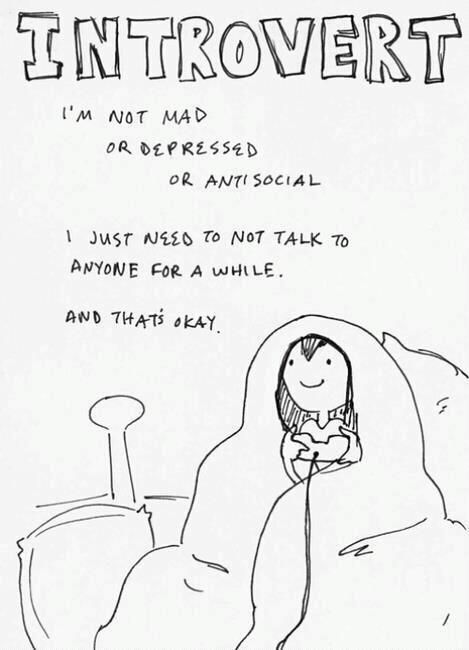
This has been done before, long past but I could not find it in the archives so take from that its been "pruned" (mod-talk) thats for it's been binned 
Let's do it again with all our new people, lovers and friends! Lets find out a bit of what makes each of us tick, tock or not together %)

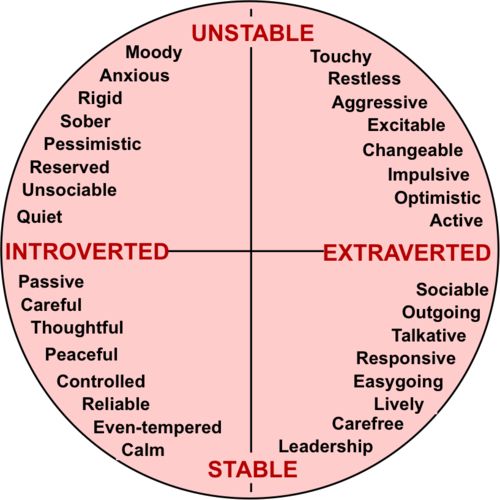

http://psychologytoday.tests.psychtests.com/take_test.php?idRegTest=1311
Extraversion and introversion
Extraversion and introversion are two key personality traits that are often considered major dimensions of personality. It is important to note that these are not either/or distinctions. In other words, you are not necessarily an extravert or an introvert. Instead, your individual personality lies at some point on the continuum between the two extremes.
OK. Most of that is pretty boring, but tell us a bit about what you think you are?
Are you:
1: INTROVERT
2. EXTROVERT
GO!
Let's do it again with all our new people, lovers and friends! Lets find out a bit of what makes each of us tick, tock or not together %)
NSFW:
http://psychologytoday.tests.psychtests.com/take_test.php?idRegTest=1311
Extraversion and introversion
Extraversion and introversion are two key personality traits that are often considered major dimensions of personality. It is important to note that these are not either/or distinctions. In other words, you are not necessarily an extravert or an introvert. Instead, your individual personality lies at some point on the continuum between the two extremes.
NSFW:
The trait of extraversion–introversion is a central dimension of human personality theories. The terms introversion and extraversion were popularized by Carl Jung,[1] although both the popular understanding and psychological usage differ from his original intent. Extraversion tends to be manifested in outgoing, talkative, energetic behavior, whereas introversion is manifested in more reserved and solitary behavior.[2] Virtually all comprehensive models of personality include these concepts in various forms. Examples include the Big Five model, Jung's analytical psychology, Hans Eysenck's three-factor model, Raymond Cattell's 16 personality factors, the Minnesota Multiphasic Personality Inventory, and the Myers–Briggs Type Indicator.
Extraversion and introversion are typically viewed as a single continuum. So, to be high in one necessitates being low in the other. Carl Jung and the authors of the Myers–Briggs provide a different perspective and suggest that everyone has both an extraverted side and an introverted side, with one being more dominant than the other. Rather than focusing on interpersonal behavior, however, Jung defined introversion as an "attitude-type characterised by orientation in life through subjective psychic contents" (focus on one's inner psychic activity); and extraversion as "an attitude type characterised by concentration of interest on the external object" (the outside world).[3]
Extraversion and introversion are typically viewed as a single continuum. So, to be high in one necessitates being low in the other. Carl Jung and the authors of the Myers–Briggs provide a different perspective and suggest that everyone has both an extraverted side and an introverted side, with one being more dominant than the other. Rather than focusing on interpersonal behavior, however, Jung defined introversion as an "attitude-type characterised by orientation in life through subjective psychic contents" (focus on one's inner psychic activity); and extraversion as "an attitude type characterised by concentration of interest on the external object" (the outside world).[3]
OK. Most of that is pretty boring, but tell us a bit about what you think you are?
- Add tests, don't
- Piss on my sandals or not
- Sit quietly or be the heart of the party, then swap....
- Tell us who you are and why?
Are you:
1: INTROVERT
2. EXTROVERT
GO!




 )
)