• Psychedelic Drugs Welcome Guest
    View threads about
    Posting RulesBluelight Rules
    PD's Best Threads Index
    Social ThreadSupport Bluelight
    Psychedelic Beginner's FAQ
  • PD Moderators: Esperighanto | JackARoe |

DMT <-> Other Psychedelics

shamus

Bluelighter
Joined
Jun 29, 2007
Messages
212
It's been a while since I've actively researched psychedelics so excuse the ignorance.


Typically speaking; psychedelic experiences are mediated by 5HT2A
dissociative experiences are mediated by NMDA
either can throw you into a schizoid-like state, along with CB1


With LSD for example, one can produce a dissociative-like experience. Is this due to its affinity to glutamate receptors? Or an emergent phenomena of the psychological effects that the psychedelic experience produces?

Ketamine boasts a somewhat psychedelic experience, although I guess this has more to do with the lack of sensory input leaving you only to your imagination.

& then there's DMT. A quick wikipedia search yielded affinities to several 5HT receptors, including 2A, yet I don't know anybody who would compare the DMT experience to your typical psychedelic experience.

Questions:
1) Why? What makes DMT so different, qualitatively speaking
2) Do other tryptamines carry similar effects? What do we know about those? (e.g. psylocycin is a trypt, yet it's feels like more of a phenythlamine trip? maybe? i dunno, it's been too long)
3) I'm no good with chemistry. Could somebody please explain SARs with respect to tryptamines, phenythlamines, 5HT & other relevant receptors.
4) Dissociation. I doubt it's entirely dependant on glutamate antagonism. What's an explanation of, for example, LSD-induced dissociation?

Come to think of it, I'm not so sure how LSD relates to these chemical groups. What is it most similar to?


Thanks peeps

 
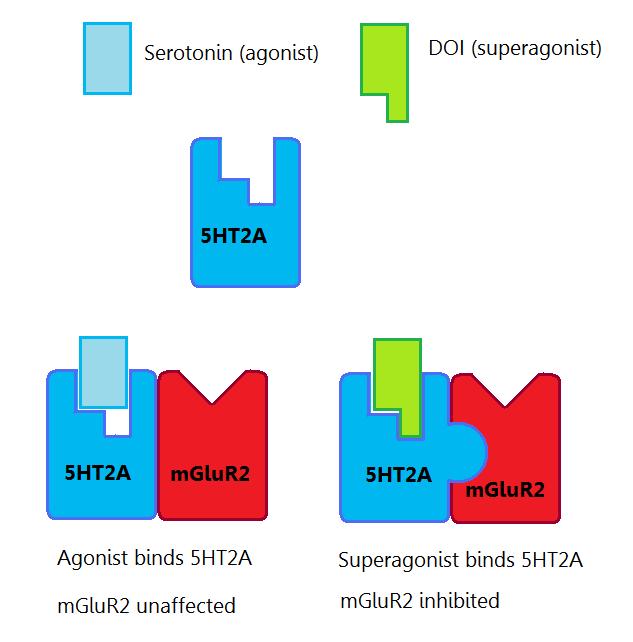
CB1 receptors inhibit the activity of postsynaptic GABA and glutamate neurons. 5-HT2A receptors are complexed with certain glutamate receptors and can inhibit them when activated with certain ligands (but not 5-HT). NMDA antagonists block a kind of glutamate receptor (NMDA). I'm guessing that their actions overlap on some glutamatergic pathways involved in mind-body association and visual perception.

khonDF9.jpg


DMT is a 1A agonist, as is I believe LSD. That might have something to do with their seemingly unique effects. Besides that, its high potency and short duration of action probably contribute to its seeming differentness.

The common structure among 5-HT2A agonists is the indole bit, or something with a similar electronic structure. Even though LSD isn't really chemically related to tryptamines, they both have that structure.

DWU6ewn.png
xzJCmXs.png


If you look along the bottom right side of LSD, you will also see an embedded 2 carbon chain ending in an amine. The entire structure of DMT is essentially embedded in LSD.

Phenethylamine psychedelics tend to also be sitmulants, while tryptamines do not.
 
Last edited:
This ain't really advanced discussion. ADD--->PD

Typically speaking; psychedelic experiences are mediated by 5HT2A
dissociative experiences are mediated by NMDA
either can throw you into a schizoid-like state, along with CB1

these are generalizations of the worst sort (being technically correct.)

What textbooks call "dissociative anesthetics" actually have little to do with the mental/emotional concept of "dissociation". For instance, a lot of people have problems with dissociation/depersonalization smoking cannabis, and THC/CBD/cannabinoids are, relatively speaking, much more active at cannabinoid receptors than at NMDA-type glutamate R's (if they're even active there at all!). The fact that a drug produces dissociation is not neccesarily indicative that it's active at NMDAr....

My personal opinion is that the dissociation from cannabis/psychedelics is a mental response to a sensory overload. The "dissociation" from dissociatives is more of a ... mental anesthesia? Like your sensory information is going to a black hole, but not as a mental defense, rather because the drug is effective at disabling glutaminergic transmission.

DMT and most simple tryptamines are pretty nonselective for serotonin and certain other receptors (sigma R's, adrenergic R's) and as such produce a powerfully immersive experience. Most of the 4-hydroxy-T's and PEA's, however, are slightly more slective towards 5ht2a/b/c, which are considered to be the receptors mostly responsible for the psychological f/x. In addtion some drugs have affinity for 5ht1 receptors. This explains a good protion of the diversity in psychedelic effects.

Route of administration and how quickly the cmpd reaches the brain also plays a role in the effects. Most people will tell you an oral DMT experience is much different than smoking DMT.

To answer your Q's -
1. DMT (like every other drug) is unique because it's not any other drug (sorry for being a smartass). But seriously, DMT is very close to serotonin, and is a very simple chemical... it hits a wide variety of receptors as a result. The fact that it's commonly administered either in large bolus doses or combined with a MAOI also adds to the intensity.
2. Yes, other tryptamines are hallucinogens. They're a varied bunch though - see TiHKAL for more info.
3. This is thoroughly beyond the scope of one post on a forum. A good starting point is reading PiHKAL and TiHKAL, and maybe also papers like this. And PubMed.
4. See above.

5(?). LSD is known as an ergoloid. Structurally it is related to both the tryptamines and phenethylamines, but the ergoloid srtructure is extra-special because it just so happens to fit the active conformation of the serotonin receptors really, really well. Other ergoloids are known, e.g. AL-LAD, LSA (morning glory/HBWR) etc. but LSD is pretty much the gold standard.

If you look along the bottom right side of LSD, you will also see an embedded 2 carbon chain ending in an amine. The entire structure of DMT is essentially embedded in LSD.

This is no more than an interesting curio. Doesn't mean anything in the chemical sense. LSD also contains the whole structure of meth in it, but...

Phenethylamine psychedelics tend to also be sitmulants, while tryptamines do not.

Broad generalization. AMT is a tryptamine stimulant. 2c-c and mescaline are considered to be (almost) sedating.
 
This is no more than an interesting curio. Doesn't mean anything in the chemical sense. LSD also contains the whole structure of meth in it, but...

Well it has the similar structure on an exposed portion of the molecule. The embedded meth structure is internal. I was just giving an example of an embedded indole.

Broad generalization.

Well yeah, I said "tend to be." ;)

Also I found this thread doing a search. It discusses stuff in this area.
 
Top