




Allylbenzene
Bluelighter
- Joined
- Jul 25, 2025
- Messages
- 1,439
This is for anyone looking for OTC access to cannabis without relying on the unregulated canna market, the regulated canna market (prescriptions, dispensaries) or growing it yourself (which is worth doing at least once).
This idea was originally intended as an alternative to legal UK medical flower which is generally contaminated. UK patients spend their money on substandard products without realising the contamination issues.
... so ... enter the DIY option.
I found it was safer & cheaper to buy outdoor CBG/CBD flower, choose my terpenes via pure stream-distilled essential oils (100's available) and make my own THC via CBD isolate + concentrated lemon juice. Lemon juice is food-grade, citric acid does the conversion job very well (see isomerisation) and CBD isolate is cheap & OTC.
There's the added benefit of being able to fully customise the theraputic effects depending on what's needed. Basically you can "make" a strain in 5 mins based on your needs instead of relying on a dispensary menu or what the street market has on offer ... aka a custom terpene profile and custom THC:CBD:CBG ratios.
Eg...
....for Sativa-style energising vibes choose pine, lemon, eucalyptus, pink pepper oils (pinene, limonene, cineole, phellandrene) + diy THC + CBG/CBD flower (optional).
For psychedelic effects add Lemon myrtle oil (95%+ citral which hits the psychedelic 5-HT2A serotonin receptor).
...for Indica-style mellow vibes choose lavender, hop, chamomile oils (linalool, humulene, myrcene, caryophyllene, bisabolol) + diy THC + CBG/CBD flower (optional).
An alternative to lavender is 'ho wood' oil which is conveniently 97%+ linalool.
The 100's of essential oils out there give access to the majority of botanical terpenoids and their theraputic effects. Ideally choose stream-distilled theraputic grade oils. Never use them pure or undiluted and keep doses reasonably low.
This idea was originally intended as an alternative to legal UK medical flower which is generally contaminated. UK patients spend their money on substandard products without realising the contamination issues.
UK flower is usually irradiated which causes the loss (degradation) of fragile terpenes & cannabinoids. This lowers the theraputic value of the flower and means that the THC/terpene numbers on the packaging don't necessarily match what's in the flower. The degradation process creates unknown break-down products (with unknown toxicity) that get inhaled by the patient.
The irradiation itself is used to kill any mold or fungus on the flower. This is good...but it leaves behind any mycotoxins produced by the mold/fungus which end up in the final product (mycotoxins are toxins produced by molds). Inhaling mycotoxins is problematic, especially for patients with pre-existing health issues.
Aside from irradiation it's pretty common for companies to use herbicides, pesticides and fungicides as long as they meet the "maximum residue limits" in the final product... There's little transparency or a 'certificate of analysis' which tells UK patients exactly what contaminants are in their medicine.
Here's an overview of irradiation as it applies to cannabis:
The irradiation itself is used to kill any mold or fungus on the flower. This is good...but it leaves behind any mycotoxins produced by the mold/fungus which end up in the final product (mycotoxins are toxins produced by molds). Inhaling mycotoxins is problematic, especially for patients with pre-existing health issues.
Aside from irradiation it's pretty common for companies to use herbicides, pesticides and fungicides as long as they meet the "maximum residue limits" in the final product... There's little transparency or a 'certificate of analysis' which tells UK patients exactly what contaminants are in their medicine.
Here's an overview of irradiation as it applies to cannabis:
A critical issue with the use of gamma irradiation on medical cannabis is the significant absence of research on the radiolytic changes that occur during the process.
• Radiolysis - the chemical decomposition of materials caused by exposure to ionizing radiation
...
The radiolytic process can generate a range of chemical by-products, some of which may be toxic or carcinogenic. In the context of medical cannabis, these by-products could include altered cannabinoids, terpenes, and other phytochemicals. The exact nature and potential health impacts of these compounds remain largely unknown due to the lack of specific research.
...
Cannabis is often smoked or vaporized, which results in direct inhalation of any radiolytic by-products.
... so ... enter the DIY option.
I found it was safer & cheaper to buy outdoor CBG/CBD flower, choose my terpenes via pure stream-distilled essential oils (100's available) and make my own THC via CBD isolate + concentrated lemon juice. Lemon juice is food-grade, citric acid does the conversion job very well (see isomerisation) and CBD isolate is cheap & OTC.
There's the added benefit of being able to fully customise the theraputic effects depending on what's needed. Basically you can "make" a strain in 5 mins based on your needs instead of relying on a dispensary menu or what the street market has on offer ... aka a custom terpene profile and custom THC:CBD:CBG ratios.
Eg...
....for Sativa-style energising vibes choose pine, lemon, eucalyptus, pink pepper oils (pinene, limonene, cineole, phellandrene) + diy THC + CBG/CBD flower (optional).
For psychedelic effects add Lemon myrtle oil (95%+ citral which hits the psychedelic 5-HT2A serotonin receptor).
...for Indica-style mellow vibes choose lavender, hop, chamomile oils (linalool, humulene, myrcene, caryophyllene, bisabolol) + diy THC + CBG/CBD flower (optional).
An alternative to lavender is 'ho wood' oil which is conveniently 97%+ linalool.
Lemon, lime & orange have limomene-dominant terpene profiles (lemon is usually ~70%, lime ~40%, orange 90%+). Pine has a pinene-dominant profile ft alpha-pinene, beta-pinene, carene. The cineole terpene in eucalyptus oil is very potent, 1 drop is usually enough. Cineole is one of the signature haze terpenes.
The 100's of essential oils out there give access to the majority of botanical terpenoids and their theraputic effects. Ideally choose stream-distilled theraputic grade oils. Never use them pure or undiluted and keep doses reasonably low.
As for the CBD isolate + concentrated lemon juice mix, this image gives some context for what to expect:
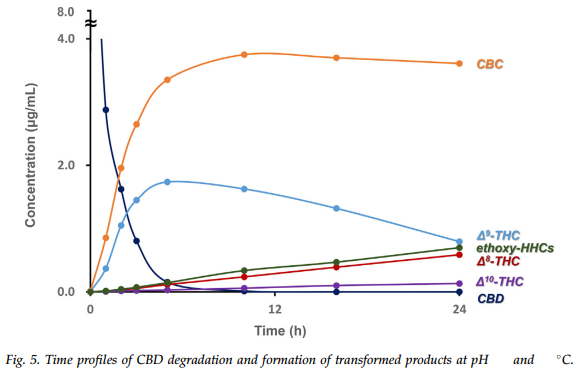
Depending on the conditions this might also produce CBC, D7, D9, D10, D11 & iso-THC, hydroxy derivatives of CBD & THC, and HHC derivatives.
Last edited:

