

[Posted this during the lost days of bluelight, I think, so I believe it is lost.... Reposting it now...]
My apologies for the length and rambliness of this... I find DiPT rather difficult to summarize. I've tried to keep things organized under section headings, to break up the rambles, and to give people an opportunity to skip the bits they're less interested in.
Please do let me know if anything needs fleshing out, or needn't have been included...
Dose, substance, route
I took 86 mg (+/- 1 mg) of DiPT, orally.
Circumstances
I took the DiPT alone in my flat at 10.15 pm on a Saturday evening, having been awake since 09.00 am and having spent a pleasant day with my girlfriend, and with no academic obligations for the following day, and the only interpersonal obligation being to see my girlfriend on the following day's evening at 7 pm.
These circumstances are my typical tripping circumstances at the moment: My girlfriend, though not entirely disapproving any more, isn't entirely comfortable with it; so trips are mostly confined to the only part of the week when typically I don't see her for almost 24 hours.
Expectations
I've taken DiPT a dozen times before, but not now for several months. Based on my previous experiences (70 mg takes me to level 3, 100 mg to level 4, as described in my summary of my DiPT experiences in the B&D DiPT thread; but your Hz/mg rate may vary : Xorkoth reports reaching level 4 on 50 mg) , I expected to experience a three-semitone perceived pitch lowering for a a few hours, accompanied by vocoding of voices, low-pass filtering, among other things; and I expected to experience a relatively brief peak within that, in which the distortions of pitch and timbre became more exotic and, in silence, elaborate closed ear audials manifested, accompanied by psychedelic cognition. I couldn't, however, recall how long it took to come up, and didn't have access to my notes on past trips to check.
I expected to be up for a while, at least six hours, and was prepared to spend most of the following day (up to 4 pm, if necessary) asleep.
My motivations for this trip were several: I wanted to reacquaint myself with DiPT-time (I prefer this phrase to DiPT-space because DiPT's primary distortions are best described as distortions of time - at the level of frequencies and frequency modulation - much as the distortions of other psychedelics are primarily, though not entirely, spatial in nature, I think) after a break of a few months; I wanted to test my perceived-pitch-measuring program and collect some initial quantitative data on the size, linearity and timecourse of the pitch-shift I had observed informally on previous occasions; I hoped the trip would also be fun, as it always has been before for me, and with psychedelic cognitive effects for a period at least; and I hoped that I would go outside for some of the trip.
Commentary
Just what I ordered
When you've reached a point where you pretty much know what to expect from a given substance, you might think that'd be a sign that you need a long break from it. But when your expectations are that you will delighted and astounded by it, well, I'm not about to stop my explorations of DiPT-time any time soon (barring as yet not noted unpleasant side-effects).
My expectations of the trip were fulfilled: I did indeed have a brief psychedelic, closed ear audials phase, nestled within a longer period of mild psychedelia and full inharmonic distortion, resting on a gentle hill of partial inharmonic distortion. It was indeed fun, and I collected a fair amount of data on the pitch-shift at various points in the trip. (The only thing I hoped to achieve but did not, was to go outside: the rainy dark saturday night city streets didn't appeal.) But I also noticed a few things I'd never previously noticed before...
Some surprises
High pitch noise flutter
At around t + 1.45, when I was at around level 1, I caught the narrow-band high-frequency noise in the act of switching on. This is described by Xorkoth in his DiPT trip report as happening at t + 0.30 on his 50 mg dose, thus:
Early pitch instability
Pre-level 1 (i.e. no overall pitch distortion noted on the piano), at about t + 1.00, I noticed - while running experiment on myself - that pure tones had an unstable pitch. They wavered, with - it seemed - varying period, sometimes a fraction of a second, sometimes a second, in a frequency modulation of width about one semitone. This made the perceptual pitch judgments required by my experiment rather tricky. In contrast, from level 1 upwards the task felt quite easy: pitches were very clear to me (albeit shifted downwards from veridical), and the judgment was most of the time quite easy and satisfying to make.
It occurred to me at the time that this is like a temporal equivalent of the spatial waviness often noted on other psychedelics. It occurred to me later that this may be the same phenomenon as the vocoder (robot-voice) effects that develop later (levels 2-4) but at a lower frequency, and perhaps a different amplitude of frequency modulation. I believe a slow FM would produce this sort of pitch instability, whereas a fast FM could produce more vocoder like effects, but with stable pitch. (Perhaps the later fast FM, with its accompanying clarity of - albeit distorted - pitch, is equivalent to the bright shiny visual clarity sometimes reported on, at least, LSD and the 2C-xs.)
I didn't notice this pitch instability effect on piano tones, but I didn't spend that much time at the piano.
Melodic contextual effects on perceived pitch
These were noted, throughout the trip, from at least the point pre-level 1 (which suggests my level numbering system is a bit crap Level 0, perhaps, or Level 0.5? ) when pitch instability was first noted, up until when I went to sleep. It took me a while to get my head round how they could be described.
I first experienced it as my chromatic scale ceasing to be chromatic: there were perceived whole-tone intervals between adjacent objective semitones. I then noted down the perceived pitches of a series of consecutive notes on the chromatic scale, which I reproduce below. The number represents the objective frequency, with a unit change in the number equalling one semitone; so 1 might be D, objectively, 2 Eb, 3 E, and 4 F, say. The letters give my perception of the pitch of the tones...
1 C
2 D
3 Eb
2 Db
3 Eb
4 E
3 D
2 Db
3 Eb
2 Db
1 C
As you can see (and as I couldn't see until I looked at my notes on this the following day) each objective frequency had two perceived pitches associated with it, e.g. 2 could be D or Db. And, when approached from below, it was always the higher of the two pitches; and when approached from above, it was always the lower.
I did not assess the effect of approaching a note by a larger leap than a semitone.
This effect was not noted at frequencies above 1760 Hz, but was noted at 440 Hz. At 220 Hz pitch perception became less clear and easy, so it's hard to be sure, but I think this effect may grow and change at those sorts of frequencies.
This effect was noted still, 24 hours after dosing, despite the absence of any other auditory effects. This led me to doubt its DiPT-relatedness, and consider attributing it to a software error. However, after four days, the effect was gone. I'm still not sure about it, but I now suspect it is DiPT-related. If so, this is an extraordinary effect, seeming - as it does - to modify perceived pitch differently depending on non-simultaneous context. I'll check this effect out again on my next DiPT trip.
Notch filter
Something I think others have mentioned, but I've never noticed before: higher pitches were more distinct, in addition to the low-pass deepness of lower sounds. I could perceive much more clearly the descant line in Mansun's Butterfly and the higher piano line in Tears for Fears' Mad World (this was noted at t+5.45, but may have been present earlier). Middle-frequency sounds were suppressed in favour of bass and high treble sounds. The suppression of middle-frequency sounds I did note during both the early and the later parts of the trip, but not during levels 3 or 4, and perhaps not level 2 either.
The sound of music
I do suspect that DiPT is doing something directly comparable to the visual effects of, say, 4-HO-DMT, but mapped onto the auditory cortex. The twanging FM effects, giving - at peak - all sound a sort of robotized fatness seem like the reptilian podginess that textured surfaces (faces, especially) sometimes adopt on 4-HO-DMT for me. The metallic sheen of some higher frequency sounds seems like the bright rainbowish qualities less textured (or more finely textured = high spatial frequency) surfaces can have on 4-HO-DMT.
Does music sound good on DiPT? I think it does, as much as paintings look good on 4-HO-DMT. In other words, some music sounds fantastic alien beautiful glorious; and some sounds ugly, grey, lifeless. Specifically, during this trip I'd say the music that DiP'd well was generally more high pitched, slower, hi-fidelity (no grungy guitars, please!). Pavement no, Air yes. Arcade Fire no, Pet Shop Boys, yes. Oddly, ABBA's Dancing Queen sounded almost unaltered, even during peak auditory effects.
Thoughts on disappointment, dosage, and choice of music
Of course, it may just be a matter of taste; but I do wonder if those who are disappointed with or not interested in DiPT's auditory effects on music, or even those who find them interesting but not beautiful, may be taking an insufficient dose of DiPT to elicit the more satisfying auditory effects, and thus reaching only the level I was at at t+6.30, i.e. quite distorted enough to sound dissonant and wrong, but not distorted enough to sound beautiful and right in its own way. Or perhaps, in some cases, they are attempting music during effects too intense to allow music enjoyment (post-level 3). Or alternatively, or additionally, they may be listening to the wrong music: I certainly found that some music was enhanced, and some impoverished, by the levels 2 to 3 auditory effects. (I don't mean to encourage recklessly high doses, of course; I'm just speculating as to whether there are reasons beyond personal taste that could explain the varied aesthetic response to DiP'd music.)
Timecourse of effects, by modality
Auditory effects
I have, as I mentioned, quantitative psychophysical data on my pitch perception during this trip, which I will summarize at the end of this report. The following is based on my subjective reports of my perception in my trip notes...
t+0.15 to 6.30 (? not beyond 12.00) Enhanced higher frequencies
t+0.35 to 6.30 (? not beyond 12.00) Suppressed middle frequencies
t+0.55 to 6.30 (? not beyond 12.00) Contextual effects on perceived pitch
t+0.55 to 1.30 Slow (enough for the wobble to be perceptible) frequency modulation, width 1 semitone
t+1.15 to 6.30 (? not beyond 12.00) Enhanced lower frequencies: voices sound deeper
t+1.30 to 6.30 (? not beyond 12.00) One semitone drop in perceived pitch
t+1.45 to 2.10 Fluttering on and off high pitched narrow band noise
t+2.05 to 6.00 Two semitone drop in perceived pitch, nonlinearly enough that music is sounding dissonant
t+2.10 to 6.00 Constant high pitched noise
t+2.10 to 2.45 Closed ear audials: Not constantly present, but appearing briefly, shards of complex chords and sequences and colourful fringes of sound appearing from behind or at the edges of the 'silence' (i.e. the background high pitched noise)
t+2.30 (? exact time unknown) to 5.30 Three semitone drop in perceived pitch, and dissonance is no longer present, because everything is fully distorted: music is consonant again, by its new DiPT-imposed rules of consonance. Different sounds are affected differently: deepers sounds have a vibrant textured reptilian twang to them, and higher sounds more a luscious alien sheen. Individual inharmonic harmonics are individually and exquisitely sensed, particularly in long relatively high pitched chords.
Cognitive effects
t+1.45 to t+4.00 Cognitive psychedelia was present in a mild and controllable way
t+2.00 to t+3.45 More intense, and semi-controllable psychedelia
t+2.10 to t+2.45 Unavoidable psychedelia
My apologies for the lack of anything beyond how intense it was: I didn't take notes during the brief period of more intense psychedelia, and cannot recall the nature of the cognitive effects.
Visual effects
t+1.05 to 3.45 Mild visual effects: slight light flickering, enhanced textures
t+2.00 to 3.50 Increased, but still mild, visual effects: slight tracers, colourful blips of light
Somatic effects
t+0.15 First alerts: mild warm rushes, pleasant breathing
t+1.15 to 2.30 Mild occasional pre-nauseous feelings, mild body buzz, essentially pleasant
t+2.00 to 2.45 Psychedelically stimulated, restless, lively, but no jitters at any stage
t+2.20 to 2.45 Enhancement of erotic sensation noted and explored
All effects, in chronological order
t+/-0.00 86 mg DiPT taken orally.
t+0.15 Pleasant mild warm rushes, and pleasure in breathing, much like I would experience around this point after taking 4-HO-DMT. Telephone ring sounded slightly higher pitched (or rather higher harmonics were more prominent), but no other auditory effects noted.
t+0.35 Mid-range frequency suppression begins.
t+0.55 Slow frequency modulation of pure tones, width 1 semitone. Contextual effects on pitch start.
t+1.05 Visual effects begin: slight light flickering, and enhanced textural appearance of, for example, duvet.
t+1.10 Music (specifically Klaxons' Atlantis to Interzone) starts to sound undefinably odd.
t+1.15 Own voice sounds deeper: suspected low-pass. Mild pre-nausea, and body buzz starts to develop, but no jitters.
t+1.30 1 semitone subjective downward shift in pitch noted on the piano.
t+1.45 Mild psychedelia, controllable. High-frequency noise starts to appear in silence, fluttering on and off.
t+2.00 Increase in psychedelia, it is no longer easily controllable. Air's Cherry Blossom Girl is sounding very strange and wonderful (I should note, though, that - on relistening to it the following day - I realized that that song, and much of the album, is pre-DiPTified already; not that DiPT doesn't alter it, but it is quite DiPT-like in many respects at any time... Run, also by Air, even more so, with its distorted voices and atonal rich bell-like sounds... not a perfect replica of the DiPT distortions, but from the same family, I'd say, with added hints of 2C-E-like auditory temporal choppiness... ).
t+2.05 In silence, fluttering noise is more pronounced, and appears to be both attentionally modulated and affected by head position. Quite psychedelically stimulated. Two semitone downward shift around now.
t+2.10 Nausea is at its worst at this point, but still quite mild if somewhat uncomfortable. Quite physically restless at this stage, but not jittery. It is at this point that DiPT wrestles me to the bed, and I lie down in the dark and near-silence.
t+2.10 --> t+2.45 This is the peak of the psychedelic cognitive effects, and is also when the closed ear audials peeked at me from behind the walls of silence. Occasional glimpses of rich and complex auditory sequences amid the dull high-pitched noise background, like the edges of a torn piece of paper dipped in rich blue inks.
Visual effects are present too: very slight tracers (temporal blurring of visual motion) and a strangely near-subliminal colour thing going on. Perhaps it's more that my visual system was joining in the perception of the mayhem going on in my auditory system, colouring the sounds; because it seemed more like I was hearing the colours than seeing them. They were located in auditory and not visual spacetime.
Unfortunately, I did not test my pitch perception very frequently during this time, and my data are not clean enough (I don't do the task perfectly consistently) to be sure, but the data seem to suggest I was at around 3 semitone lowering during this period.
t+3.00 I note at this point that, while complex tones are severely distorted in timbre (a rich textured metallic depth to everything), pure (sine) tones seem distorted not a jot (as regards timbre). Psychedelic cognition is still present, though perhaps at a slightly lower plateau than the peak. Trip report notes are not plentiful during this period, and details of this cannot easily be recalled.
t+3.05 Psychedelia is at a partly controllable level, low enough that I can and do consider going out in to the streets of my city; but not low enough, perhaps, that I feel comfortable enough to actually do so. Visual effects (in the form of odd blips of coloured light) are present.
t+3.45 Controllable psychedelia: the take it or leave it level. Auditory effects in nonsilence are still strongly present.
t+4.00 Closer still to baseline, psychedelically. Auditory effects still high and constant.
t+4.15 At this stage, I felt quite baseline, but wondered whether I could still lose myself in psychedelia should I give myself the chance by lying down quietly (I didn't test this immediately).
t+4.30 Vocoding on voices is still prominent.
t+5.00 Tried lying down in silence, and it became evident that the time of psychedelic cognition and interesting closed ear audials had passed: only a constant high pitched noise band present, quietly and undistractingly, but also lacking in hidden beauties.
t+5.10 Voices still completely vocoded. Music still enjoyably altered.
t+5.30 Still at the auditory level of full harmonic stretching, enjoying Tears for Fears' Mad World, and Pet Shop Boys' Suburbia, but not enjoying OMD's Call my Name, or Suede. Higher voices, though, have lost vocoding. Portishead's Half Day Closing is lovely, but not much altered. The notch is still noticeably present, making higher pitched passages more clearly perceptible than usual.
t+6.00 Vocoding reduced, but present in lower sounds.
t+6.20 Not ready for sleep, but desiring it.
t+6.30 Auditory distortion is reduced such that lower sounds and higher sounds within music sound out of tune with each other, and the notch filter is present to an extent, but the more complex timbral effects are barely present now. The result is that very little music sounds any good; that which does does so despite the DiPT, not because of it. There is some slight vocoding in deeper voices still, though.
t+7.15 Slept
t+12.45 Awoke, with slight headache. Piano seems to be normal or at most 0.5 semitone down.
t+15.00 Auditory perception seems, subjectively, 100% normal. No high pitched noise remaining, and no pitch shift. Headache has passed, and I feel fine.
Experience
I've taken DiPT a dozen or so times before at between 60 and 100 mg oral doses. Previous experience with other psychedelics (including a few debatable psychedelics) includes:
MDMC (more than a dozen times, at doses mostly between 180 mg and 240 mg),
MDMA (perhaps three times a long time ago, at 120 mg to 150 mg doses, I'd guess, and more recently one 80 mg dose),
2C-B (twice at 25 mg, once at c. 15 mg),
2C-C (once at 36 mg),
2C-E (half a dozen times, at 18 to 25 mg),
LSA (once, unknown low dose from perhaps 6 HBWR seeds, iirc)
LSD (a few times, a long time ago, mostly fairly low - but not precisely known - doses),
4-HO-DMT and 4-PO DMT (both in the form of mushrooms, at a wide range of not precisely known doses, on many occasions, ranging from threshhold to intense trips),
4-AcO-DMT (four occasions, ranging from 10 mg to 30 mg),
pFPP (one occasion, 60 mg),
Salvinorin A (in the form of smoked Salvia divinorum perhaps a dozen times, range of not very precise doses, from threshold to intense in effects),
THC (in the form of smoked cannabis, innumerable times, wide range of doses).
What else passed my lips that day?
Food: 1 pizza, at t - 4.00. Prior to that, at t - 9.00, 1 egg and two slices of toast, and at t - 12.00 a bowl of cereal.
Other drugs taken: caffeine (in the form of tea and coffee) during the day, but at a reduced level (none in the three hours before dosing); nicotine (in the form of smoked cigarettes) during the day (perhaps 10 roll-ups). Tobacco and cannabis were smoked regularly throughout the DiPT trip. I'm fairly confident cannabis did not greatly modulate the DiPT effects, based on similarity to my previous often-cannabis-lacking DiPT trips.
What other drugs had I used recently?
Most recent was 36 mg 2C-C 14 days before this trip. Prior to that, was a combination of 80 mg MDMA and 15 mg 2C-B oral, followed by an unknown (probably no more than 180 mg over an hour) quantity of insufflated methylone, 21 days prior to the current dose. No other psychedelic, empathogenic, or stimulant use (other than cannabis, tobacco, and caffeine) in the past month.
Would I do this again?
Oh, inevitably. The auditory effects, both on music, and - at peak - in silence are a delight to behold every time. The general mental and physical buzz is positive and pleasant for me every time, thus far. The perceptual effects fascinate me, from an academic research point of view, and I am determined to map them out in as much rigorous detail as possible.
And I still haven't bloody gone outside during peak auditory effects. Next time! Maybe!!
Quantitative data
I've now had a look at the quantitative data from this trip, and I'll give a brief summary of them here. (If anyone wants more details on how I analyzed the data or plan to analyze later data, let me know: these are fairly crude analyses, by the way... I'll use more sophisticated approaches when analyzing data from the experiment proper)
These are just pilot data: I was just trying out the simple pitch-judgment program I've made while under DiPT to check if it was sensitive to DiPT's auditory effects... It seemed possible that pure tones might not be affected like complex tones are, but it appears that they are. I found peak effects of a drop in perceived pitch of about three semitones, consistent with my previous informal observations. The timecourse of the pitch effects as measured by the task seems broadly consistent with the timecourse I perceived.
The task
For each experimental session, I did twelve trials. In each trial, the program asked me to produce a randomly selected pitch (say, F sharp), and a pure tone started playing. I had to adjust a slider to change the pure tone's pitch until I thought it was the desired pitch (F sharp in this case). I then pressed a button, and the program recorded my response, and the size of my error (if any) from the desired pitch, in semitones. So if I moved the slider so it was playing a G sharp, because I thought the G sharp sounded like an F sharp, it would record my error as -2, because I perceived the G sharp as being 2 semitones below its objective pitch.
Before each trial, it played a random sequence of different pitches. The idea of this was to mask any previous pitch, and so make each judgment independent of the others. It's not invariably effective at masking, and I shall seek out a better masking stimulus for the experiments proper.
Results
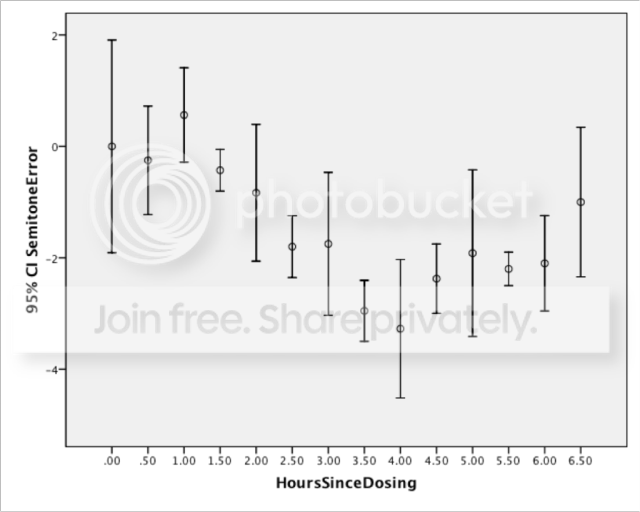
My performance was by no means perfect. At any given point in the trip, I would have different errors across different trials within each session; sometimes more variation, sometimes less, but always some. Nonetheless, this raw data, displayed below as the mean pitch error within each half hour, shows clearly that, for a period during the trip, my perceived pitch shifted below normal/objective.
On the vertical axis, lower points mean that I perceived sounds as lower than they really were (as evidenced by me producing an objectively too high sound in the task). The horizontal axis is time since dosing...
To clean up the data and get a clearer idea of the perceived pitch at each point, I trimmed extreme data points on a session by session basis, on an ultra-strict outlier exclusion criterion. I then took the mean for each session, thus producing a central tendency measure partway between a mean and a median of the raw data. This measure retains some of the mean's nuance, while avoiding being affected by extreme data points, by taking the mean only of the observations within one interquartile range of the median.
Each green dot in the graph, below, is the trimmed mean of one session. As you can see, during the steepest part of the graph, I did relatively few sessions (this coincided with the peak cognitive psychedelic effects), so we don't have a very clear picture of that period. However, there is a clear peak and subsidence (though not quite all the way to baseline before I fell asleep) of the effects, with the peak being a drop of about 3 semitones, which concurs with my previous subjective observations.
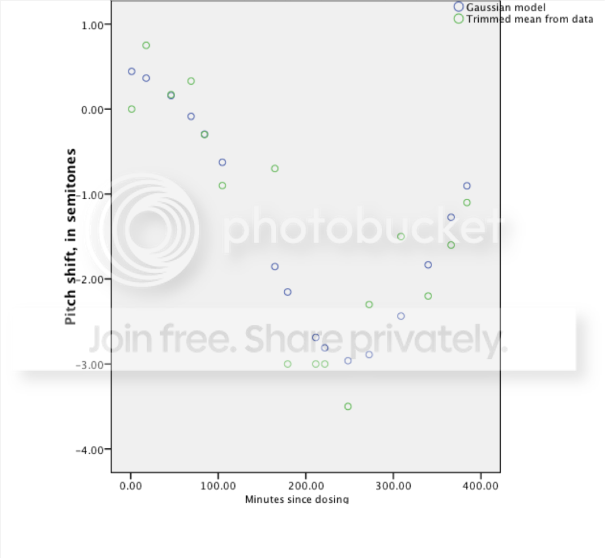
I modeled the relationship between time since dosing and pitch shift by fitting a gaussian to it. The blue dots in the above graph are the predictions of that model. On a whim, I phrased the regression in terms more psychologically than statistically relevant (the coming-up time parameter is really the mean, i.e. the peak time, minus one standard deviation). The estimates of the parameters (with standard errors and 95% confidence intervals) were as follows:
Time of peak after dosing: 4 hours 12 minutes (SE = 11 minutes, CI = 3 hours 48 minutes --> 4 hours 35 minutes)
Peak error in pitch perception, relative to baseline: -3.6 semitones (SE = 0.6 semitones, CI = -4.9 semitones --> -2.3 semitones)
Coming up time after dosing: 2 hours 31 minutes (SE = 27 minutes, CI = 1 hour 32 minutes --> 3 hours 30 minutes)
Baseline error in pitch perception, relative to objective: +0.6 semitones (SE = 0.6 semitones, CI = -0.8 semitones --> +2.0 semitones)
Again, the lack of data from the coming-up phase is reflected in the large confidence interval (i.e. high uncertainty) for the parameter that indicates the time of that phase. However, overall the model explains over 80% of the variance in the data and looks a pretty good fit, really; and it predicted the data with a significance level of p=0.000001.
So this task seems to provide a simple set of psychologically relevant quantitative measures that can be used to investigate dose-response relationships in DiPT, and indicates that (in me at least; I've yet to have anyone send me results from running my test program, so I don't yet know whether the task will be doable by most other people) a meaningful estimate of perceived pitch can be obtained from the task. This task may, then, be able to serve as the basis and starting point for a range of tools for investigating various aspects of DiPT's auditory effects, such as its many effects on timbre, apparent appoggiatura effects, and the qualitative difference between its partial and full inharmonicity phases.
If it turns out that other people generally can't do this pitch-judgment task, I'll have to use other, more implicit measures. One that occurs to me, that may or may not be easier than absolute pitch judgment, is to play a familiar song (or snippet of a song) to a participant, with the pitch altered, and ask them to alter the pitch until it sounds right. This would, at least, not require knowledge of note names (or the ability to acquire that knowledge) or knowledge of the correct pitch of an unfamiliar pure tone. However, it would require that an absolute representation of the pitch of the song is possessed by the participant (I seem to recall a study that demonstrated people could do that, but I'll have to check), and it would have the disadvantage that a large range of frequencies would be being presented, so it'd be harder to get a handle on any nonlinearities in the pitch shift across frequencies. Another problem with this method is that participants on DiPT may be led by the low-pass filtering to compensate for that as well as or instead of the pitch effect, which could muddy the results.
A bit of data at higher and lower frequencies, which is too bitty to present, really, so I won't
All the data above were collected on pitches between middle A and the octave above (440 to 880 Hz). I did also collect some data at lower and higher frequencies, but not enough to say anything statistically about them. It seems like there might be some differences, but I'm not sure. I'll collect more data at these frequencies in my next DiPT trip (which I anticipate will be in the next week or two).
substancecode_dipt
My apologies for the length and rambliness of this... I find DiPT rather difficult to summarize. I've tried to keep things organized under section headings, to break up the rambles, and to give people an opportunity to skip the bits they're less interested in.
Please do let me know if anything needs fleshing out, or needn't have been included...
Dose, substance, route
I took 86 mg (+/- 1 mg) of DiPT, orally.
Circumstances
I took the DiPT alone in my flat at 10.15 pm on a Saturday evening, having been awake since 09.00 am and having spent a pleasant day with my girlfriend, and with no academic obligations for the following day, and the only interpersonal obligation being to see my girlfriend on the following day's evening at 7 pm.
These circumstances are my typical tripping circumstances at the moment: My girlfriend, though not entirely disapproving any more, isn't entirely comfortable with it; so trips are mostly confined to the only part of the week when typically I don't see her for almost 24 hours.
Expectations
I've taken DiPT a dozen times before, but not now for several months. Based on my previous experiences (70 mg takes me to level 3, 100 mg to level 4, as described in my summary of my DiPT experiences in the B&D DiPT thread; but your Hz/mg rate may vary : Xorkoth reports reaching level 4 on 50 mg) , I expected to experience a three-semitone perceived pitch lowering for a a few hours, accompanied by vocoding of voices, low-pass filtering, among other things; and I expected to experience a relatively brief peak within that, in which the distortions of pitch and timbre became more exotic and, in silence, elaborate closed ear audials manifested, accompanied by psychedelic cognition. I couldn't, however, recall how long it took to come up, and didn't have access to my notes on past trips to check.
I expected to be up for a while, at least six hours, and was prepared to spend most of the following day (up to 4 pm, if necessary) asleep.
My motivations for this trip were several: I wanted to reacquaint myself with DiPT-time (I prefer this phrase to DiPT-space because DiPT's primary distortions are best described as distortions of time - at the level of frequencies and frequency modulation - much as the distortions of other psychedelics are primarily, though not entirely, spatial in nature, I think) after a break of a few months; I wanted to test my perceived-pitch-measuring program and collect some initial quantitative data on the size, linearity and timecourse of the pitch-shift I had observed informally on previous occasions; I hoped the trip would also be fun, as it always has been before for me, and with psychedelic cognitive effects for a period at least; and I hoped that I would go outside for some of the trip.
Commentary
Just what I ordered
When you've reached a point where you pretty much know what to expect from a given substance, you might think that'd be a sign that you need a long break from it. But when your expectations are that you will delighted and astounded by it, well, I'm not about to stop my explorations of DiPT-time any time soon (barring as yet not noted unpleasant side-effects).
My expectations of the trip were fulfilled: I did indeed have a brief psychedelic, closed ear audials phase, nestled within a longer period of mild psychedelia and full inharmonic distortion, resting on a gentle hill of partial inharmonic distortion. It was indeed fun, and I collected a fair amount of data on the pitch-shift at various points in the trip. (The only thing I hoped to achieve but did not, was to go outside: the rainy dark saturday night city streets didn't appeal.) But I also noticed a few things I'd never previously noticed before...
Some surprises
High pitch noise flutter
At around t + 1.45, when I was at around level 1, I caught the narrow-band high-frequency noise in the act of switching on. This is described by Xorkoth in his DiPT trip report as happening at t + 0.30 on his 50 mg dose, thus:
Except that I couldn't swear to the sidedness of the percept, this describes my experience perfectly. The noise (later to become constant) was fluttering intermittently at this stage.Xorkoth said:It's as if there are extra channels opening up in my ears, strangely particularly my left one. Whenever I yawn or swallow, this channel gets blocked for a moment. It sounds like a soft TV static noise is coming through that channel right now. Also, twice now I've had my these channels switch on and off rapidly, in one ear then the other, as if my ears were drumming sixteenth notes, but with each drumstroke being that strange sound channel closing momentarily. Keep in mind this went on for less than a full second each time.
Early pitch instability
Pre-level 1 (i.e. no overall pitch distortion noted on the piano), at about t + 1.00, I noticed - while running experiment on myself - that pure tones had an unstable pitch. They wavered, with - it seemed - varying period, sometimes a fraction of a second, sometimes a second, in a frequency modulation of width about one semitone. This made the perceptual pitch judgments required by my experiment rather tricky. In contrast, from level 1 upwards the task felt quite easy: pitches were very clear to me (albeit shifted downwards from veridical), and the judgment was most of the time quite easy and satisfying to make.
It occurred to me at the time that this is like a temporal equivalent of the spatial waviness often noted on other psychedelics. It occurred to me later that this may be the same phenomenon as the vocoder (robot-voice) effects that develop later (levels 2-4) but at a lower frequency, and perhaps a different amplitude of frequency modulation. I believe a slow FM would produce this sort of pitch instability, whereas a fast FM could produce more vocoder like effects, but with stable pitch. (Perhaps the later fast FM, with its accompanying clarity of - albeit distorted - pitch, is equivalent to the bright shiny visual clarity sometimes reported on, at least, LSD and the 2C-xs.)
I didn't notice this pitch instability effect on piano tones, but I didn't spend that much time at the piano.
Melodic contextual effects on perceived pitch
These were noted, throughout the trip, from at least the point pre-level 1 (which suggests my level numbering system is a bit crap Level 0, perhaps, or Level 0.5? ) when pitch instability was first noted, up until when I went to sleep. It took me a while to get my head round how they could be described.
I first experienced it as my chromatic scale ceasing to be chromatic: there were perceived whole-tone intervals between adjacent objective semitones. I then noted down the perceived pitches of a series of consecutive notes on the chromatic scale, which I reproduce below. The number represents the objective frequency, with a unit change in the number equalling one semitone; so 1 might be D, objectively, 2 Eb, 3 E, and 4 F, say. The letters give my perception of the pitch of the tones...
1 C
2 D
3 Eb
2 Db
3 Eb
4 E
3 D
2 Db
3 Eb
2 Db
1 C
As you can see (and as I couldn't see until I looked at my notes on this the following day) each objective frequency had two perceived pitches associated with it, e.g. 2 could be D or Db. And, when approached from below, it was always the higher of the two pitches; and when approached from above, it was always the lower.
I did not assess the effect of approaching a note by a larger leap than a semitone.
This effect was not noted at frequencies above 1760 Hz, but was noted at 440 Hz. At 220 Hz pitch perception became less clear and easy, so it's hard to be sure, but I think this effect may grow and change at those sorts of frequencies.
This effect was noted still, 24 hours after dosing, despite the absence of any other auditory effects. This led me to doubt its DiPT-relatedness, and consider attributing it to a software error. However, after four days, the effect was gone. I'm still not sure about it, but I now suspect it is DiPT-related. If so, this is an extraordinary effect, seeming - as it does - to modify perceived pitch differently depending on non-simultaneous context. I'll check this effect out again on my next DiPT trip.
Notch filter
Something I think others have mentioned, but I've never noticed before: higher pitches were more distinct, in addition to the low-pass deepness of lower sounds. I could perceive much more clearly the descant line in Mansun's Butterfly and the higher piano line in Tears for Fears' Mad World (this was noted at t+5.45, but may have been present earlier). Middle-frequency sounds were suppressed in favour of bass and high treble sounds. The suppression of middle-frequency sounds I did note during both the early and the later parts of the trip, but not during levels 3 or 4, and perhaps not level 2 either.
The sound of music
I do suspect that DiPT is doing something directly comparable to the visual effects of, say, 4-HO-DMT, but mapped onto the auditory cortex. The twanging FM effects, giving - at peak - all sound a sort of robotized fatness seem like the reptilian podginess that textured surfaces (faces, especially) sometimes adopt on 4-HO-DMT for me. The metallic sheen of some higher frequency sounds seems like the bright rainbowish qualities less textured (or more finely textured = high spatial frequency) surfaces can have on 4-HO-DMT.
Does music sound good on DiPT? I think it does, as much as paintings look good on 4-HO-DMT. In other words, some music sounds fantastic alien beautiful glorious; and some sounds ugly, grey, lifeless. Specifically, during this trip I'd say the music that DiP'd well was generally more high pitched, slower, hi-fidelity (no grungy guitars, please!). Pavement no, Air yes. Arcade Fire no, Pet Shop Boys, yes. Oddly, ABBA's Dancing Queen sounded almost unaltered, even during peak auditory effects.
Thoughts on disappointment, dosage, and choice of music
Of course, it may just be a matter of taste; but I do wonder if those who are disappointed with or not interested in DiPT's auditory effects on music, or even those who find them interesting but not beautiful, may be taking an insufficient dose of DiPT to elicit the more satisfying auditory effects, and thus reaching only the level I was at at t+6.30, i.e. quite distorted enough to sound dissonant and wrong, but not distorted enough to sound beautiful and right in its own way. Or perhaps, in some cases, they are attempting music during effects too intense to allow music enjoyment (post-level 3). Or alternatively, or additionally, they may be listening to the wrong music: I certainly found that some music was enhanced, and some impoverished, by the levels 2 to 3 auditory effects. (I don't mean to encourage recklessly high doses, of course; I'm just speculating as to whether there are reasons beyond personal taste that could explain the varied aesthetic response to DiP'd music.)
Timecourse of effects, by modality
Auditory effects
I have, as I mentioned, quantitative psychophysical data on my pitch perception during this trip, which I will summarize at the end of this report. The following is based on my subjective reports of my perception in my trip notes...
t+0.15 to 6.30 (? not beyond 12.00) Enhanced higher frequencies
t+0.35 to 6.30 (? not beyond 12.00) Suppressed middle frequencies
t+0.55 to 6.30 (? not beyond 12.00) Contextual effects on perceived pitch
t+0.55 to 1.30 Slow (enough for the wobble to be perceptible) frequency modulation, width 1 semitone
t+1.15 to 6.30 (? not beyond 12.00) Enhanced lower frequencies: voices sound deeper
t+1.30 to 6.30 (? not beyond 12.00) One semitone drop in perceived pitch
t+1.45 to 2.10 Fluttering on and off high pitched narrow band noise
t+2.05 to 6.00 Two semitone drop in perceived pitch, nonlinearly enough that music is sounding dissonant
t+2.10 to 6.00 Constant high pitched noise
t+2.10 to 2.45 Closed ear audials: Not constantly present, but appearing briefly, shards of complex chords and sequences and colourful fringes of sound appearing from behind or at the edges of the 'silence' (i.e. the background high pitched noise)
t+2.30 (? exact time unknown) to 5.30 Three semitone drop in perceived pitch, and dissonance is no longer present, because everything is fully distorted: music is consonant again, by its new DiPT-imposed rules of consonance. Different sounds are affected differently: deepers sounds have a vibrant textured reptilian twang to them, and higher sounds more a luscious alien sheen. Individual inharmonic harmonics are individually and exquisitely sensed, particularly in long relatively high pitched chords.
Cognitive effects
t+1.45 to t+4.00 Cognitive psychedelia was present in a mild and controllable way
t+2.00 to t+3.45 More intense, and semi-controllable psychedelia
t+2.10 to t+2.45 Unavoidable psychedelia
My apologies for the lack of anything beyond how intense it was: I didn't take notes during the brief period of more intense psychedelia, and cannot recall the nature of the cognitive effects.
Visual effects
t+1.05 to 3.45 Mild visual effects: slight light flickering, enhanced textures
t+2.00 to 3.50 Increased, but still mild, visual effects: slight tracers, colourful blips of light
Somatic effects
t+0.15 First alerts: mild warm rushes, pleasant breathing
t+1.15 to 2.30 Mild occasional pre-nauseous feelings, mild body buzz, essentially pleasant
t+2.00 to 2.45 Psychedelically stimulated, restless, lively, but no jitters at any stage
t+2.20 to 2.45 Enhancement of erotic sensation noted and explored
All effects, in chronological order
t+/-0.00 86 mg DiPT taken orally.
t+0.15 Pleasant mild warm rushes, and pleasure in breathing, much like I would experience around this point after taking 4-HO-DMT. Telephone ring sounded slightly higher pitched (or rather higher harmonics were more prominent), but no other auditory effects noted.
t+0.35 Mid-range frequency suppression begins.
t+0.55 Slow frequency modulation of pure tones, width 1 semitone. Contextual effects on pitch start.
t+1.05 Visual effects begin: slight light flickering, and enhanced textural appearance of, for example, duvet.
t+1.10 Music (specifically Klaxons' Atlantis to Interzone) starts to sound undefinably odd.
t+1.15 Own voice sounds deeper: suspected low-pass. Mild pre-nausea, and body buzz starts to develop, but no jitters.
t+1.30 1 semitone subjective downward shift in pitch noted on the piano.
t+1.45 Mild psychedelia, controllable. High-frequency noise starts to appear in silence, fluttering on and off.
t+2.00 Increase in psychedelia, it is no longer easily controllable. Air's Cherry Blossom Girl is sounding very strange and wonderful (I should note, though, that - on relistening to it the following day - I realized that that song, and much of the album, is pre-DiPTified already; not that DiPT doesn't alter it, but it is quite DiPT-like in many respects at any time... Run, also by Air, even more so, with its distorted voices and atonal rich bell-like sounds... not a perfect replica of the DiPT distortions, but from the same family, I'd say, with added hints of 2C-E-like auditory temporal choppiness... ).
t+2.05 In silence, fluttering noise is more pronounced, and appears to be both attentionally modulated and affected by head position. Quite psychedelically stimulated. Two semitone downward shift around now.
t+2.10 Nausea is at its worst at this point, but still quite mild if somewhat uncomfortable. Quite physically restless at this stage, but not jittery. It is at this point that DiPT wrestles me to the bed, and I lie down in the dark and near-silence.
t+2.10 --> t+2.45 This is the peak of the psychedelic cognitive effects, and is also when the closed ear audials peeked at me from behind the walls of silence. Occasional glimpses of rich and complex auditory sequences amid the dull high-pitched noise background, like the edges of a torn piece of paper dipped in rich blue inks.
Visual effects are present too: very slight tracers (temporal blurring of visual motion) and a strangely near-subliminal colour thing going on. Perhaps it's more that my visual system was joining in the perception of the mayhem going on in my auditory system, colouring the sounds; because it seemed more like I was hearing the colours than seeing them. They were located in auditory and not visual spacetime.
Unfortunately, I did not test my pitch perception very frequently during this time, and my data are not clean enough (I don't do the task perfectly consistently) to be sure, but the data seem to suggest I was at around 3 semitone lowering during this period.
t+3.00 I note at this point that, while complex tones are severely distorted in timbre (a rich textured metallic depth to everything), pure (sine) tones seem distorted not a jot (as regards timbre). Psychedelic cognition is still present, though perhaps at a slightly lower plateau than the peak. Trip report notes are not plentiful during this period, and details of this cannot easily be recalled.
t+3.05 Psychedelia is at a partly controllable level, low enough that I can and do consider going out in to the streets of my city; but not low enough, perhaps, that I feel comfortable enough to actually do so. Visual effects (in the form of odd blips of coloured light) are present.
t+3.45 Controllable psychedelia: the take it or leave it level. Auditory effects in nonsilence are still strongly present.
t+4.00 Closer still to baseline, psychedelically. Auditory effects still high and constant.
t+4.15 At this stage, I felt quite baseline, but wondered whether I could still lose myself in psychedelia should I give myself the chance by lying down quietly (I didn't test this immediately).
t+4.30 Vocoding on voices is still prominent.
t+5.00 Tried lying down in silence, and it became evident that the time of psychedelic cognition and interesting closed ear audials had passed: only a constant high pitched noise band present, quietly and undistractingly, but also lacking in hidden beauties.
t+5.10 Voices still completely vocoded. Music still enjoyably altered.
t+5.30 Still at the auditory level of full harmonic stretching, enjoying Tears for Fears' Mad World, and Pet Shop Boys' Suburbia, but not enjoying OMD's Call my Name, or Suede. Higher voices, though, have lost vocoding. Portishead's Half Day Closing is lovely, but not much altered. The notch is still noticeably present, making higher pitched passages more clearly perceptible than usual.
t+6.00 Vocoding reduced, but present in lower sounds.
t+6.20 Not ready for sleep, but desiring it.
t+6.30 Auditory distortion is reduced such that lower sounds and higher sounds within music sound out of tune with each other, and the notch filter is present to an extent, but the more complex timbral effects are barely present now. The result is that very little music sounds any good; that which does does so despite the DiPT, not because of it. There is some slight vocoding in deeper voices still, though.
t+7.15 Slept
t+12.45 Awoke, with slight headache. Piano seems to be normal or at most 0.5 semitone down.
t+15.00 Auditory perception seems, subjectively, 100% normal. No high pitched noise remaining, and no pitch shift. Headache has passed, and I feel fine.
Experience
I've taken DiPT a dozen or so times before at between 60 and 100 mg oral doses. Previous experience with other psychedelics (including a few debatable psychedelics) includes:
MDMC (more than a dozen times, at doses mostly between 180 mg and 240 mg),
MDMA (perhaps three times a long time ago, at 120 mg to 150 mg doses, I'd guess, and more recently one 80 mg dose),
2C-B (twice at 25 mg, once at c. 15 mg),
2C-C (once at 36 mg),
2C-E (half a dozen times, at 18 to 25 mg),
LSA (once, unknown low dose from perhaps 6 HBWR seeds, iirc)
LSD (a few times, a long time ago, mostly fairly low - but not precisely known - doses),
4-HO-DMT and 4-PO DMT (both in the form of mushrooms, at a wide range of not precisely known doses, on many occasions, ranging from threshhold to intense trips),
4-AcO-DMT (four occasions, ranging from 10 mg to 30 mg),
pFPP (one occasion, 60 mg),
Salvinorin A (in the form of smoked Salvia divinorum perhaps a dozen times, range of not very precise doses, from threshold to intense in effects),
THC (in the form of smoked cannabis, innumerable times, wide range of doses).
What else passed my lips that day?
Food: 1 pizza, at t - 4.00. Prior to that, at t - 9.00, 1 egg and two slices of toast, and at t - 12.00 a bowl of cereal.
Other drugs taken: caffeine (in the form of tea and coffee) during the day, but at a reduced level (none in the three hours before dosing); nicotine (in the form of smoked cigarettes) during the day (perhaps 10 roll-ups). Tobacco and cannabis were smoked regularly throughout the DiPT trip. I'm fairly confident cannabis did not greatly modulate the DiPT effects, based on similarity to my previous often-cannabis-lacking DiPT trips.
What other drugs had I used recently?
Most recent was 36 mg 2C-C 14 days before this trip. Prior to that, was a combination of 80 mg MDMA and 15 mg 2C-B oral, followed by an unknown (probably no more than 180 mg over an hour) quantity of insufflated methylone, 21 days prior to the current dose. No other psychedelic, empathogenic, or stimulant use (other than cannabis, tobacco, and caffeine) in the past month.
Would I do this again?
Oh, inevitably. The auditory effects, both on music, and - at peak - in silence are a delight to behold every time. The general mental and physical buzz is positive and pleasant for me every time, thus far. The perceptual effects fascinate me, from an academic research point of view, and I am determined to map them out in as much rigorous detail as possible.
And I still haven't bloody gone outside during peak auditory effects. Next time! Maybe!!
Quantitative data
I've now had a look at the quantitative data from this trip, and I'll give a brief summary of them here. (If anyone wants more details on how I analyzed the data or plan to analyze later data, let me know: these are fairly crude analyses, by the way... I'll use more sophisticated approaches when analyzing data from the experiment proper)
These are just pilot data: I was just trying out the simple pitch-judgment program I've made while under DiPT to check if it was sensitive to DiPT's auditory effects... It seemed possible that pure tones might not be affected like complex tones are, but it appears that they are. I found peak effects of a drop in perceived pitch of about three semitones, consistent with my previous informal observations. The timecourse of the pitch effects as measured by the task seems broadly consistent with the timecourse I perceived.
The task
For each experimental session, I did twelve trials. In each trial, the program asked me to produce a randomly selected pitch (say, F sharp), and a pure tone started playing. I had to adjust a slider to change the pure tone's pitch until I thought it was the desired pitch (F sharp in this case). I then pressed a button, and the program recorded my response, and the size of my error (if any) from the desired pitch, in semitones. So if I moved the slider so it was playing a G sharp, because I thought the G sharp sounded like an F sharp, it would record my error as -2, because I perceived the G sharp as being 2 semitones below its objective pitch.
Before each trial, it played a random sequence of different pitches. The idea of this was to mask any previous pitch, and so make each judgment independent of the others. It's not invariably effective at masking, and I shall seek out a better masking stimulus for the experiments proper.
Results
My performance was by no means perfect. At any given point in the trip, I would have different errors across different trials within each session; sometimes more variation, sometimes less, but always some. Nonetheless, this raw data, displayed below as the mean pitch error within each half hour, shows clearly that, for a period during the trip, my perceived pitch shifted below normal/objective.
On the vertical axis, lower points mean that I perceived sounds as lower than they really were (as evidenced by me producing an objectively too high sound in the task). The horizontal axis is time since dosing...
To clean up the data and get a clearer idea of the perceived pitch at each point, I trimmed extreme data points on a session by session basis, on an ultra-strict outlier exclusion criterion. I then took the mean for each session, thus producing a central tendency measure partway between a mean and a median of the raw data. This measure retains some of the mean's nuance, while avoiding being affected by extreme data points, by taking the mean only of the observations within one interquartile range of the median.
Each green dot in the graph, below, is the trimmed mean of one session. As you can see, during the steepest part of the graph, I did relatively few sessions (this coincided with the peak cognitive psychedelic effects), so we don't have a very clear picture of that period. However, there is a clear peak and subsidence (though not quite all the way to baseline before I fell asleep) of the effects, with the peak being a drop of about 3 semitones, which concurs with my previous subjective observations.
I modeled the relationship between time since dosing and pitch shift by fitting a gaussian to it. The blue dots in the above graph are the predictions of that model. On a whim, I phrased the regression in terms more psychologically than statistically relevant (the coming-up time parameter is really the mean, i.e. the peak time, minus one standard deviation). The estimates of the parameters (with standard errors and 95% confidence intervals) were as follows:
Time of peak after dosing: 4 hours 12 minutes (SE = 11 minutes, CI = 3 hours 48 minutes --> 4 hours 35 minutes)
Peak error in pitch perception, relative to baseline: -3.6 semitones (SE = 0.6 semitones, CI = -4.9 semitones --> -2.3 semitones)
Coming up time after dosing: 2 hours 31 minutes (SE = 27 minutes, CI = 1 hour 32 minutes --> 3 hours 30 minutes)
Baseline error in pitch perception, relative to objective: +0.6 semitones (SE = 0.6 semitones, CI = -0.8 semitones --> +2.0 semitones)
Again, the lack of data from the coming-up phase is reflected in the large confidence interval (i.e. high uncertainty) for the parameter that indicates the time of that phase. However, overall the model explains over 80% of the variance in the data and looks a pretty good fit, really; and it predicted the data with a significance level of p=0.000001.
So this task seems to provide a simple set of psychologically relevant quantitative measures that can be used to investigate dose-response relationships in DiPT, and indicates that (in me at least; I've yet to have anyone send me results from running my test program, so I don't yet know whether the task will be doable by most other people) a meaningful estimate of perceived pitch can be obtained from the task. This task may, then, be able to serve as the basis and starting point for a range of tools for investigating various aspects of DiPT's auditory effects, such as its many effects on timbre, apparent appoggiatura effects, and the qualitative difference between its partial and full inharmonicity phases.
If it turns out that other people generally can't do this pitch-judgment task, I'll have to use other, more implicit measures. One that occurs to me, that may or may not be easier than absolute pitch judgment, is to play a familiar song (or snippet of a song) to a participant, with the pitch altered, and ask them to alter the pitch until it sounds right. This would, at least, not require knowledge of note names (or the ability to acquire that knowledge) or knowledge of the correct pitch of an unfamiliar pure tone. However, it would require that an absolute representation of the pitch of the song is possessed by the participant (I seem to recall a study that demonstrated people could do that, but I'll have to check), and it would have the disadvantage that a large range of frequencies would be being presented, so it'd be harder to get a handle on any nonlinearities in the pitch shift across frequencies. Another problem with this method is that participants on DiPT may be led by the low-pass filtering to compensate for that as well as or instead of the pitch effect, which could muddy the results.
A bit of data at higher and lower frequencies, which is too bitty to present, really, so I won't
All the data above were collected on pitches between middle A and the octave above (440 to 880 Hz). I did also collect some data at lower and higher frequencies, but not enough to say anything statistically about them. It seems like there might be some differences, but I'm not sure. I'll collect more data at these frequencies in my next DiPT trip (which I anticipate will be in the next week or two).
substancecode_dipt
Last edited:
