• N&PD Moderators: Skorpio

desoxypipradol information request

vecktor

Bluelight Crew
Joined
Jan 17, 2006
Messages
2,130
This is a request for anyone who works for, or knows someone who works for Ciba Geigy or perhaps someone in an academic setting who can request data to try and find out why desoxypipradrol was dropped by Ciba Geigy Pharma following human trials in 1958-9

The historywas that Merrell now part of Aventis patented 1952 or thereabouts and ran with pipradrol, which was rather successfull.
Ciba Geigy held the patent for desoxypipradrol and given the success of piradrol they initiated trials, these trials went as far as human trials and even came up with 1 and 2 mg tablet formulations. then the trials were then stopped and the product never made it to market.
Schering also carried out trials of various diphenylmethylpiperidines which were substituted with hydroxy groups on the piperidine ring and some with hydroxyethyl group on the nitrogen,none of these made it to market either.

the isomeric 4-(diphenylmethyl)piperidine (desoxypiradrol with the diphenyl methyl group moved opposite the nitrogen) has potent toxic effects on the islet cells in the pancreas, apparently the 2-(diphenylmethyl)piperidine (desoxypipradrol) does not have these effects so I don't thnk this is the reason.

perhaps the long duration of action or idiosyncratic reactions were the reason?

In the interests of harm reduction it would be nice to know what they discovered 40 years ago hence this request.
I'm no guinea pig but I am rather interested in desoxypipradrol.
forewarned is forearmed

V

 
The T1/2 of the stuff would mean that the levels in your system would go up & up I would imagine. Reaching a steady plasma level is most likely quite difficult to do and so would require blood tests (like drugs such as the lithium salts).
 
From what I can gather it's because of

1) the extremely long half life (the OH group on pipradrol seems to reduce the t 1/2 to a managable level so it only acts for 12 hours as opposed to 36+ hrs)

2) the fact that it had a much higher abuse potential than pipradrol (it was about the late 50s early 60s when amphetamine abuse was starting to become a public concern)

Most probably reason no 1 that was the reason they dropped it as it really does stop you sleeping for at least a day, even with 5mg doses. I don't know if the rapid build-up of tolerance to the psychostimulant effects played a role as well. Tolerance builds much quicker than with most stimulants, in fact it's not too dissimilar to psychedelics in that the same dose taken on a 1st & 4th day (of a 1 dose/day regieme)will be markedly different (as in it's hardly active on the 4th day)

I knew the 4 isomer was toxic, but didn't know what specifically it's toxicity involved (which is why I didn't go along with people suggesting 4-(diphenylmethyl)pyridine as a DAT inhibitoe as it's the possible metabolic fate of the 4-substituted piperidine drug (courtesy of MAO-B)
 
Last edited:
Actually, on reflection it must have been either it's much greater abuse potential or the massive increase in tolerance to the psychostimulant effects as they'd have known about the half life issues from phase 3 trials (human volunteers taking individual doses and work-up of blood samples at different intervals). Things like abuse potential & the tolerance issue wouldn't appear until it was used theraputically on a group of selected patients
 
Last edited:
20mg taken at 11am kept me awake for 2 nights but I felt so hsppy it didn't mstter. That SCH-5472 with an -OH taking the other ortho position on the piperidine ring could well a)reduce the T1/2 since it's something to body can do to lever the drug out of the body & b)engender the thing with even more activty. I would think that it would have more body load, but if it means that it inhibits the reuptake of NE then cool, the strongest, longest lasting speed which I'm sure would still be very smooth. I did also wonder about a methoxy instead of a hydroxy (i.e. etherified pipredrol)...
 
To get to the point where they're giving it to a selected population means that desoxypipradrol passed the usual battery of toxicological demands, but it is possible that it might have gone on to develop an idiosyncratic reaction in some people (like agranulocytosis with AET), but my money is on the quick loss of clinical efficiency. Drugs generally are prescribed at a fixed dose every day, but the tolerance issue with desoxypipradrol means that by the end of the week, the dose would have had to at least tripled to get the same effect (after dialy dosing). There will be a ceiling where it levels out, but I have no idea how high that is.

Nice to know Ciba Geigy got it so far through the clinical trials though, so it must be faily safe. Must remember to give a 2mg dose a try to see how long that lasts, but drug piggery (10+mg dose) will make it last much longer than in clinical use. Ciba-Geigy were the people for clinical, non antidepressant reuptake inhibitors; wgen did they bring out Ritalin (methylphenidate)? Could it be that they thought methylphenidate far better so dropped desoxypipradrol?

I've noticed that adrenergic/stimulant drugs have a much longer half life if the benzylic OH is modified in some way eg compare t 1/2 of ephedrine & methamphetamine (a.k.a. desoxyephedrine). Removing the benzhydryl oxygen seems to increase abuse potential as well (also seen with cathine/amphetamine. I know that pipradrol is a mild stimulant compared with desoxypipradrol and considering it was getting prescribed a lot (I believe the trade name was Merital) for people who'd ground to a halt on opioids or with exhaustion who'd suffered the same fate & the last thing you'd want to give an addict on state maintainance is a powerful, euphoric psychostimulant as they'd see it's abuse potential straight away.

All of the above bodes well for 2-benzylpiperidine (unless it has a toxic flaw)
 
Merital or Meritol is nomfensine from Hoechst which was pulled amid controversy and severe life-threatening side effects including kidney failure, liver failure, haemolytic anaemia and deaths. Shame as Nomifensine had great potential and seemed to work. perhaps the side effects of nomifensine were due to the aromatic amino group?
Piradrol was marketed as Meratran or Meratonic by Merrell.

Understandably I always take a cautious approach to these things, and mostly it has paid off.
 
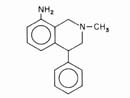
Nomifensine? Isn't it this:

nomifensine.jpg


Do you mean an aromatic amine? I wonder what removing that N-methyl group would do to the activity?
 
haribo1 said:
Nomifensine? Isn't it this:

nomifensine.jpg


Do you mean an aromatic amine? I wonder what removing that N-methyl group would do to the activity?

the nor version might retain some activity and reduce the immunogenic toxic effects, which might be due to oxidation of the heterocyclic ring to a dihydroisoquinolinum ion, then again the hepatic effects might be due to the aromatic amino group and therefore removing the N-methyl will make no difference.

http://dmd.aspetjournals.org/cgi/content/abstract/dmd.106.010173v1?ck=nck

the full paper is also available free.
 
A lot of the N-methyl pyridinium compounds seem to be really toxic ans MAO-B will turn quite a few of the N-methyl piperidines into the pyridinium version (that;s what makes MPTP so toxic to dopaminergic neurones in thr substantia bugre; it gets oxidized to 1-methyl-4-phenyl pyridinium chloride by MAO-B and that destroys the cells


About the Mertal thing - pre-senile dementia isn't much fun at all!
 
fastandbulbous said:
All of the above bodes well for 2-benzylpiperidine (unless it has a toxic flaw)

All I've found on 2-benzylpiperidine was an LD50 of 190 mg/kg in mice, and characteristics like raised pulse without increase in BP, tremor, etc. I don't have access to any pharmacological databases except the public ones. And I can't really find much on it in the chemical databases, and some articles were unobtainable to me.

If anyone has access to pharmacological databases it would be much appreciated if you can dig up some articles on 2-benzylpiperidine.
 
Vecktor,
Likewise, I am interested in DESOXYPIPRADROL=D ,May i ask where you got your info. on the human trials, if it made it to phase 3, it must of been documented somewhere,I can't find it anywhere on the internet:(

Thanks
 
Last edited:
It made it past phase 3 testing as that's when they give one off doses to volunteers and take regular blood samples. It seems it fell from favour during tge time when it is given to a small set of named patients who are asked to report back. The fact that they got as far as planning the tablet dose size means that it passed all the general toxicology tests
 
jah said:
Vecktor,
Likewise, I am interested in DESOXYPIPRADROL=D ,May i ask where you got your info. on the human trials, if it made it to phase 3, it must of been documented somewhere,I can't find it anywhere on the internet:(

Thanks
this is based on personal communication with a former colleague, I don't have the reference but there is also, I believe, a paper in German describing trials, I will see if I can find the reference.
 
I found some info.(reference) on DESOXY from wikipedia. I find it kind of funny, that the info. on it, is almost verbatim to the posts in this forum!8) Hmmm?

P.S. Fast, i'm trying to PM you,but you need to clear some space!=D Unless this is your way of saying "Get the hint!;)
 
Last edited:
vecktor said:
this is based on personal communication with a former colleague, I don't have the reference but there is also, I believe, a paper in German describing trials, I will see if I can find the reference.


If you can (even get a copy of the paper which would be better), I'll ask my other half to translate it (even if it costs a weeks worth of cooking!). You wouldn't want my translation, not with my command of German (I can ask & understand directions to hospitals, train stations etc but thats my limit other than food & saying "I'm ill .please help"!)
 
Top