



• N&PD Moderators: Skorpio

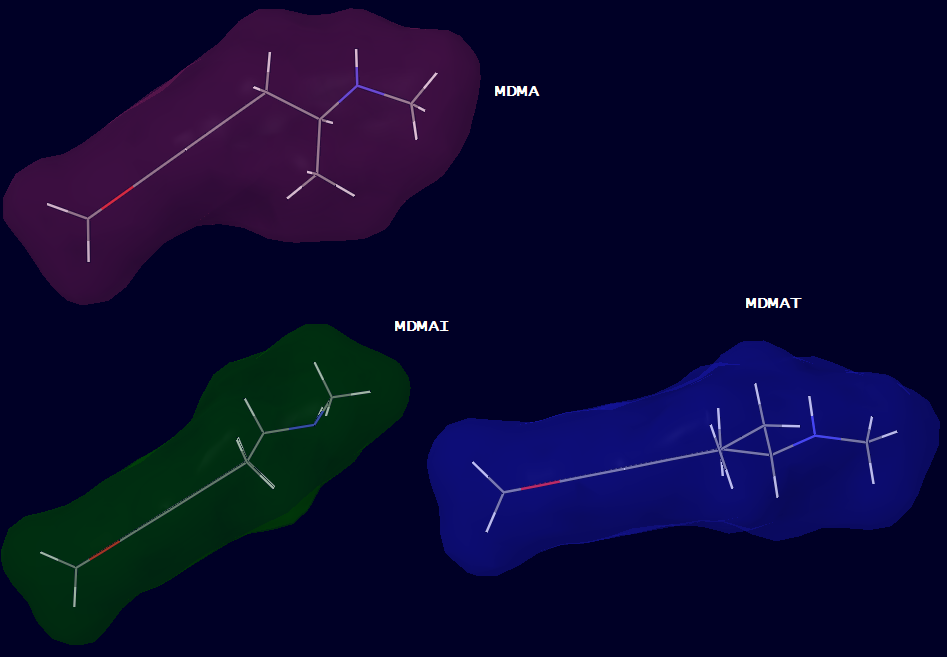
Comparison of top-down views of the molecular surfaces of MDMA, MDMAT and MDMAI

basement_shaman

Bluelighter
Joined
Dec 14, 2010
Messages
168
I've been toying around in ChemBio3D and Maestro, and this image is what I came up with:
Q2br6.png


Based on this image, it seems that MDMAT has a molecular surface closer to that of MDMA compared with MDMAI, but the differences are still vast due to the closing of the ring system and reduced mobility of the carbons close to the amino group.
The part of the molecule that has been looped around to close the ring is exactly the part of the molecule that gives MDMA its high affinity for the different monoamine transporters. The methylenedioxy moiety and planar six-carbon ring fit neatly into the SERT protein, but without the carbon dangling off to the side to fit in the hydrophilic pocket of the transporter protein, we see chiefly SSRA activity and barely any affinity for the DAT and NET proteins.

Based on this, could we engage in molecular masturbation and dream up a structure that has the stimulating properties of MDMA without the neurotoxic properties, or is there still too little knowledge about the structures and neurotoxicity of these compounds?

 
You're going about this in the wrong way. Top down molecular models mean basically nothing.

Based on this, could we engage in molecular masturbation and dream up a structure that has the stimulating properties of MDMA without the neurotoxic properties, or is there still too little knowledge about the structures and neurotoxicity of these compounds?


How about you ask Dr. Nichols and all the other Ph.D. level chemists that are trying this? I think there are more than enough stimulants derived from MDxx out there.
 
Oh well. It was fun making the models.
Saying that specifically top down molecular models mean nothing implies that molecular models from another view do mean something. What view would be preferred? This is the view that, in my opinion, best shows the differences in shape. There is a model available on pdb for the LeuT transporter with various pharmaceutical SSRIs docked in the binding pocket - perhaps I could run docking scripts and see how MDMAT and MDMAI fit in there. I just downloaded the manual for the docking script in Maestro and it's like 70 pages so this might take me a while to learn how to do.
 
nice work, basement shaman.

don't let anyone's super-advanced knowledge put you off, everyone loves nice pics, right? and you are obviously getting down with some great modeling software, i mean to say i think your head's in the right place! have you checked out the thread here in ADD on 'modeling the 5ht2a receptor'? I've been using Autodock Vina to explore docking poses for ligands at the serotonin 2a receptor. that program is free for educational use, and i found it pretty straightforward to use. then you could dump the results back to Maestro for modeling (i use pymol, another great free one!).

been curious about those MDxx's but i knew they don't work at the post-synaptic receptor. looks like you dug up some good pdb's of a SERT. nice, i'll have to give it a try. pretty busy this week, but soon. holla if you get crackin' at that and wanna collab!

peace,
nirvus
 
The problem with basing SAR off of a top-down model is that molecules and receptors are 3d objects; reducing them to 2d planes removes a lot of information. Some sort of perspective view would be better, though docked models are the way to go.
 
Molecules can adopt many conformations - You need to identify the binding conformation first and then overlay or try to align many high affinity, similar efficacy, structurally different molecules. You have some kind of energy minimized conformation, and in all likelihood, that won't be the conformation that the molecule takes when it binds to the protein.
 
nirvus:
Thanks for the nice words!
I'll check out Autodock Vina, it sounds like a great tool.
I'll also check out the thread you mention, it sounds extremely informative.

Sekio:
The reason I chose the top-down view in this case was the the molecules had almost identical 2D contours in the other two planes - this view was the one that I felt provided the most information.

Enkidu:
I guess you are right - but I can't ask my modeling software to make the molecule adopt the binding conformation. I, as you correctly guessed, asked it to make the molecules have their energy-minimized conformations, and then compared the surfaces of these. I can find one good file on pdb with methamphetamine bound to some transporter protein, and it seems that you are right that it doesn't bind in its energy-minimized conformation. Ah well. I guess this is a complete waste of time then.
It seems every time I get a new toy that I think I can use to predict stuff, someone shoots my morale in the head by explaining to me why what I am doing doesn't make sense :(
 
Last edited:
Don't give up, just download better software with more protocols. PM me for ideas.

Another thing you can do is find potent conformationally constrained molecules. Or, look up the pharmacore for a certain binding site and make the molecule conform to it. Often matching ligands to a known pharmacore is easier than docking
 
^what endiku said. don't sweat it, the docking programs usually allow ligand flexibility, so if you have a decent pdb structure, you'll get something like the right conformer. comparing docked poses for flexible ligands to poses for rigid active ones should prove useful, as was noted.

molecules and receptors are 3d objects; reducing them to 2d planes removes a lot of information. Some sort of perspective view would be better, though docked models are the way to go.

i've recently been lucky enough to do lots of this modeling in a 3D facility recently. talkin' nvidia pro, large projector. rocks for visualizing these binding pockets.
 
Thanks a lot everyone for the great and insightful responses!
You've definitely given me an idea of how to continue. It seems I need better software and better knowledge of how to use it. I'll try to see what my university email can get me (it's how I got Maestro and ChemBioSuite).
 
Top
