• N&PD Moderators: Skorpio

Combinging Mg2+ with memantine may be a no-no in preventing AMPH tolerance/sensitizat

monoamine

Bluelighter
Joined
Dec 14, 2003
Messages
92
Of four NMDA receptor subtypes, the effects of memantine are diminished on two and preserved in two. However, amongst the first two, NR1/2A and NR1/2B, the effect of memantine is nearly abolished in the presence of Mg2+, presumably from a greater affinity for the cation for the binding site of memantine. What'll I do with that magnesium glycinate? Hmmm . . :\


http://www.ncbi.nlm.nih.gov/pubmed/19261873
 
also the NR3 are inhibitory towards activity of this particular TM element (NMDA channel), so don't want to inhibit those. It would seem magnesium supplementation along with memantine is not a good idea, ostensibly from these studies. wikipedia: "The NMDA receptor forms a heterotetramer between two NR1 and two NR2 subunits (the subunits are also called glutamate-binding NMDA receptor subunits or GluN for short); two obligatory NR1 subunits and two regionally localized NR2 subunits. A related gene family of NR3 A and B subunits have an inhibitory effect on receptor activity. Multiple receptor isoforms with distinct brain distributions and functional properties arise by selective splicing of the NR1 transcripts and differential expression of the NR2 subunits."
 
Well both are voltage dependent NMDA channel blockers so I really don't see an issue unless memantine really blocks more Ca2+ influx than magnesium.
Honestly memantine binds to a lot more than just NMDA so I really don't think this will have massive implications, 5ht3 and NAChR antagonism probably play a larger role in memantine's role.

Just my $0.02
 
Unfamiliar with the NAChR antagonism, but there's multiple binding sites I read in the TM protein, one labeled "weak" and one "strong" maybe it depends on where memantine binds, but the NR1 and NR2 types seem to have a stronger binding affinity to Mg2+ than memantine . . . maybe at steady state it's different, but I will research the 5ht3 and NAChR antagonism. I'll pm you if you can send me some literature cuz, thx.
 
Interesting that abilify, a 5-HT (forgot receptor subtype) antagonist and D2 partial agonist causes TD, neuroleptic malignant syndrome, and inflammation of the pancreas (maybe causative factor for diabetes from antipsychotics). It would seem we're on the precipice of something to replace the monoamine hypothesis. A grand unifying theorem.
 
A lot of it appears to be due to faulty 5HT metabolism/release resulting in issues with DA and NMDA receptors and quite a bit more as far as metabolism goes.
D2 antagonists make the body use fats rather than sugars for energy resulting in some massive metabolic issues.

Hopefully there are a few more breakthroughs in this decade.
 
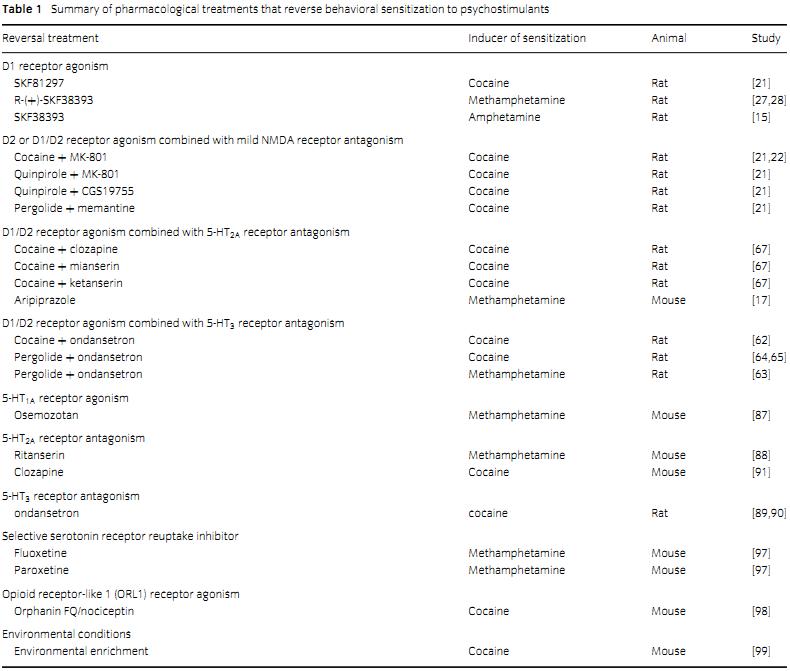
Was just reading this, it's pretty much a review of reversing meth sensitisation.

Table from paper:
NSFW:
0y861.jpg


I thought aripiprazole was just such a weak partial agonist that it effectively acted as an antagonist, I could never find any actual data for its intrinsic activity though.
 
EA said:
Well both are voltage dependent NMDA channel blockers so I really don't see an issue unless memantine really blocks more Ca2+ influx than magnesium.

Well, memantine has far greater affinity for NMDA channels, right?

5HT3 antagonism seems to block a lot of the sensitization issues while leaving reward intact.
NAChR antagonism is complex as all hell but blocks the production of ROS.

What does this suggest about the utility of mirtazapine as an adjunct to use of amphetamines (a dirty drug, I know)?

ebola
 
Well, memantine has far greater affinity for NMDA channels, right?


What does this suggest about the utility of mirtazapine as an adjunct to use of amphetamines (a dirty drug, I know)?

ebola

I have a link to a study discussing just that over in my thread with "MAJOR BREAKTHROUGH IN ADDICTION RESEARCH" as the body text. It didn't seem to work in a rat study due to what they presumed was a lack of selectivity for 5HT3 IIRC, might work at lower doses than what they used though.

Kind of seems like there's a receptor that if over (ant)agonized will prevent the reversal of sensitization. Also curcumin antagonizes 5HT2A, but I have no clue what that means in the real world. Despite being gold on paper curcumin has less than a 50% success rate from my reports :\
 
I've researched for countless hours and days on the subject of amphetamine tolerance. I've seen many contradicting reports about NMDA Receptor Antagonists.

Here are the facts-
NMDA Receptor Antagonists make the neuron take up less calcium, resulting in a lesser firing. Neurons either fire or don't. It is programmed into your DNA the acceptable range of firing that may occur before Sensitization/Desensitization. Using NMDA Receptor Antagonists will in theory result in dopaminergic neurons firing less, which should then cause less effects of the drug. I read a report of how Magnesium cause increased positive effects in Amphetamine and Cocaine users, which I find strange.

I've taken prescription amphetamines for a long time, tolerance will build. After 6 months of daily prescription doses it became virtually ineffective. I would say 90% of the positive effects are gone and almost all of the negative effects are still apparent. I've gone up to 3 weeks off of my meds to try to reduce my tolerance only to be disappointed. I don't want to preach to you because you will do what you want, but If I could suggest anything it would be if you want to use stimulants and not gain a massive tolerance, then spend more time off them, than on them.

 
I've researched for countless hours and days on the subject of amphetamine tolerance. I've seen many contradicting reports about NMDA Receptor Antagonists.

Here are the facts-
NMDA Receptor Antagonists make the neuron take up less calcium, resulting in a lesser firing. Neurons either fire or don't. It is programmed into your DNA the acceptable range of firing that may occur before Sensitization/Desensitization. Using NMDA Receptor Antagonists will in theory result in dopaminergic neurons firing less, which should then cause less effects of the drug. I read a report of how Magnesium cause increased positive effects in Amphetamine and Cocaine users, which I find strange.

I've taken prescription amphetamines for a long time, tolerance will build. After 6 months of daily prescription doses it became virtually ineffective. I would say 90% of the positive effects are gone and almost all of the negative effects are still apparent. I've gone up to 3 weeks off of my meds to try to reduce my tolerance only to be disappointed. I don't want to preach to you because you will do what you want, but If I could suggest anything it would be if you want to use stimulants and not gain a massive tolerance, then spend more time off them, than on them.


Give curcumin a shot for tolerance, so far its 9/21 people have a 25% reduction in dosage and most of them reported at least a short term boost in efficacy. I'm slowly working on my next big info dump/thread revamp but effectively there appears to be a very precise formula for reduction of sensitization/tolerance that curcumin hits on roughly.
 
@Ebola: That is very interesting. I happen to have prescribed mitrazapine on hand . . if my current combo (antioxidants(primarily ALA) and namenda) fail or are subpar I will report on the effect of mitrazapine. Thx for the connection.
 
I printed this same study for my P-DOC . . .although I can't understand why d1 agonism would reverse sensitization . . . I would think antagonism? Because D1 agonism and the NMDA activation go hand-in-hand . . maybe it's the D1/D2 ratio? Any thoughts? Had a couple odansetron left . . . did seem to really help, though I only had a couple. In emotional terms, it felt like I was less "high" (not my objective just focus/ADHD), but it was selective for the pointless "high" behaviors. Like . . I don't know . . . say replacing a part on your car that doesn't need replacing. I will report further if my pdoc Rxs me more, which I hope he will has he's been open with the memantine, and I've noticed I really don't have a comedown with the memantine though I'm still titrating upwards, sorry for the incidental comments- ADHD and all
 
@Epsilon Alpha I thought mitrazapine, with the 5HT2a antagonist properties would be a good canididate for a trial, but I've read in studies it doesn't produce the same effects as odansetron so I guess 5ht2a antagonism doesn't mean shit . . it's a metabotropic receptor and 5-ht3 is ionotropic is maybe why?
 
Bumping this old thread, how would Zinc supplementation play into all of this, being a NMDA ligand as well?
 
Give curcumin a shot for tolerance, so far its 9/21 people have a 25% reduction in dosage and most of them reported at least a short term boost in efficacy. I'm slowly working on my next big info dump/thread revamp but effectively there appears to be a very precise formula for reduction of sensitization/tolerance that curcumin hits on roughly.

I get the impression that curcumin's boost is probably mediated via the fact that it, in itself, is quite stimulatory in some people. For example, I've seen people compare even 500 mg of Curcumin (without Piperine) to 25 mg of ephedrine.

I think it's just a synergistic or additive effect going on, but you may be right, and probably know a lot more about its MOA than I do.
 
If people used amp only to get stimulation id agree with you but many use it for ADHD; anxiety; following the trend to take amp or other things and they would notice there's only a stimulatory boost. Its MAOI action will explain a bit the reduction in dosage tough.
 
Top