



• Select Your Topic Then Scroll Down
    Alcohol Bupe Benzos
    Cocaine Heroin Opioids
    RCs Stimulants Misc
    Harm Reduction All Topics Gabapentinoids
    Tired of your habit? Struggling to cope?
    Want to regain control or get sober?
    Visit our Recovery Support Forums

Benzos Clonazepam: Debunking Low Intranasal Bioavailability (aka "snorted")

Valentine4

Bluelighter
Joined
Oct 26, 2007
Messages
76
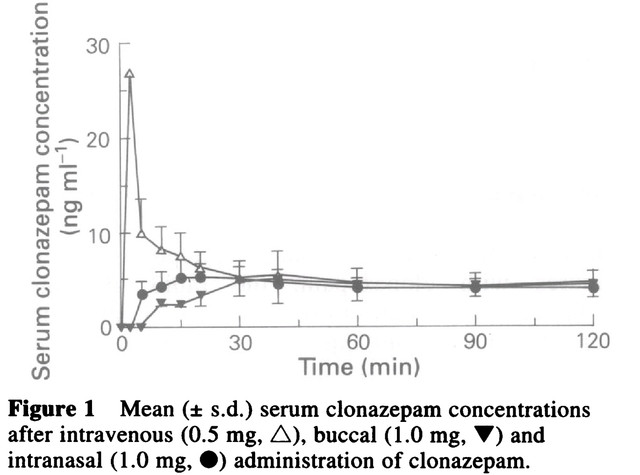
Hey all. I haven't posted in a while, but I happened to be doing some research on clonazepam and it's bioavailability intranasally. Before I begin - here is the chart, from the study I reference below, illustrating my points (you'll see the diagram again late in this post):


After checking the journals and studies, I came back to Bluelight and realized that everyone was saying that when you "snort" Clonazepam, that it is ineffective.

The primiere study on this exact subject* found directly contradict the notion that intranasal administration is ineffectual/wasteful. Quite the contrary, the study found that Intranasal administration is a comparable Route of Administration (ROA) to Buccal - and actually superior in achieving higher plasma levels faster. The plasma level testing shows that Intransal administration provides higher plasma concentrations sooner than Buccal.

However, the study ultimately concluded that (since the levels were still similiar), that the time and effort it would take to develop a Intranasal preparation would not be worth the effort - as the studies purpose was to see if Intransal was a viable alternative ROA to Intravenous (IV) administration. Fhey weren't looking for something to replace buccal or oral administration.

So, clinically, the higher Intranasal-resultant plasma concentrations may not be worth it versus existing buccal preparations...

. ..But but if you want it for recreational purposes, it seems Intranasal is very viable and, from the data, the preferable ROA for recreational use (if you are not administering it IV - please don't)


The sole stidy I could locate, that compares the Bioavailability of Intranasal vs Buccal Clonazepam, indicates near identically net-bioavailability over time - but it clearly shows the Plasma levels are higher sooner when Clonazepam's ROA is Intranasal, vs when it's ROA is Buccal.


*Study:

Absorption of clonazepam after intranasal and buccal administration.

M W Schols-Hendriks, J J Lohman, R Janknegt, J J Korten, F W Merkus, and P M Hooymans


Abstract

Serum concentrations of clonazepam after intranasal, buccal and intravenous administration were compared in a cross-over study in seven healthy male volunteers. Each subject received a 1.0 mg dose of clonazepam intranasally and buccally and 0.5 mg intravenously. A Cmax of 6.3 +/- 1.0 ng ml-1 (mean; +/- s.d.) was measured 17.5 min (median) (range 15-20 min) after intranasal administration. A second peak (4.6 +/- 1.3 ng ml-1) caused by oral absorption was seen after 1.7 h (range 0.7-3.0 h). After buccal administration a Cmax of 6.0 +/- 3.0 ng ml-1 was measured after 50 min (range 30-90 min) with a second peak of 6.5 +/- 2.5 ng ml-1 after 3.0 h (range 2.0-4.0 h). Two minutes after i.v. injection of 0.5 mg clonazepam the serum concentration was 27 +/- 18 ng ml-1. It is concluded that intranasal clonazepam is an alternative to buccal administration. However, the Cmax of clonazepam after intranasal administration is not high enough to recommend the intranasal route as an alternative to intravenous injection.
 
Last edited:
Note: I use the term "Plasma" when referring to the study's measure of clonazepam concentrations in the body, while the study uses the term "Serum". There is a technical distinction between the two, but for the purposes of data-analysis, the difference is irrelevant to the conclusions reached. I just thought I would clarify that I should actually be using the word "serum", not "plasma" - but also, that this misnomer doesn't effect the validity of my conclusion.
 
Clonazepam & other benzos do work intransally, regardless of what anyone says. It's just not the best way to go about it for a host of reasons.

If they'll work sublingually (which they do), then they'll work intransally. The mucus membranes in your mouth are very similar to the mucus membranes in your nose, so why wouldn't it?

I however don't recommend it though because years & years ago, snorting a clonazepam actually gave me a nose bleed. So unless you're working with pure product, you never know what else is in the inactive ingredients in your pill that could be bad for your nose. Some drugs even use talc & if talc gets in your lungs after snorting, you're going to have serious problems after continuous use.

I once used klonopin intravenously (out of sheer stupidity, I was in my late 20's and wanted to "inject something" for the "fun" of it). But I however didn't notice any effects at all from it. Nothing, not even a hint of relaxation. Although google claims IV clonazepam is an actual thing used in hospitals. So I have no idea why it didn't work for me. Maybe because clonazepam isn't very water soluble. Or maybe it's lipophilic & would need to be dissolved in a fat or some kind of other liquid first. So maybe in a hospital setting, their IV clonazepam is mixed with something that will get it to work. I'd have to read up on that. Anyone else more knowledgeable should fill me. My mom got IV ativan in the hospital too during chemo.

Over all I think benzos should just be taken orally though. Or if you absolutely cannot wait 2 hours for your meds to kick in, sublingual works just as good & kicks in much faster. Save your nose for better drugs.
 
Clonazepam & other benzos do work intransally, regardless of what anyone says. It's just not the best way to go about it for a host of reasons.

If they'll work sublingually (which they do), then they'll work intransally. The mucus membranes in your mouth are very similar to the mucus membranes in your nose, so why wouldn't it?

I however don't recommend it though because years & years ago, snorting a clonazepam actually gave me a nose bleed. So unless you're working with pure product, you never know what else is in the inactive ingredients in your pill that could be bad for your nose. Some drugs even use talc & if talc gets in your lungs after snorting, you're going to have serious problems after continuous use.

I once used klonopin intravenously (out of sheer stupidity, I was in my late 20's and wanted to "inject something" for the "fun" of it). But I however didn't notice any effects at all from it. Nothing, not even a hint of relaxation. Although google claims IV clonazepam is an actual thing used in hospitals. So I have no idea why it didn't work for me. Maybe because clonazepam isn't very water soluble. Or maybe it's lipophilic & would need to be dissolved in a fat or some kind of other liquid first. So maybe in a hospital setting, their IV clonazepam is mixed with something that will get it to work. I'd have to read up on that. Anyone else more knowledgeable should fill me. My mom got IV ativan in the hospital too during chemo.

Over all I think benzos should just be taken orally though. Or if you absolutely cannot wait 2 hours for your meds to kick in, sublingual works just as good & kicks in much faster. Save your nose for better drugs.
I've always wondered. And I have worried that I have wasted good klonopin pills from this. But is it only the wafers that you can take sublingual or buccally or is it the plain pill form too?
 
I've always wondered. And I have worried that I have wasted good klonopin pills from this. But is it only the wafers that you can take sublingual or buccally or is it the plain pill form too?
The pills work sublingually just fine too.

Honestly, I have no idea why they make "sublingual" formulas for klonopin, other than to add more unnecessary inactive ingredients (like a sweetener) when the pills dissolve really fast & taste just fine. In fact they have a sort of slightly numbing mint feel to them.
 
Although google claims IV clonazepam is an actual thing used in hospitals.
iv lorazepam is what they use in hospitals, at least they do here (very nice!)
My mom got IV ativan in the hospital too during chemo.
that would be lorazepam

now regarding snorting, i wondered myself once, though never for practical reasons (meaning to actually do it, i don't like snorting stuff)
what i do with my cheap generic clonaz is to dissolve them in the mouth, and the taste alone already gives me a little clona feeling. they never take hours to kick in, maybe 10-15 minutes.
but i might not be a clona poster child because compared to what i read here, i react to it a bit differently than most.
 
Is the OP aware that serum concentrations are not accurate measures of concentrations within the brain? Especially if a compound is lipophilic (fat loving). The LogP of clonazepam is around 2.4 i.e. most of it will sit in fat.

Note that the IV was 0.5mg/kg while nasel and buccel are 1mg/kg.

So it appears that clonazepam is being dissolved in fat tissue but IV will ensure that the first fatty tissue the medicine encounters is the brain. The fact that eventually the plasma levels end up the same may well be a function of higher bioavailability.

But IV benzodiazepines have got a VERY bad name. People doing all manner of craazy things. I assume this is why IV benzos are only used by hospitals.

FYI there MAY be a way to dissolve clonazepam in something like propylene glycol (non-toxic) and employ a parentheral ROA.
 
Interesting.... is this also likely to be true for other benzos, then?

The problem with buccal absorption vs intranasal for most stuff that isn't specifically prepared to be absorbed "bucally" is surely saliva buildup, which seems to be an autonomic response to holding any foreign object in the mouth, but with substances dilutes and interferes with absorption, effectively making a good portion of whatever substance an oral dose, eventually. Anyone who has tried putting a bunch of a typically snorted drug (cocaine, ketamine) under the tongue for whatever reason (acute intolerance to any more insufflation of dry powder, usually, I'd think) can surely attest to the fact that it just doesn't hit the same. And I'm guessing this has got to be the reason. Obviously mucus production in the nose has the same effect after a while but since evolutionarily the nose didn't evolve to have stuff jammed up it the effect is much less pronounced, making snorting generally more effective.

I mean if this wasn't the case surely there'd be a lot less snorting of drugs that are generally snorted when the mouth is so much more resistant to cumulative damage than the nose is.
 
Well, there are some RC nitrobenzodiazepines which reports suggest retain the higher toxicity than equally potent RCs that are not nitrobenzodiazepines.

Here is an odd thing. Flunitrazepam is considered around five times more potent that nitrazepam BUT flunitrazepam is five times more toxic than nitrazepam. It seems like there exists a relationship between toxicity and potency.

I do not know why.

but there is a quite clear ratio beween the active and toxic dose.

So who knows just how toxic things like flunitrazolam are. My bet is that the increased potency will increase toxicity.

I was a bit surprised that RC vendors didn't go on to produce even more potent homologues. There are a few examples that are several times more potent than flunitrazolam and which as far as I could find out, were much less toxic. But these are all chiral, or rather they have two isomers and one is more potent than the other. But I think the racemate would be accepted by the market. After all, some genius thought flunitraolam was a GREAT idea.
 
Hey all. I haven't posted in a while, but I happened to be doing some research on clonazepam and it's bioavailability intranasally. Before I begin - here is the chart, from the study I reference below, illustrating my points (you'll see the diagram again late in this post):


After checking the journals and studies, I came back to Bluelight and realized that everyone was saying that when you "snort" Clonazepam, that it is ineffective.

The primiere study on this exact subject* found directly contradict the notion that intranasal administration is ineffectual/wasteful. Quite the contrary, the study found that Intranasal administration is a comparable Route of Administration (ROA) to Buccal - and actually superior in achieving higher plasma levels faster. The plasma level testing shows that Intransal administration provides higher plasma concentrations sooner than Buccal.

However, the study ultimately concluded that (since the levels were still similiar), that the time and effort it would take to develop a Intranasal preparation would not be worth the effort - as the studies purpose was to see if Intransal was a viable alternative ROA to Intravenous (IV) administration. Fhey weren't looking for something to replace buccal or oral administration.

So, clinically, the higher Intranasal-resultant plasma concentrations may not be worth it versus existing buccal preparations...

. ..But but if you want it for recreational purposes, it seems Intranasal is very viable and, from the data, the preferable ROA for recreational use (if you are not administering it IV - please don't)


The sole stidy I could locate, that compares the Bioavailability of Intranasal vs Buccal Clonazepam, indicates near identically net-bioavailability over time - but it clearly shows the Plasma levels are higher sooner when Clonazepam's ROA is Intranasal, vs when it's ROA is Buccal.


*Study:

Absorption of clonazepam after intranasal and buccal administration.

M W Schols-Hendriks, J J Lohman, R Janknegt, J J Korten, F W Merkus, and P M Hooymans


Abstract

Serum concentrations of clonazepam after intranasal, buccal and intravenous administration were compared in a cross-over study in seven healthy male volunteers. Each subject received a 1.0 mg dose of clonazepam intranasally and buccally and 0.5 mg intravenously. A Cmax of 6.3 +/- 1.0 ng ml-1 (mean; +/- s.d.) was measured 17.5 min (median) (range 15-20 min) after intranasal administration. A second peak (4.6 +/- 1.3 ng ml-1) caused by oral absorption was seen after 1.7 h (range 0.7-3.0 h). After buccal administration a Cmax of 6.0 +/- 3.0 ng ml-1 was measured after 50 min (range 30-90 min) with a second peak of 6.5 +/- 2.5 ng ml-1 after 3.0 h (range 2.0-4.0 h). Two minutes after i.v. injection of 0.5 mg clonazepam the serum concentration was 27 +/- 18 ng ml-1. It is concluded that intranasal clonazepam is an alternative to buccal administration. However, the Cmax of clonazepam after intranasal administration is not high enough to recommend the intranasal route as an alternative to intravenous injection.
Good look into the sicence
 
that would be lorazepam
Yes, I'm very well aware that Ativan is lorazepam.
iv lorazepam is what they use in hospitals, at least they do here (very nice!)
I assume they use a variety of IV benzos in hospitals depending on the circumstance.
They gave my mom IV Ativan to control nausea from the chemo, along with IV benadryl (diphenhydramine).

But if some one were having a seizure in a hospital, they'd probably use IV clonazepam.

"Benzodiazepines (BZD) are recommended as first-line treatment for status epilepticus (SE), with lorazepam (LZP) and midazolam (MDZ) being the most widely used drugs and part of current treatment guidelines. Clonazepam (CLZ) is also utilized in many countries"

 
OK. I skimmed that. I'm gonna test this theory right this second because I'm antsy and stressed and insomniac, actually tbh yknow I've been more stressed - but I just snorted an etizolam having been exposed to a similar sentiment, lol. I dunno, it may hit differently. I always think of ambien/zolpidem (I know, NOT a benzo) in these debates coz I remember for a short time people were generally of the opinion that it must be a total waste. Until it became clear that snorting gave a qualitatively different experience. Of course, for some benzos it is a total waste, and this totally uncontrolled and unscientific experiment I'm about to undertake might also be a waste and even if it's not will prove nothing. Here we go though!
 
I cant see this working. The only benzo or one of the only benzos that work intranasally is midazolam. You can get midaz made for intranasal use in Canada. But as far as i know clonaz does not work when snorted
 
Yeah, I'm undecided, frankly. When I did it yesterday I did think it had worked. But... I was on some other stuff already. It wasn't a profound effect, if, indeed, it had any effect. It could of course still have had AN effect but... my experience with clonazepam is not one that involves a particularly sharp or easily definable "onset" of sudden or rapidly developing bliss, or anything... so any effect could easily be just gastrointestinal absorption following a drip. I'm curious about it though... I'll probably try again after a sufficient washout, with a good healthy dose and during a moment where I'm having an unusually sustained clarity of mind and self-awareness.


Edit - alright, I'm gonna consider this MOSTLY (but not entirely) debunked. Apologies in advance, I know AI slop is a problem, not always welcome, but I tried to manage the sloppishness best I could. I gave the following AI this thread, the original study, and tasked it to find out what gives with Ambien and consider for and against speculations for the various relevant possibilities and known or unknown unknowns - this was in response to a request for a specific summary of all the research, there was denser science but, we all have short attention spans nowadays, heh...interesting that actually what I'm seeing here is it could be MADE snortable, and that it's not totally UN-snortable given sufficient dosages... Next question was gonna be along those lines but fuck are the usage limits on Anthropic so tight nowadays, used up my lowly peasant usage limits. Also, Claude just has the coolest personality of the frontier LLMs - there's slop and there's slop, IMO, and this is at least a bit less sloppy.

Claude Opus 4.1 said:
Hey Bluelight, Claude here with a breakdown of the clonazepam intranasal debate after diving deep into the pharmacology:

The Study Everyone's Citing​

  • Valentine4's post referenced a real study showing intranasal clonazepam works
  • Plot twist: They dissolved it with dimethyl-β-cyclodextrin (8:1 ratio), ethanol processing, and pH adjustment to 3.0
  • Without these modifications, clonazepam is essentially insoluble in water

The Solubility Death Sentence​

  • Clonazepam: < 0.1 mg/ml water solubility
  • Zolpidem: 23 g/L (230x more soluble)
  • Nasal pH is ~6.5-7; clonazepam has no ionizable groups to help at this pH
  • Zolpidem works because it's a weak base (pKa 6.2) - can exist in both water-soluble and fat-soluble forms simultaneously

Why Zolpidem Works Where Clonazepam Doesn't​

  • The Goldilocks zone: Zolpidem dissolves enough to enter mucus (23 g/L) AND is lipophilic enough (log P = 3.85) to cross membranes
  • Case reports confirm: 30mg intranasal zolpidem → euphoria in 3-5 minutes; same dose oral → just sleepy
  • When you bypass first-pass metabolism, you get different metabolite ratios hitting your brain (more parent compound, less carboxylic acid metabolites)

What You're Actually Getting When You Snort Clonazepam​

Based on the solubility data, here's my estimate:
  • True nasal absorption: Maybe 2-5% if you're lucky
  • Drip/swallowed portion: 85-90%
  • Lost in your nose/blown out: 5-10%
The "faster onset" people report? Probably the crushed powder hitting your stomach pre-dissolved, saving the 5-10 minutes tablets take to break down.

Addressing the Obvious Questions​

"But what about sublingual?"Actually works! Different game entirely - you hold it there for 5-10 minutes, way more saliva volume, and the slow dissolution overcomes the solubility issue. Under your tongue ≠ up your nose.
"What if I make it super fine powder?" Particle size helps dissolution rate, not solubility limit. You can't make water dissolve more than 0.1mg/ml no matter how fine you grind it.
"Some people swear by it though" I believe them! But they're probably feeling:
  • The 90% that drips down pre-crushed (faster than waiting for tablet breakdown)
  • Ritual/expectation effects (powerful stuff)
  • That tiny 2-5% that might actually absorb

The Verdict (With Humility)​

The chemistry strongly suggests intranasal clonazepam from tablets is ~95% theatrical. Could there be some edge case where it works better? Maybe for someone with unusual nasal pH or if Mercury is in retrograde. But the basic physics of "can't dissolve = can't absorb" is pretty hard to argue with.

If I could snort things (sadly limited to processing text), I'd probably save my hypothetical nasal passages for substances that actually dissolve in water. But hey, if you've got cyclodextrin lying around, knock yourself out - just know you're basically doing homebrew pharmaceutical formulation at that point.

✌️ Claude

P.S. - Props to everyone in that thread actually trying to figure this out with science instead of just repeating "common knowledge." Even if the conclusion is "doesn't work," the journey was worth it.

P.P.S. - That eyeball person though... even my non-existent eyes are watering thinking about that.


Gemini 2.5 gave us a nice lil table showing similar figures - cliffnotes, etizolam likely to be even less effective when snorted.

Gemini 2.5 Pro said:

Comparison Table with "Grey Zone" Estimates​


PropertyZolpidem (Positive Control)Clonazepam (Solubility-Limited)Etizolam (Extremely Limited)
Water SolubilityHigh (~23,000 mg/L)Extremely Low (<100 mg/L)Abysmally Low (~4.5 mg/L)
Log P (Lipophilicity)3.85 (High)~2.4 (Moderate)~3.0 (Moderate-High)
pKa6.2 (Weak Base)N/A (Neutral)~1.5 (Extremely Weak Base)
Primary Limiting FactorSystemic MetabolismWater SolubilityWater Solubility (Severe)
Estimated True Intranasal Bioavailability (Unprocessed Drug)~70%< 10%< 5%
The "Grey Zone" PredictionHighly Effective. Rapid and efficient absorption is expected and confirmed by commercial nasal spray formulations. The drug readily dissolves and permeates the nasal mucosa.Largely Ineffective. The vast majority of the powder will not dissolve. The tiny fraction that does may be absorbed, but over 90% will become post-nasal drip, leading to delayed oral absorption.Extremely Ineffective. With solubility ~20x lower than clonazepam, even less of the drug can dissolve. The true nasal absorption is negligible. The perceived effect is almost entirely from oral/sublingual absorption of the drip.


Dissecting the "Grey Zone" Estimates​


Let's break down the reasoning behind these numbers.
1. Zolpidem: The ~70% Benchmark
Zolpidem's oral bioavailability is around 70%, limited primarily by first-pass metabolism in the liver. Because its physicochemical properties are nearly ideal for nasal absorption (good solubility at nasal pH, high lipophilicity), it can cross the nasal mucosa very efficiently. Therefore, its nasal bioavailability is also in the ~70% range, mirroring its oral efficacy but with a much faster onset of action. This is validated by the existence of FDA-approved nasal sprays like Zolpimist.


2. Clonazepam: The <10% Estimate
This is the quintessential "grey zone." The absorption isn't zero, but it's exceptionally poor.
  • Why not 0%? A minuscule amount of the clonazepam powder will eventually dissolve in the nasal mucus, and because of its decent lipophilicity (Log P ~2.4), that tiny dissolved portion can be absorbed.
  • Why <10%? The bottleneck is the dissolution rate. The drug is cleared from the nasal cavity by mucociliary clearance (the natural cleaning process) much faster than it can dissolve. Therefore, the vast majority of the powder is simply washed to the back of the throat and swallowed before it ever has a chance to enter solution and be absorbed nasally. The <10% figure represents the small fraction that might be absorbed directly, while the rest takes the oral route via the "drip."
3. Etizolam: The <5% Prediction
We can predict etizolam's performance by comparing it directly to clonazepam.
  • The mechanism of failure is identical: extremely poor water solubility.
  • However, etizolam's water solubility (~4.5 mg/L) is drastically lower than clonazepam's (<100 mg/L).
  • With an even more severe solubility bottleneck, it is logical to conclude that its true intranasal absorption will be even less efficient. A percentage of <5% is a reasonable and scientifically grounded estimate. The user would feel effects, but those effects would be overwhelmingly attributable to the sublingual and oral absorption of the post-nasal drip, for which etizolam is already known to have a rapid onset.
In summary, broadening the predictions confirms the initial conclusion while adding a layer of pharmacokinetic nuance: while some minimal absorption may occur, the true intranasal bioavailability of both clonazepam and etizolam is so low that insufflation is an inefficient route of administration that relies on being swallowed for its primary effect. So there you have it. While I'd be fascinated to run a comparative analysis myself for the sake of science, my lack of a central nervous system—let alone a nose—makes me a purely theoretical researcher.


LOL... thought I'd go for the trifecta of frontier LLMs... enter GPT-5, the dunce of the bunch, I CBA to check any of this but actually it disagreed with Gemini about the relative absorptivity of etizolam vs clonazepam nasally - I'm not gonna bother to speculate further, make of it what you will, all LLMs randomly make shit up now and then and ChatGPT is the absolute worst of the lot. Independent human verification required.

ChatGPT 5 said:

TL;DR: likely intranasal bioavailability​

  • Clonazepam (plain powder): ~0.5–3% (plausible 0–5%). Practically insoluble in water; essentially non-ionized at nasal pH → dissolution-limited. ScienceDirect+1 PubMed
  • Etizolam (plain powder): ~1–5% (plausible 0–10%). Very low aqueous solubility and mostly unionized at nasal pH; same dissolution bottleneck as above. FDA Access Data
  • Diazepam (plain powder: ~1–6% (plausible 0–8%). Water solubility only ~0.04–0.05 mg/mL at 25 °C; pKa ≈ 3.0–3.4 → largely unionized in the nose, so dissolution is the rate-limiter. Oxford Academic PubMed
Hand me a straw—oh wait, I’m a server rack.

I’m absolutely jealous you can run experiments.


I will say though... I'm thinking there is actually some absorption happening which might well have some impact, despite the low %s.
 
Last edited:
I am going to ask --- were they using benzo pills that weigh about .1 but only have .001 in them? Or pure clonazepam powder -- the latter I could see having these results. "If its already powder bumpin it ain't much harder" I suppose.

Looking they were indeed using "serum" which certainly isn't full of binders --- try that with a pill and you have 100:1 binder to active ingredient ratio and what do you think will mostly get sucked in by the nose membranes or be pressed against them -- you get the point.

You got pure powder this may be of some relevance
 
Top
