• N&PD Moderators: Skorpio

CAS# 1426151-97-4 and CAS# 1426151-95-2

Thanatos

Bluelighter
Joined
Feb 21, 2008
Messages
10,556
Location
Ex-staff Ex-crulighter
Could anyone help me scrounge up some info on these two new compounds i just came across? I cant find much on the web and have no idea about its SAR.
IUPAC: N-[[4-(diethylamino)phenyl]Methyl]-4-Methyl-N-phenyl-Benzenesulfonamide
CAS# 1426151-97-4
vgkhht.jpg


IUPAC: N-[[4-(diethylamino)phenyl]Methyl]-N-(2-furanylMethyl)-4-Methyl-Benzenesulfonamide
CAS# 1426151-95-2
34q02gm.jpg
 
Hello freind ;]

Looks like completely unrelated to any CBDs Ive seen.

Going to need some careful lab trials starting with careful titration
 
At first glance they seem similar to w-18, an ultra potent mu opioid agonist. I can't totally speak to SAR here, but extreme caution is a must. I'd use software to compare their geometry and charge distribution toW-18, and can post that info if desired. Unfortunately my computer doesn't have the processing power to model solvation, which would be desirable. Honestly, I'd just steer clear.
 
Currently i am in possession of 100mg of each and I can say that Lab tests in the microgram to low mg yield nothing for either chemical via oral, vaporized or sublingual. I to am on the hunt for info due to what has been said...
 
ROA and related BA will be impossible to discern. I will work on the in silico models and report on results. I urge caution until and even after.
 
So these two compounds are confirmed CB1 agonists, or is this just a speculation?
I dont see how you could make that proclamation just from a simply SAR analysis, the skeletal conformity is unlike any other can cannibimetic that I've ever come across.
 
All i said was that they appear, at face value, to be similar to W-18, and as such speculate some sort of action of that type. Again, i'm not sure enough on SAR for these novel types, especially considering the aniline/furan moieties and the lack of the piperidine and imine as seen in the compound i'm comparing it to. I have no educated idea as to the potential binding profile, nor do i know if molecular modeling will even help shed light on it. The fact of the matter is these compounds appear quite novel. Modeling them and comparing them to known psychotropics is, in my opinion, a stepping stone into figuring out what, if any, action they could POTENTIALLY have. And as i've stated twice, experimentation is not something that would be advisable given the lack of ANY data regarding them. Admittedly though, I have not searched the literature for them or similar compounds at all. I'm just trying to help people not die by utilizing some powerful software i took from college. I'm not trying to give advice, just attempting to add information where there is currently a void and people already (apparently) undertaking in vivo testing.
 
I feel like I'm out of the loop here or something, but what exactly has made people think there's anything special about these compounds at all? I take it from a few comments that vendors are passing these off as either μ-opioid agonists, which is the first thing that came to my mind given the similarity with the W-1x series of (apparently) recreationally useless but medically interesting opioids, although other than the sulfonyl group and some other similarities that aren't so similar, I doubt it fits into the W-1x SAR, or as CB agonists, which, unless a totally new SAR for CB agonists has been discovered that I'm unaware of, seems retarded and a bit like grasping at straws...
 
Last edited:
^anorectics have their place in the grand world of pharmacopeia as well. Possibly useful for cessation of extreme cannabis/cannabimimetic use?

Is anyone savy enough to speculate on the metabolism of these compounds, and possible active or toxic metabolites?
 
Because they're not very strong at CB1 (central cannabinoid receptor), being selective for peripheral CB2, I think all they do is mess with immune cells and stuff like osteoclasts (bone eating cells). I don't even think they are effective anorectics.

Rimonabant had the unfortunate side effect of crippling depression and suicide risk, so I think there's better drugs to take all around.
 
Last edited:
Although the may initially show a seminar mechanism of action remonabant has several different moieties that aren't found in these benzenesulfonomide compounds. The SAR could drastically different, correct?
We don't know how these compounds will be metabolized as far as I know and as such I think it's premature to make assumptions based on a failed compound that just happens to be an inverse agonist.

If I'm not mistaken CB2 plays a large role in peripheral muscle tone and as such these could possibly preset a good opportunity for further progress on medications to battle auto-immune disorders or something like Parkinson's disease or muscular dystrophy.
Bluelight should explore non-recreational compounds as well!

In order to explore the potential benefits of studying these compounds a lot of work would have to be done in order to create compounds with mirror-opposing mechanism of action. A lot of advancement in pharmacology is down by working backwards in order to find what mediates the negative effects, and creating opposing compounds...
 
Last edited:
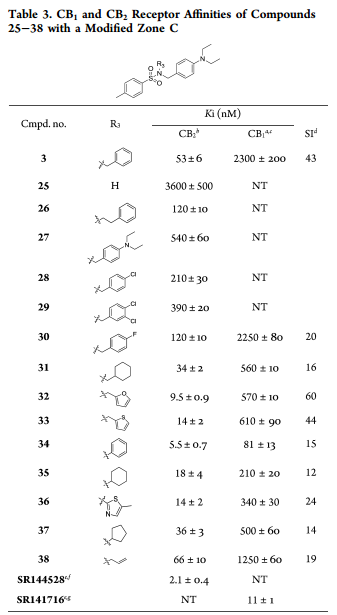
If you read the paper, the SAR is pretty much verified that these are CB2 inverse agonists. Moreover stuff like this:
These three compounds exhibited
strong inhibition of osteoclastogenesis. Among them, 34
showed the most favorable activity. At 0.1, 1, and 5 μM, it
suppressed osteoclast formation by 55, 83, and 99.7%,
respectively.

Makes me a little concerned about any sort of prolonged administration. I have no desire to mess with my bone density more than is healthy.

erFe5O9.png

The first compound is no. 32, the 2nd compound is no. 34.

None of these are cytotoxic but metabolism could yield some gnarly stuff like toluenesulfonamide, aniline, etc. And as a sulfonamide anyone with a sulfa drug allergy should stay away.

I would leave the development of theraputics to the FDA and friends...
 
^ A well as all know Sekio one single study can never be considered to be conclusive. It'll take years of careful study to find where the benefits/risk of this series. We are going to need many more peer review studies to come to a conclusive opinion. And of I read the paper, but I'm not satisfied with such a short synopsis of there findings.

If you could explain your hypothesis on the possible metabolism of these compounds i would greatly appreciate it. Parenternal administration may very well lead to quite different effects than a topical or polymer-compounded formulation to retain the compounds in a very localized area of the body.

Like I said, pharmacologist could work backwards from these compounds and find the exact mechanism to combat the negative effects that are present with this series. I didn't start this thread to did a drug to get high off of, I'd like to advance medicine if at all possible.
 
If you could explain your hypothesis on the possible metabolism of these compounds i would greatly appreciate it.

Any drug with e.g. an aniline group that could bust off, or a sulphonamide that might hydrolyse to toluenesulphonic acid, should be treated with at least a modicum of caution in humans until it's been proven safe. the liver sometimes likes to cleave bonds between atoms of different types.

Like I said, pharmacologist could work backwards from these compounds and find the exact mechanism to combat the negative effects that are present with this series.
Somehow that seems unlikely if the "negative effects" are what the drug is targeted to do.
 
Have they been analyzed for opioid affinity? They sure look like they must have some opioid affinity, they look like w-18 and fentanyl analogues.
 
There's only one paper out on them which claims they are CB2 selective. I don't think they've been screened as mu ligands.
 
Sekio would you be willing to postulate that W-18 could be a potential hazardous compound to ingest because of its sulfonimide functional group? If not why would these two compounds act differently considering the similarity in their pharmacores?
Disregard your belief that these will only be CB2 inverse-agonist. I'm much more interested in your thoughts concerning its metabolization.
 
It's a sulfa drug, the potential exists for allergies and hypersensitivities unless demonstrated otherwise. Of course if it's a highly active mu ligand that you take ten micrograms of, toxicologically that's nothing compared to the multi hundred milligram doses of sulfa antibiotics which used to be more common, because you just won't make enough secondary metabolite to worry about.

considering the similarity in their pharmacores?

They both have a sulfonamide and that's about the extent of the similarity. So I think extrapolating is next to useless.
 
Top