• N&PD Moderators: Skorpio

C8813

Status
Not open for further replies.

Canis aureus

Bluelighter
Joined
Nov 25, 2005
Messages
930
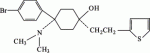
There exists said novel opioid compound C8813. It is unlike morphine like some other opioid drugs recently discussed here (Lednicer compounds & Bromidol). It is similar to Lednicer's invented 4-arylcyclohexanone derivatives to some extent.

I'd like to know how long or short-acting this chemical is or could be? In some respects this and those others discussed here seem promising. Are there some (hidden) inherent toxicities or possibilities for those..?
 

Attachments

  • C8813.gif
    C8813.gif
    3.4 KB · Views: 305
I think that all those ultra-potent opioids are not suitable for the RC market or recreational use. Too high is the risk of overdoses and fatalities, unless they are packaged as dose units (ampoules etc), which brings a lot of other legal problems with it. A good opioid for the RC market should have a dose range similar to morphine or heroin and a high therapeutic index.

An exception could be a certain derivative of etonitazene, which is 5x more potent than the parent molecule, so it's 5000x morphine. The ED50 sc in mice is 1µg/kg, the LD50 iv in mice is 25mg/kg, so it has a therapeutic index of 25,000. I think that's reasonable safety.
 
The best thing for the recreational market would be potent partial agonists that have a very low risk of overdose, something that is to similar to what benzodiazepines are compared to barbiturates.

(in fact, I would expect such compounds to replace drugs like hydrocodone/oxycodone for mild to moderate pain in the near future)
 
The ED50 sc in mice is 1µg/kg, the LD50 iv in mice is 25mg/kg, so it has a therapeutic index of 25,000. I think that's reasonable safety.

Rodents are not primates - you canj't just transpose ED & LD figures. Cannabis (well cannabichromene, a component of cannabis) is toxic to dogs, but not cats, primates, rodents etc. There are countless other such examples, even involving opioids (much more toxic to cats than other genus of mammals).

Etonitazene causes much more respiratory depression for an analgesic dose in humans than most other opioids, which is why the nitazenes never made it to clinical use
 
The worlds best therapeutic index doesn't mean much if the dose is so ultra tiny that no one could possibly safely handle it.
 
I mentioned this stuff in the bromidol thread. They wanted to test the replacment of the phenyl with a 2 thienyl because in the case of the fentanyls it increases potency. In this case it seems to 1/20 the potency (they claim the trans isomer is 591 x morphine. Bromidol is about x12000 morphine.
Maybe next they will try substituting the cyclohexane ring or put a beta hydroxy on the phenylethyl.

To be honest, I don't think you can increase from x12000. Ohmefentanyl is 6300x morphine but you have to seperate out one of the 8 isomers. The only stronger one is 4'Fluoro ohmefentanyl which is about x18000. Maybe placing a 4'F onto the phenylethyl grouping of bromidol will have a similer effect on potency.

There MUST be a maximum potency for analgesics. The binding of these type of things is SO high. I mean, how many mu receptors are their in the brain and spinal column. Once you have filled every one, you can't make things any stronger... can you. (I'm assuming that these are 'full agonists').
 
fastandbulbous said:
Etonitazene causes much more respiratory depression for an analgesic dose in humans than most other opioids, which is why the nitazenes never made it to clinical use

I was under the impression it was because of unreliable activity. The dose depends on the person. It was reliable in rats, but not in humans.

Thomas K Highsmith is one person
Michael Hovey is another

Highsmith made etonitazine whilst working at Morton Thiokol. He didn't sell it or distribute it, he just took it via nasal inhaller. When he was caught, there was no dose of methadone able to stop the dreadful withdrawal and he killed himself. I know the case in detail since I was the one who wrote it up for Wiki.

Michael Hovey was a Dupont chemist who made 3 methyl fentanyl but had no distribution system. In the end he asked the janitor (who was black, so MUST have heavy connections) who promptly dropped a dime on him.

George Marquardt was the chemist who made a number of fentanyl analogs specifically for distribution. A lot of people died because trying to make a cut accurate is very difficult. So, one bag could be OK, the next 10,100 or even 1000x stronger. The product was made in Wichita, but sold on the west coast.

You didn't mention Barry Kidston (the man behind MPTP) or, indeed, the many other 'rogue' chemists who were caught. Owsley & Sands, Richard Kemp, Pickard & Appleton, Casey Hardison and so on. The list is endless.

Etonitazine also turned up in Germany and Russia. If you want to buy fentanyl analogs cheap, then hop on a plain to Tashkent where it's sold as 'Egg White' or 'Crocadile Snow Powder'. It's usually a raecemic mix of 3 methyl fentanyl although there are other similar compounds out there.

 
I know most of those chemist and... but the case Highsmith caugh my attention. What dose of methadone was he given? I don't know but he should have been able to get rid of WD's with it, if there weren't tight dose requirements. But of course if he got 30 mg or those starting doses in US clinics, then...

I have been in St. Petersburg because I happen to live the next corner. But I live very deliberatively novadays... mostly interested in theoretical aspects.
 
If I remember correctly, the problem was that the toxic side-effects of methadone (and it's metabolites) build up. I think it's cardiotoxic. He was given up to 250mg per day, but he had been using the etonitazine for about 3 months and had built up a huge tolerance. I think he was doing in about 100mg per day. What he thought he was going to do if his supply was cut off I don't know. I mean, thats like 150g of morphine per day!!!!! All I can say is that it proves the overall NON toxicity of etonitazine. As I said, methadone gets cardiotoxic (so does dextropropoxythene) so even if your opiate tolerance builds up, it will still kill you.
 
As I recall, back when MMT was still pretty new, in Florida they tried ambulatory dosing and there were patients who got up to 500mg/day.

It's not a big surprise that giving an addict an steady and increasing supply of a drug will continue to increase the dose.
 
Wow! I don't know the range in which it becomes cardiotoxic, but 500mg per day is an awful lot. I wonder if anyone knows the biggest daily dose of methadone ever prescribed? I remember one guy off BL who made his own fentanyl. He took it nasally and said he ended up every 45 minutes at night, needing to redose. He then panicked and... through the rest away. Then he went cold turkey and he described the withdrawal as more acute, painful and emotional than anything he had ever tried. I know that 2 months later he was still suffering. There be the lesson, short-acting opioids are a real trap...
 
The same authors gave an ED50 of 5µg/kg and a LD50 of 1mg/kg for etonitazene itself, giving it a therapeutic index of 200. Thus, said derivative is certainly a great improvement over etonitazene, at least in mice. Said derivative also has a chiral carbon, so it would be most interesting to evaluate the two enantiomers.
 
^People have asked, but what IS this derivative? It's all very well singing it's praises, but without any pointers, how do we know what your talking about...
 
Biphasic said:
The best thing for the recreational market would be potent partial agonists that have a very low risk of overdose, something that is to similar to what benzodiazepines are compared to barbiturates.

(in fact, I would expect such compounds to replace drugs like hydrocodone/oxycodone for mild to moderate pain in the near future)

Ciramadol is that kind of opioid with a ceiling effect, not going beyond 15mg morphine. Dezocine seems to be similar.
 
^Please answer the question or people will liable get suspicious....
 
This compound seems to be around the same potency as "bromidol", I'm not sure why haribo1 says its 1/20th as strong?

Lednicer et al. (1981) had reported the antinociceptive effect of some 4-arylcyclohexanone derivatives. Compound trans-4-(p-bromophenyl)-4-(dimethylamino)-1-phenylethyl-cyclohexanol was the most potent compound of this series. We had compared the antinociceptive effect and the binding affinity for μ-opioid receptor between C8813 and trans-4-(p-bromophenyl)-4-(dimethylamino)-1-phenylethyl-cyclohexanol. The antinociceptive ED50 in mouse hot plate of the two compounds were 11.5 μg/kg and 13.4 μg/kg respectively. The binding Ki values for μ-opioid receptor of the two compounds were 1.37 nM and 1.49 nM respectively. Therefore, C8813 was similar to trans-4-(p-bromophenyl)-4-(dimethylamino)-1-phenylethyl-cyclohexanol not only in chemical structure but also in antinociceptive efficacy and affinity for μ-opioid receptor.

Z.-H. Liu et al. / Life Sciences 73 (2003) 233–241
 
Status
Not open for further replies.
Top