strangladesh
Greenlighter
- Joined
- Jul 31, 2008
- Messages
- 15
Can I get some feed back on good possible compounds that would not be to potent. edited by vecktor, please get smart.
Last edited by a moderator:




N&PD Moderators: Skorpio
You are using an out of date browser. It may not display this or other websites correctly.
You should upgrade or use an alternative browser.
Buprenorphine analogues
strangladesh
Greenlighter
Can I get some feed back on good possible compounds that would not be to potent. edited by vecktor, please get smart.
Last edited by a moderator:




johanneschimpo
Bluelighter
How is a bupe analog not also a morphine analog? Consider that first...

Swerlz
Bluelight Crew
Honestly, if you can't research something like this on your own than you shouldn't even be thinking about it..
daddysgone
Bluelighter
How is a bupe analog not also a morphine analog? Consider that first...
well is bupe itself an analog of morphine. I did not think this was the case?
strangladesh
Greenlighter
Ive been looking but I cant find a good list, so yah thanks for the help.
If i can get a compound thats even farther away from morphine I dont think It would fall under the A act.
daddysgone
Bluelighter
again.... i REALLY didnt think bupe was an analog of morphine. In fact i cant imagine how it could be even argued that it is analog (aside from the fact they are both opioids).
ignoring all other facts, bupe is a partial agonist/antagonist while morphine is a full agonist. i would imagine this fact alone would preclude it from being considered an analog-thats not to mention a whole host of other major differences- chemical and otherwise.
strangladesh
Greenlighter
Ok so what are possible compounds that could be derived around buprenorphine?
strangladesh
Greenlighter
I also just found this as a possible tramadol analogue that would be legal
desmethyltramadol
Input please.
daddysgone
Bluelighter
Ok so what are possible compounds that could be derived around buprenorphine?
well what are u looking for. u said u want something less potent (an odd desire). but what else are u shooting for- do u want a full agonist or would u like it to remain a partial agonist like bupe.
also- i think this would be better suited for Advanced drug discussions. Mods, u might wanna move it over there.
johanneschimpo
Bluelighter
Thats what I mean - whatever changes are made, say a methyl group here or there, wouldn't distance the new drug from the old ones very well.
well is bupe itself an analog of morphine.
Or, this: http://en.wikipedia.org/wiki/Oripavine (the last paragraph, about legal status)
I know wikipedia is a half-assed source, but then again, this is a half-assed question, so it fits.
This forum isn't really about us giving you input for... whatever the hell your plan is. We don't promote illegal activities here. Not ones that fall into a gray area either.
Input please.
This is one of those "if you have to ask..." situations. 
daddysgone
Bluelighter
meh- i think if this thread was moved to ADD, it would be fine.
JC- I agree that CERTAIN alterations could cause a bupe analog to more closely resemble a CI or CII drug. However i have little doubt that if one were so inclined, they could synth a bupe analog that would not be a morphine analog.
agreed, this thread does perhaps get into a bit of a gray area, but if you read, it seems like the OP is actively trying to AVOID engaging in illegal activity (by synthing an analog of a CIII drug that would not fall under the analog act).
Again, the people that can help you with the questions youve asked would be found in Advanced Drug Discussion and a Mod should really move it to that forum.
johanneschimpo
Bluelighter
No matter what crazy functional groups you add on, you still have this skeleton:
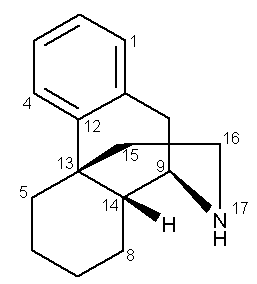
I don't know exactly how the government thinks (or if it does), but I bet that skeleton alone (which bupe/morphine/etc have) is enough for it to be an analog. Either way, I don't want to contribute to the OP's delinquency, so I won't go in depth on how to beat the CSA.
strangladesh
Greenlighter
Ok, there have been a few cases were changes have been made to a chemical structure that was ruled to not be considered a analogue. I cant remember the specific compound but i think this is completely feasible to circumvent the laws. I don't see how this is wrong or illegal in any way. It is done daily in lots of corporations to find loop holes.....Why all the static, I just want to find a suitable replacement to scheduled drugs.
I will be looking into the desmethyltramadol until something else comes along.
Thanks guys.
Swerlz
Bluelight Crew
A lot of them don't have names to them. Just numbers like HS-599 which is a didehydroderivative of buprenorphine.
daddysgone
Bluelighter
Ok, there have been a few cases were changes have been made to a chemical structure that was ruled to not be considered a analogue. I cant remember the specific compound but i think this is completely feasible to circumvent the laws. I don't see how this is wrong or illegal in any way. It is done daily in lots of corporations to find loop holes.....Why all the static, I just want to find a suitable replacement to scheduled drugs.
I will be looking into the desmethyltramadol until something else comes along.
Thanks guys.
As i see it- there is NOTHING wrong with your question. I completely agree with you. you arent asking where to score heroin. you are asking advice regarding what analogs you could have synthed that would not violate the federal scheduling laws. I think people are having a sort of "knee jerk" reaction to your questions due to the fact that what you are asking sort of "seems sketchy"-in that you are trying to circumvent the law to meet your means. but....whats wrong with that?
as i KEEP saying though- this is the wrong forum for this question. there is no question that this belongs in ADD
also- since u are a greenlighter and cannot yet write PMs to other members, is there an email where i can contact you? there are some things id like to ask you that would be better suited through email. thanks-DG
strangladesh
Greenlighter
Well great I think I saw that first analogue, but i was getting mixed info about potency.
How much more potent is it compared to morphine?
Last edited by a moderator:
johanneschimpo
Bluelighter
btw, if you want this moved to ADD, reporting it would be the best way to get a staff members attention (its the "!" box in the bottom left of each post)

Jabberwocky
Frumious Bandersnatch
Od =====> add

Hammilton
Bluelighter
Oh God, why leftwing, why?
This is a thread where people think that buprenorphine analogues aren't morphine analogues. Isn't there a trash can alternative????
There are two ways this could happen: 1. Not knowing what an analogue is and just posting and offering opinions on something they obviously have no clue about for the sheer hell of it or 2. Actually not having a brain.
I assume that #2 doesn't accurately describe the situation, so we're left with #1.
Buprenorphine

Etorphine

Analogue status (by law) is first conferred by close structural relationship to a schedule I or II drug. Anyone with vision will see that these two are very closely related. The difference between buprenorphine and etorphine is smaller than the difference between bupe and morphine, but any derivative of buprenorphine is still obviously a morphine analogue. Second, it must have substantially similar effect. Since they're both agonists (whether full or partial, doesn't really matter) they obviously meet this second aspect. Now, a buprenophine analogue that is an antagonist would not be considered an analogue by law (though structurally, it still would be).
There will be absolutely no phenanthrene derived opiate that will fall outside of the analogue act.
JC- I agree that CERTAIN alterations could cause a bupe analog to more closely resemble a CI or CII drug. However i have little doubt that if one were so inclined, they could synth a bupe analog that would not be a morphine analog.
agreed, this thread does perhaps get into a bit of a gray area, but if you read, it seems like the OP is actively trying to AVOID engaging in illegal activity (by synthing an analog of a CIII drug that would not fall under the analog act).
No, not certain, just about every alteration- you can't possibly get far enough away from the morphine / etorphine skeleton to have a non-analogue.
And desmethyltramadol won't be legal long. Tapentadol is up for scheduling- and if it goes to CII, and it almost certainly will, desmethyltramadol will be illegal.
I'd advise listening to JC from now on.
(btw- why aren't you on AIM tonight JC? You might be pleasant talking to when sober  )
Last edited:
)
Last edited:
strangladesh
Greenlighter
why so hostel??
Am I in the wrong for seeking information, you act like some one made you go out of your way to answer my question, which you did so I thank you for that. but you are only partially right, since the government never defined what an analogue is the definition is up for debate and really falls on the judge to intemperate. you could be right but the area is so grey that I think If you have a compound that's got more then a couple changes to the structure it wouldn't be considered an analogue. Ill look up some of the specific cases I have read on, I think it was AET that wasn't considered an analogue so the DEA placed under schedule 1. I could be wrong But my point stands the same.
There was a compound that by your definition would be an analogue but a court ruled that it wasn't so the DEA made it schedule 1.
I'm going to look into those compounds you posted on, hopefully something will fall far enough away to make me feal comfortable enough...