• N&PD Moderators: Skorpio

Bridged Nitrogenous Ethers of known PEAs

N0 W4RN1NG

Bluelighter
Joined
Jul 16, 2008
Messages
506
Location
Long Island
Tertiary amines which are attached to 2 carbons and one oxygen are known to preferentially and quickly become reduced to secondary amines, where the carbon bonds remain intact but the oxygen is reduced away.

Taking this mechanism to it's logistical extreme, we can theoretically abuse this system to create either:

A. Uncontrolled, but pharmacologically identical chemical versions for streamlined in-vitro research without obtaining the necessary DEA license to do so:

2epooxj.png

DiMDMA Ether

or

B. Uncontrolled Hybrid compounds which have an unusual synergistic effect without the need for separate chemicals:

34grcjo.png

MDMAI + MC Ether


Does anyone know of any potential consequences to this I have overlooked?

 
N-O-N linkages aren't very stable. You do see things like Weinreb amides where you have N-O-C linkages or N-O-H linkages (hydroxylamines/oximes).

Try a bis-carbonate ester.
 
Right, I've been looking at dinitrogen pentoxide, as that's the closest thing I can find. How unstable are we talking though? I mean the HOT-x series is very unstable on paper too, but it's made the rounds. Or is N-O-N *much* more unstable than a N-OH and I'm an ass?

Thanks for the suggestion by the way.

EDIT: Here's a visualization of Sekio's version:
2mm7eck.png
 
Last edited:
N-O-N is way more unstable than N-O-H. I don't even know if there are any stable 'amine ethers'.

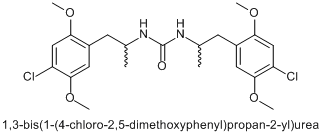
I guess it's not a carbonate ester but rather a urea I'm thinking of:
AVkOwOd.png
 
Okay, I can see that that would clearly be more stable, but do you think that would be cleaved as readily into DOC x 2?
 
I would expect it would be pretty rapidly metabolised.

Another idea is a 2-carbon linker between the amines a la fenethylline.
 
Ahh, I was looking into Fenethylline a few days ago. What turned me off about it is
Fenethylline is metabolized by the body to form two drugs amphetamine (24.5% of oral dose) and theophylline (13.7% of oral dose), both of which are active stimulants themselves.[2] The physiological effects of fenethylline therefore result from a combination of all three drugs.[3]

Which implies that only ~38% of the oral dose is actually utilized, with the remainder sticking around as the bridged parent compound. While this issue could theoretically be solved by increasing the dose, that approach worries me somewhat - for all we know, the parent compound could be a 5HT2B agonist or something.
 
the parent compound could be a 5HT2B agonist or something.

so what? lots of psychedelics and entactogens are. as long as it isn't an especially potent full agonist (like 5-APB, which still could turn out safe for the purpose it's usually used) and as long as we're talking about occasial, recreational use i wouldn't expect any problems with that
 
It's just bad form though, as RDD'ers we have many tools available to us today - if we want to make pro-drugs that have a <50% metabolic turnover we may as well just make simple N-Benzyl versions...
 
Top