



• N&PD Moderators: Skorpio

BOTME, 2-Bicyclo[4.2.0]octa-1,3,5-trien-3-yl-1-methyl-ethylamine

Probably similar to AIP I guess. One less carbon in the ring, though.

TCB-2 seems pretty amazing potency wise, though.
 
No it is not (well, not in the usual arrangement anyway), look at the structure. Where the second furan ring joins up (the -6 position, using the usual numbering), the cyclobutane ring joins up.
So instead, the "hemi-fly" compound is possible, where the -2 methoxyl substituent is tethered in a furan ring.

Also, I [jokingly] propose the name hammerhead for the cyclobutane IAP variant.
 
Jackson2004 said:
Is TCB-2-Fly possible, if so.
No as explained above, although the N-(2-methoxybenzyl)-1 analogue of 2c-b-fly might be possible. Might make beta-hydroxy N-subst pea's possible?

http://en.wikipedia.org/wiki/25I-NBOMe

Seems to not work with DOM not sure if that would translate to all 3C- compounds.


MattPsy said:
Also, I [jokingly] propose the name hammerhead for the cyclobutane IAP variant.
:D excellent
 
Thanks, I should have taken a closer look at the structure.

Has 25I-NBOMe been explored on human trials, or is the substance totally untested.

Does anyone have any info on the toxity of the above mentioned substance

Has the hemi-fly variant been explored
 
jackson2004 said:
Has 25I-NBOMe been explored on human trials, or is the substance totally untested.

Completely untested or unofficially tested in small numbers and unpublished. Either way no safety data, no information, no dose -> anything could happen.
 
Interestingly while the N-benzyl derivatives of 2C-I were significantly increased in potency compared to 2C-I, the N-benzyl derivatives of DOI were inactive.[1]

Does anyone have comments in regards to speculation as to why the n-benzy derivative of DOI is inactive.
 
jackson2004 said:
Does anyone have comments in regards to speculation as to why the n-benzy derivative of DOI is inactive.

Looking at the molecular shape: adding an alpha-methyl to e.g 2C-I to make DOI simply changes the relative position of the NH2 to the rest of the molecule. However both positions are fairly close.

On the other hand if you have a BIG long group attached to the NH2 (which in this case increases potency), a small change in the position of the NH2 can mean a big difference in position (relative to the rest of the molecule) of the attached N-(2-methoxybenzyl)-1 group.

The N-(2-methoxybenzyl)-1 group was probably one of many attempts to tweak the potency by N-substition and is therefore probably hitting a fairly specific target.
 
Reminisant B said:
The N-(2-methoxybenzyl)-1 group was probably one of many attempts to tweak the potency by N-substition and is therefore probably hitting a fairly specific target.

I believe they tested a whole range of N-substituted PEA derivatives and everything apart from the N-benzyl, N-(2-hydroxybenzyl) and N-(2-methoxybenzyl) was completely inactive, with the exception of the N-(4-bromobenzyl) compound which interestingly was a potent 5HT2A antagonist.
 
The point of the subbed N-benzyls was to add a binding moiety to mimic LSD, and indeed in the assays they did with mutated and nonmutated receptors this was successful. There have been no human bioassays done, to my knowledge. It will be interesting to see whether it manages to activate the right signalling pathways (AA production and induction of Src transcription, AFAIK) to actually be psychedelic.

As for why N-benzyl DOI inactive but N-benzyl 2C-I active, the alpha-Me will change the conformation of the molecule, putting the binding groups out of plane. The alpha-Me is successful in the simple PEAs as it has much less of an effect on binding conformation and moiety positioning, and provides useful protection against MAO. Reminisant B has got it.
 
Last edited:
Reminisant B said:
Yes that's right another hypothetical chemical thread :\ , still...

Any predictions on the cyclopentane analogue of IAP?
2-Bicyclo[4.2.0]octa-1,3,5-trien-3-yl-1-methyl-ethylamine


Related compounds:
IAP
http://en.wikipedia.org/wiki/Indanylaminopropane
TCB-2
http://en.wikipedia.org/wiki/TCB-2
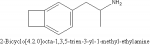

I'm sorry, but I think that your analogue has pratically no general interest:

In TCB-2, the cyclobutyl places the amine in the same position of the amine of LSD. The cyclobutyl placed in the para position acts like simple alkanes. This compound is probably similar to IAP or 3,4-xylyl-aminopropane but much more difficult to synthetise due to the huge tension of the benzocyclobutene.
 
you will have fun synthesizing a benzocylcobutane without substitution on the cyclobutane, shulgin looked at it when he was making the G series and didn't manage it.
the benzocyclobutane is isomeric with the highly reactive diene, and it is converted to the diene on heating.
it does lead to the question whether the related TCB-2 benzocyclobutane opens in vivo, there doesn't seem to be much metabolic data on these compounds????
 
Top

