• N&PD Moderators: Skorpio

Bicyclic and Tricyclic Ergoline Partial Structures...as partial dopamine agonists

kidamnesiac

Bluelighter
Joined
Oct 19, 2006
Messages
533
Bicyclic and Tricyclic Ergoline Partial Structures. Rigid 3-(2-Aminoethyl)pyrroles
and 3- and 4-(2-Aminoethyl)pyrazoles as Dopamine Agonists
Bach et al 1980 J med chem 23 : 481

Abstract:

It is proposed, based upon comparisons with apomorphine, that the rigid pyrroleethylamine moiety of the ergolines
is the portion of the molecule responsible for dopamine agonist activity. In support of this hypothesis, bicyclic and
tricyclic ergoline partial structures 6, 11,25, and 35 have been synthesized. In addition, some pyrazole isosters (37,
38, 40, and 45) of these rigid pyrroleethylamines have been made. All of the classes show dopaminergic activity
in prolactin inhibition and in lesioned rat turning assays. The most potent drugs, the linear tricyclic pyrazoles 38
(R = Pr) and 40 (R = Pr), are comparable in potency with the highly active ergoline pergolide (41).


In the conclusions:

The results reported here give strong support to the
hypothesis that the pyrroleethylamine moiety of the ergolines
is, in fact, the dopamine agonist active portion of
the class. It is evident also that the benzene ring of an
ergoline is not essential for dopaminergic activity.
Of further interest is the observation that the new partial
structures appear to be "cleaner" or "purer" dopaminergic
agents than the ergolines. For instance, isolated smooth
muscle testing of the linear BCD compounds shows none
of the serotonin antagonist (or agonist) or a-blocking activities
seen with many of the ergolines. Additional studies
on the biological evaluation of the series will be published
elsewhere.

Ran across this, thought it interesting.
Has anyone ever sampled pyrrole-propyl amine? Is it legal? If so, great opportunity for the bathroom chemyst.
Or, for that matter, other interesting aromatic propyl amines?

 
D1? dopamine agonists
tasty I suppose if you have parkinsons or leaking breasts,
otherwise useless.
there are plenty of others with varying toxicities and profiles 8 hydroxy Dipropylamino tetralin or propylamino benz cd indoles.
what wuould be much more iteresting from a recreational point of view is identifyling tha partial structure of ergolines responsable for highly potent 5ht2a agonism. I do wonder whether some substituted clavines (ergolines with the D ring opened) have activity, though I suspect the potency would be way down because of the loss of rigidity.
 
vecktor said:
D1? dopamine agonists
tasty I suppose if you have parkinsons or leaking breasts,
otherwise useless.

So how is it that DA agonists at certain receptors are "fun" and others are not? Isn't DA supposed to be a more or less universal reward chemical? How do you understand the relationship between agonism at the different DA receptors and recreational potential?
 
^Yes, please help dispel our ignorance

Here is something I ran across when looking through the same literature:

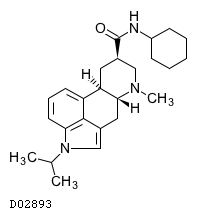
Amesergide:
D02893.gif


A very potent 5ht2a antagonist

This is the first paper that comes up in google when searching for amesergide:

Comparative 5-HT2-receptor antagonist activity of amesergide and its active metabolite 4-hydroxyamesergide in rats and rabbits.

abstract:
Amesergide is an orally active ergoline amide, 5-HT2-receptor antagonist with a long duration of action. Since a major metabolite of amesergide is 4-hydroxyamesergide, we questioned whether the formation of this metabolite might contribute to the pharmacological activity and long duration of action observed after oral administration of amesergide. 4-Hydroxyamesergide was a potent 5-HT2-receptor antagonist with an affinity equal to or greater than amesergide under in-vitro conditions as measured by blockade of vascular 5-HT2 receptors, and 5-hydroxytryptamine (5-HT)-amplified ADP-induced rabbit platelet aggregation. Furthermore, 4-hydroxyamesergide, like amesergide, inhibited the pressor response to 5-HT after its intravenous administration to rats and was about 3-fold more potent than amesergide in this regard. 4-Hydroxyamesergide was also a potent inhibitor of vascular 5-HT2 receptors after oral administration to rats. After oral administration, 4-hydroxyamesergide had a similar or slightly greater duration of activity than the parent molecule. 4-Hydroxyamesergide, again like amesergide, also blocked central 5-HT2 receptors after its in-vivo administration to rats as measured by its ability to inhibit quipazine-induced increases in serum corticosterone. Thus, the formation of 4-hydroxyamesergide after oral administration of amesergide to animals and man may contribute to the potency and long duration of action of amesergide as a 5-HT2-receptor antagonist.

I ran across the molecule from looking @ this paper, albeit very briefly:

Amesergide and Structurally Related Nor-D-ergolines: 5HT2 Receptor Interactions
in the Rat

A series of tricyclic (nor-D) partial ergolines were synthesized via a highly convergent enantiospecific
strategy, ultimately arising from a racemic tricyclic ketone. Michael addition to an acrylamide,
followed by reductive methylation, afforded the key intermediate. Selective deprotection and
oxidation provided the tricyclic ergoline. Vascular 5HT2 receptor interactions for the partial
ergolines were dramatically reduced compared to the parent ergoline, amesergide, as determined
in vivo by activation of a pressor response or blockade of 5HT-induced pressor responses in pithed
rats. The desisopropyl tricyclic ergolines possessed some modest pressor activity that was unlikely
to be related to 5HTz receptor activation since these compounds did not inhibit the pressor response
to serotonin. In contrast, the isopropyl tricyclic ergolines exhibited no agonist activity, but inhibited
the pressor response to serotonin at 1 mg/kg iv. The ergoline amesergide inhibited the pressor
response to serotonin in doses of 0.01-0.1 mg/kg iv. The homochiral isopropyl tricyclic ergoline
was more potent as a 5HT2 receptor antagonist than the epimeric (unnatural stereochemistry)
analogue. Thus, the isopropyl moiety on the indole nitrogen is important for vascular 5HT2 receptor
affinity in the rat. Most importantly, these data suggest that conformational rigidity of the ergoline
D-ring is required for optimal 5HT2 receptor interactions in the rat.


bold added by me

The paper goes over the synthesis of a number of d-ring lacking mimicks and looking at affinity.

Unfortunately, I had to get back to what I was doing before I could find more.
 
Most importantly, these data suggest that conformational rigidity of the ergoline
D-ring is required for optimal 5HT2 receptor interactions in the rat

It does look like the rigidity is due to the conjugated double bond systems right up to the carboxamide group is vitally important for activity at the 5HT2a receptor
 
Yea, that paper has some structures of the compounds missing the D ring and they look, i dunno, off somehow

I'm still curious about this dopamine thing, insights welcome!
 
hussness said:
So how is it that DA agonists at certain receptors are "fun" and others are not? Isn't DA supposed to be a more or less universal reward chemical? How do you understand the relationship between agonism at the different DA receptors and recreational potential?

I don't think agonism with a DA agonist of any individual DA receptor subtype is likely to be fun.

Dopamine is the chemical involved with most reward pathways at some point, but it is untrue to say that dopamine and dopaminergic neurons are exclusively associated with reward or that it is a universal reward chemical. The simple dopamine hypothesis of reward stems from earlier work with cocaine and the related WIN compounds which are of course not dopamine agonists but reuptake inhibitors. This concept of each neurotransmitter being associated with a certain emotion or whatever, dopamine = reward serotonin and impulsivity has been actively encouraged by the pharma industry because they wanted to sell SSRI's or DRI's and it is easy to explain this way, it unfortunately is bullshit.
From a pyschopharmalogical point of view the difference between a DRI and a dopamine agonist is that the DRI will exert proportionately more effects in areas of the brain where there is high turn over and lots of DAT mostly D1 and D2 receptors are present in the high turnover areas. in areas where there is little dopaminergic activity; the dopaminergic neurons are suppressed then a DRI will have relatively little effect. on the other hand an unselective dopamine agonist will have greater effects where there is little turnover of dopamine and so will effect different areas of the brain preferentially. (it will fil the mostly vacant receptors) . So DRI's act like unselective (with respect to subtypes) indirect agonists but are selective in exerting greater effects where there is high DAT concentrations. same goes for AMP it is more effective in areas with high DAT concentrations as it has to be taken into the neuron by a transporter before it can work.


I don't really have the time to go into major detail and I am working form memory, but essentially dopaminergic neurons are located in various areas of the brain only certain receptor subtypes in certain areas of the brain lead to recreational potential. essentially those in the mesolimbic and mesocortical pathways. other dopaminergic neurons for example those in the nigrostriatal pathway are primarily concerned with movement, stimulate these excessively and you twitch and shake. Other dopaminergic agonists are very potent emetics, make you throw up, apomorphine for example is a potent d2 agonist.


dopamine receptor subtypes differ in their location, the secondary messengers or how they induce a response once triggered, in short
D1 and D5 are cAMP stimulaters D1 like receptors
D2 D3 D5 are cAMP inhibitors.
D1 and D2 are by far the most common receptors.

D2 agonists are used medicinally as antiparkinson treatments, they have been screened for abuse potential, self administration and reinforcement and are essentially devoid of recreational potential.

D3 agonists are calmatives, which is interesting opposite to what the classical view of dopamine would say, they also stimulate growth of dopaminergc neurons. In my opinion D3 is by far the most interesting area of the dopamine system and now selective potent D3 agonists are being discovered this are could yield something novel.

I am not aware of any pure dopamine agonist that has any real history of recreational use. For the reward pathways to be triggered both D1 and D2 receptors in the mesollimbic and cortical areas, have to be stimulated, and the best way to do this is using a DRI or a dopamine releaser to increase the synaptic concentrations of DA, which will interact with both subtypes.
I continue to watch this area quite closely, I think there are some very powerful and useful knowledge not far over the horizon.

so to summarize dopamine is associated with reward and pleasure but it isn't exclusively, it does plenty more and is far more complex than the simple dopamine = reward equation

I hope this helps a little, I am no teacher, I suggest a search of google scholar, I have quite a few papers on DA that I got free from there, maybe at some point I should read them all properly.

V
 
D02893.gif

as an aside
the parabromo anilide of lysergic acid has been reported as an active hallucinogen, it is the amesergide above with the cyclohexylamine replaced with 4-br aniline and the 9-10 double bond ( lysergic rather than dihydro)
 
I don't know how I never saw this thread. Am I reviving the dead? It's an interesting one, but dopamine agonists aren't enjoyable. It's the DARIs that we enjoy, not direct agonists.

I don't think there are any direct agonists at any subtype that are enjoyable.
 
I agree that D3 agonists look to be quite interesting. Pramipexole and cabergoline, both of which affect D3 to the greatest extent (although not really selective as such, as they both act as D2 agonists as well) both cause side effects like triggering pathological gambling and hypersexual behaviour, and both are sometimes used to counteract the sexual side effects of SSRIs.

If they make gambling and sex more fun, then it would make sense that they might make drug use more enjoyable as well, although I haven't seen anything in the literature to support this.

Also has there been much research into the D4 and D5 subtypes? Most of the research I have seen is all to do with D1, D2 and D3, and there doesn't seem to be any truely selective dopamine agonists that I can find. Surely if dopamine reuptake inhibitors cause euphoria then some kind of dopamine agonist should have recreational potential...
 
Sounds like nitrous ;p ! (i reckon it's pretty boring by itself, but it's like a drug amplifier... even if you've taken only a little MDMA or LSD or whatever, it makes them A for awesome.)
Shulgin discovered a couple of compounds like that, ones that had little activity by themselves, but which dramtically boosted the effects of other drugs taken after them (I think they were psychedelics).
A more general enhancer that made pretty much everything better by providing a stronger reward component could be... dangerously recreational? heh.
Do there already exist DA modulators? Seems to me like that would be a better way of going about it, because then you amplify regions of already high activity, rather than simply making all the receptors get activated more by means of an agonist. You'd also avoid the problems of oxidative stress and monoamine depletion that you get with NDRI & VMAT stimulants.
 
Last edited:
A drug that makes other drugs more fun. Indeed, an interesting concept (one explored by Shuglin with methylenedioxy-propylamphetamine, which is inactive by itself but amplifies MDMA and 5-HT2a agonist psychedelics). In my experience, the drug that makes all other drugs more fun is THC. Cannabinoids always bring a little to the table--making everything else just that much more enjoyable.

I don't think dopamine is necessarily the answer for creation of such an 'auxiliary' drug. Since no specific dopamine receptor directly correlates with reward and the mesocorticolimbic dopamine pathway is already activated by amphetamines and psychedelics, involving other neurotransmitter systems might be a more fruitful approach.
 
mad_scientist said:
I agree that D3 agonists look to be quite interesting. Pramipexole and cabergoline, both of which affect D3 to the greatest extent (although not really selective as such, as they both act as D2 agonists as well) both cause side effects like triggering pathological gambling and hypersexual behaviour, and both are sometimes used to counteract the sexual side effects of SSRIs.

If they make gambling and sex more fun, then it would make sense that they might make drug use more enjoyable as well, although I haven't seen anything in the literature to support this.

Also has there been much research into the D4 and D5 subtypes? Most of the research I have seen is all to do with D1, D2 and D3, and there doesn't seem to be any truely selective dopamine agonists that I can find. Surely if dopamine reuptake inhibitors cause euphoria then some kind of dopamine agonist should have recreational potential...

I think you're mistaking what those substances are doing. They're not making sex and drugs more fun, they're causing impulsive behavior, plain and simple. Impulsive behavior and fun aren't neccessarily linked- at least when you're altering brain chemistry. When you're fucking around with Dopamine agonists, you can seperate the two.

So, considering that we've never found a dopamine agonist with (real) recreational potential, I think it's probably the wrong road to go down.
 
Yeah I guess its more likely that dopamine agonists would just make you crave drugs more and want to redose constantly rather than actually making them any more fun.

I was thinking about whether they might be good to mix with fun drugs that don't release dopamine themselves, but that would mainly mean hallucinogens, and seeing as dopamine antagonists are a good antidote for when trips go bad, taking dopamine agonists while tripping would just be asking for trouble...

On the other hand though pramipexole and cabergoline both sometimes get prescribed to increase libido in people who are on SSRIs (pramipexole more often now days as cabergoline has been shown to cause cardiac fibrosis) and so I dunno if its as simple as just saying that they trigger impulsive behaviours, they might make normal (i.e. non-drug) fun activities more fun.

I was reading a few case studies and one guy who started on pramipexole started going fishing the whole time....fishing was his thing, and so once he started on the drug he just wanted to be out fishing constantly, to the exclusion of all else....could definitely see that turning out bad when the activity you enjoy doing is gambling or taking hard drugs though!!
 
I think that it had less to do with him enjoying it more than with him becoming obsessed with it. Not obsessed, I can't think of the right word. Complulsion? I'm not sure.

I think that the fact that these dopamine agonists cause impulsive behavior that this might provide a clue into obsessive compulsive disorder more than anything else has.

I think that no one's going to become obsessed or compelled to cut out paper snowflakes or write out thank-you notes, so the object of compulsion needs to be enjoyable to begin with. I think that the agonist will take away your ability to say 'no' to something when you ordinarily would- and cause you to keep doing that at-least-somewhat enjoyable activity.

I'm having trouble trying to verbalize this sort of behavior, because it's hard to think of seperating compulsive/impulsive behavior without the positive consequences we normally see linked together.

Hammilton
loving TiVO
 
Top