• N&PD Moderators: Skorpio

beta ketone analogs

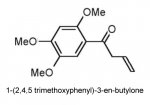
Here's a posible interesting naturally occuring beta-keto I have some potential to work with.

No it's not a phenethylamine as there's no nitrogen in there (see attached jpeg) and most likely inactive.


PS. You've already posted about this in PD. Double posting is verboten - don't do it again
 

Attachments

  • asarone derivative.JPG
    asarone derivative.JPG
    25 KB · Views: 290
I apologize for the double post. Though its no excuse I was having difficulty staying logged in yesterday and didn't think my post had stuck here. Ill do my best to keep it from happening again. Btw thank you for the answer. I'd never seen or heard of a butylone group being used in any compound until now.
 
If I remember correctly, someone on what used to be The Hive once posted their synthesis and bioasssay of 4-bromomethcathinone, and reported a +++ on a shulgin scale.

I suppose this would be bk-PBMA.
 
I can't find the earlier thread where FnF talk about phenylpropenamine anologs.

Do you think they would be psychoactive? For example the alkene analog of amphetamine where the double bond is on carbon 1?

Feels like stuff will happen to that double bond once in the body?
 
fastandbulbous said:
^ good chance of being neurotoxic as well though (para-bromomethamphetamine is)

Yep (apparently 4-iodometh (also toxic) is an adultrant from some HI/RP synth screwups), and I'm willing to bet on that as well, especially that 4-bromoamphetamine is toxic as well.

That being said, since 4-FA is seemingly less toxic than the others, and I find it to be a decent compound, I would be interested in seeing what its bk analogues have to offer.
 
And did anyone taste 4-bromomethamphetamin?Aren't the bk's less toxic?PMMA is another toxic one (toxic means psychologically complex) but is in fact as good as MDMA.
 
Unless you are depressed:

"Novel aminopropiophenones as potential antidepressants. Foley, Kevin F.; Cozzi, Nicholas V. Department of Pharmacology and Toxicology, Brody School of Medicine, East Carolina University, Greenville, NC, USA. Drug Development Research (2003), 60(4), 252-260. Publisher: Wiley-Liss, Inc., CODEN: DDREDK ISSN: 0272-4391. Journal written in English. CAN 140:297283 AN 2003:954697 CAPLUS

Abstract

The atypical antidepressant drug bupropion and the psychostimulant drug methcathinone are both members of a chem. class known as aminopropiophenones. Differences in the psychoactive effects of these two drugs result from small variations in their chem. structures, but the relationship between chem. structure and psychoactivity has not been characterized. To investigate how structural modifications to aminopropiophenones affect antidepressant or stimulant activity, we synthesized several analogs of bupropion and methcathinone and tested the new compds. for antidepressant-like or psychostimulant effects. The synthesized compds. are 2-(methylamino)-1-(3-bromophenyl)propan-1-one (3-BMAP), 2-(methylamino)-1-(4-bromophenyl)propan-1-one (4-BMAP), 2-(iso-propylamino)-1-phenylpropan-1-one (i-PAP), and 2-(tert-butylamino)-1-phenylpropan-1-one (t-BAP). Bupropion, methcathinone, desipramine, and the newly-synthesized aminopropiophenones were administered to rats for behavioral testing. We used the Porsolt swim test to assess antidepressant-like activity and a locomotor activity assay to test for psychostimulant effects. All of the compds. displayed antidepressant-like effects in the Porsolt swim test. Some compds., including bupropion, increased locomotor activity at moderate-to-high doses. A halogenated analog of methcathinone, 4-BMAP, increased swim time but did not stimulate locomotor activity, even at the highest dose tested. The data indicate that Ph ring substitution or branched alkylamines can shift the psychopharmacol. profile of aminopropiophenones from stimulant activity to antidepressant-like activity. Several of the new drugs may be effective antidepressants in humans with fewer stimulant-like side effects compared to bupropion. "

 
^ I'm not denying that they'd be active, just that I wouldn't fancy the possible long term consequences of taking them!

It doesn't mention any long term follow up on the animals fed the para-bromomethcathinone ( 2-(methylamino)-1-(4-bromophenyl)propan-1-one/4-BMAP ), either in terms of behavioural or neurophysiological consequences.


BTW it's things like the swim test that stopped me wanting to continue in research - basically it's a 'swim or die' test of activity - depressed animals give up faster and drown. Just didn't sit well with me - to much of a 'tree-hugger' mentality at heart, I suppose!
 
If I remember correctly, someone on what used to be The Hive once posted their synthesis and bioasssay of 4-bromomethcathinone, and reported a +++ on a shulgin scale.

I suppose this would be bk-PBMA.

a plus 3 on a bk? that'd be a sight to see
 
F&B, do you think that such dimers can be biologically active?
I have seen info on such polymers compound in meth after Rp/I synth, and one mane on hyperlab synthed polyamphetamines(2-amphetamine) and found that it is psychoactive.
And the main question, can this happen to pyrrolydinopropio and valerophenones? Can it happen to MDPV freebase?

Beta-ketone primary amines are stable, but only when in salt form (ie while in protonated ammonium form), or else cathinone wouldn't exist at all. When it comes to getting to them via a synthetic route that's not involving enzymes (like cathinone), then at some point it's almost inevitable that you'll need to do an acid/base extraction, involving the substituted cathinone in alkaline soln; as a result, you end up with the diamer formation (ie. you're fucked!).


Actually, none of the psychedelic amphetamines or phenethylamines would work

See attached jpeg
 
Yep (apparently 4-iodometh (also toxic) is an adultrant from some HI/RP synth screwups), and I'm willing to bet on that as well, especially that 4-bromoamphetamine is toxic as well.

That being said, since 4-FA is seemingly less toxic than the others, and I find it to be a decent compound, I would be interested in seeing what its bk analogues have to offer.

It is NO 4-iodomet, it's and a meth with an I in OH position of an ephedrine.
 
F&B, do you think that such dimers can be biologically active?
I have seen info on such polymers compound in meth after Rp/I synth, and one mane on hyperlab synthed polyamphetamines(2-amphetamine) and found that it is psychoactive.
And the main question, can this happen to pyrrolydinopropio and valerophenones? Can it happen to MDPV freebase?

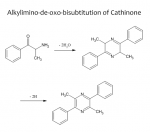
The dimers only form in the presence of a primary amine and a ketone group, because a primary amine will displace the ketone and form an imine by alkylimino-de-oxo-bisubstitution. This happens twice to form the dimer. It's much less spontaneous for secondary amines than it is for primary amines, hence why methcathinones do not form dimers readily. Secondary amines can form aminals with carbonyl groups, but this doesn't appear to be a problem for methcathinone. The pyrrolidine-substituted cathinones are all tertiary amines and will never encounter this problem.

The activity of the compounds is probably not all that likely and I imagine it must have been tried at some point. In Catha edulis, the problem with the plants and time is that a beta-reductase/beta-ketohydroxylase forms norpseudoephedrine/cathine from the much more active cathinone, not the actual dimerization as far I know. See page 31 of "The alkaloids: chemistry and pharmacology" by Arnold Brossi.
 

Attachments

  • cathinone.png
    cathinone.png
    10.6 KB · Views: 628
he's saying that 4-iodomethamphetamine isn't formed by messed up synth. He's saying that beta-iodo-methamphetamine is formed.

just very poorly. Don't think that 4-iodo-methamp could be a side product from that synth. from what I remember of halogenation of benzene rings, it's not gonna happen.
 
^ Well now I understand, thanks :)

In that case, I apologize for the mixup between the two compounds.

That said, I clearly recall a paper by shulgin about 4-FA where he clearly states that it is advantageous over all other 4-halogenated amphetamines by being the only one that isn't severely toxic.
 
Digging up an old post here, but I have a quick question or two for anyone who can answer.

If I am reading this correctly, the consensus is that we are not seeing more beta keto substituted PEA's (other than the stimulants and the entactogens) because the synths would be considerably harder (if not impossible?)

I was really trying to find some information on things like beta keto TMA-2, which (at least from the perspective of a novice) would appear to be straightforward. Could bk-TMA-2 not be synthed with TMA-2 as a starting point with some reasonable yield?

Does anyone know if any of these are known and active? (other than the shulgin quote earlier in the thread.) I was afraid perhaps we were not seeing any bk-DOB or bk-2c-B because the ketone did something to destroy HT receptor affinity and they lacked activity.

It would be nice to see a published result somewhere just to know that it was possible. Perhaps one of these days...?

*Edit*
I just found this journal article in another thread http://www.sciencedirect.com/scienc...serid=10&md5=6638898d475b246eace9ea739cf06fbd

The abstract indicates that while MDA will subsitute for both DOM and amphetamine in rats trained to discriminate those chemicals, bk-MDA (named MDC in the article) only partially substituted for amphetamine and did not significantly substitute for DOM. Now I know that MDA is quite unique in that, as far as I know, it is the only PEA that is TRULY both an entactogen and a classic psychedelic. I would be willing to bet that bk-MDA would substitute for methylone in rats.

A truly useful discrimination study to determine if psychedelic PEAs can maintain their psychedelic activity with the addition of a keto group in the beta position would be to see if bk-DOM substituted for DOM in rats. Does anyone have access to any published findings about such a study, or know of one being done? I am running out of information about this subject.
 
Last edited:
Top