slimvictor
Bluelight Crew
After decades of misguided hysteria, the War on Drugs may have an epidemic worth freaking out about, and it's spreading across state and demographic lines at the speed of the Internet. NATASHA VARGAS-COOPER travels the country to uncover the way-less-glamorous-than-it-sounds world of bath salts, which has already come to a strip mall near you.
On an unseasonably hot and muggy May afternoon, a squad of armed agents from the Franklin County Drug Task Force — some wearing street clothes, some wearing menacing ski masks — swarms into a storefront aptly named the Joint. Sandwiched between a liquor store and a sex shop, and adjacent to the Ohio State University campus, the Joint is one of 18 different head shops, gas stations, carryout restaurants, and mini-marts being searched this day by seven task force teams consisting of several dozen officers from numerous local police departments and prosecutors' offices, all spearheaded by the County Sheriff here in the state capital.
Make no mistake: This is no ordinary pot bust. The raids are part of the ongoing Operation Synthetic Drugs, a highly coordinated and choreographed sweep through central Ohio. The target of this operation — which has received assistance from the DEA and the FBI — is a strand of a relatively obscure but insidiously metastasizing illegal substance marketed under the name "bath salts," a deceptively innocuous moniker used to disguise the drug as a benign household product.
As small knots of sweaty tweakers gape from across the street, visibly frustrated that one of their favorite haunts is being hit, the law-enforcement troops inside the Joint hit pay dirt. After a meticulous, two-and-a-half-hour ceiling-to-floor toss, the cops emerge with a bulging Hefty bag and cardboard cartons brimming with $70,000 worth of synthetic marijuana known as Spice and what they assume to be bath salts, the latter being sold in little foil packets. By the time night falls, the task force teams seize $250,000 in illegal synthetic drugs in the greater Columbus area. Selling and possessing bath salts in Ohio is a felony, yet due to loopholes in state and federal laws, the anonymity of the Internet, and the pace at which the chemicals can be altered, prosecuting anyone above a street-level seller and buyer currently poses a stiff challenge.
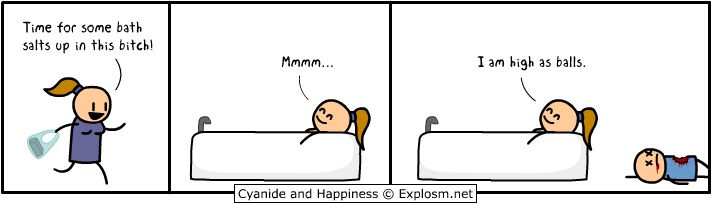
About two years ago, bath salts — a lab-brewed drug that unpredictably mimics a freakish combination of coke, meth, and Ecstasy — suddenly popped into public consciousness with a rat-tat-tat of reports from emergency rooms and law-enforcement officials that sounded like the stuff of a D.A.R.E. officer's most florid nightmare. By most accounts, the drug — then legal — first surfaced in Louisiana in mid-2010, quickly moved through the South, and then spread out in all directions. It was, in fact, in Louisiana where one of the first Code Red warnings about bath salts emerged, when a user lost her arm and part of her shoulder after she shot herself up and sparked a flesh-eating bacteria.
Not all drugs are created equal. Unlike, say, meth, bath salts transcend class. They most often establish a beachhead in college towns where head shops tend to cluster. To generalize, there are two types of users: college-age kids who want to get high without engaging in criminal activity and just plain drug addicts looking for a hassle-free fix.
In some sense, bath salts are an exercise in decriminalization. Buying drugs, especially hard narcotics, is often a seedy experience: You have to go to dangerous areas to obtain them, make the transaction with active, often violent, criminals, and then sweat at stoplights, hoping to make it back home without a felony possession charge. But the way the synthetic drug market currently exists, you can walk into a climate-controlled shop, slide your ATM card under the glass, and walk out. Or you can skip all that and just order online. The casualness of the purchase, the sterilization of the exchange, is part of what makes bath salts so pernicious and appealing. And the ease with which key chemical compounds can be disseminated, and thus adjusted to stay one step ahead of the law, ensures that the drug stays decriminalized.
cont at
http://www.spin.com/articles/bathlands-deep-heart-americas-new-drug-nightmare