



Work-in-progress. This article attempts to address the confusion regarding the different chemicals found in morning glory seeds. Click here to see a list of the different chemicals found in morning glory seeds.
-
Bruce Eisner: Well, people could say the same thing about LSD, they could say there’s sassafras and there’s nutmeg in nature, and there is morning glories and ergot in nature, but you have to do the chemistry in order to make something that’s effective.
Owsley: No, that’s not true. Ergot contains many natural, highly psychedelic alkaloids. Iso-ergine is one of them, hydroxyethyl-lysergamide* is another one, and in fact, is considered nearly identical to LSD in effect. Albert Hoffman told me so himself. They believe that it was this derivative contained in extracts of c.paspalum that was used in the Eleusian Mysteries.
Eisner, Bruce. "Interview with an Alchemist: Bear Owsley Interview." Bruce Eisner's Writings DOWNLOAD
-
Original article says hydroxy-methyl-lysergamide in place of hydroxyethyl-lysergamide. The latter is obviously a type-o of the former. Hydroxyethyl-lysergamide is a synonym of lysergic acid hydroxyethylamide:
lysergic acid alpha-hydroxyethylamide
lysergic acid methyl carbinolamide
N-(alpha-Hydroxyethyl)lysergamide
(S)-9,10-Didehydro-N-(1-hydroxyethyl)-6-methylergoline-8beta-carboxamide
Ergoline-8-carboxamide, 9,10-didehydro-N-(1-hydroxyethyl)-6-methyl-, (8-beta)-
Lysergamide, N-(1-hydroxyethyl)- (7CI)
(8beta)-N-(1-hydroxyethyl)-6-methyl-9,10-didehydroergoline-8-carboxamide
Source: http://www.guidechem.com/reference/dic-628998.html
There are other minor issues with the above quote. Why did Owsley reference isoergine, but not ergine? Nichols says the iso epimers of lysergamides are generally inactive.[1] And "many natural, highly psychedelic alakloids?" More like one or two. Ergonovine has been found to be psychedelic,[2][3] but Bigwood et al (ref. # 3) found that unnaturally high doses were needed to achieve good effects. I think a typical ergot or morning glory seeds preparation contains pretty low numbers of ergonovine; I still need to do calculations on the chemical analyses to see... Off the bat, I can say that Hofmann says this: "We were able to isolate the active principles responsible for the effect of these seeds and I was quite astonished to find out that these seeds contained as the active principles monoamide and hydroxyethylamide of lysergic acid and a bit of ergonovine."[4]
Gröger 1963[5] found lysergic acid hydroxyethylamide ("LAH") to be in greater quantity than ergine. Other analyses have found LAH to be in only small amounts. This could indicate LAH quickly decomposes simply when sitting in morning glory seeds; fresh seeds may only contain significant quantities of LAH. A web search will show that there is a rumor that only fresh morning glory seeds are truly psychedelic.
One issue with lysergic acid hydroxyethylamide is that it may simply convert to ergine in the body.[6][7][8][9][10] One Peter Webster pointed out at the 2006 LSD Symposium that ergine is unique in that it exists in three different forms.[11] He feels that only an equilibrium of the three different forms of ergine produce maximal psychedelic effects. wesbter doesn't acknowledge the presence of LAH, but I will add to his hypothesis that if lysergic acid hydroxyethylamide decomoses in the body, the ergine(s) that arise as such may be different than the ergine(s) found in a batch of seeds in which the LAH had decomposed.
This is a list of all the ergoline alkaloids that have been found in morning glory seeds. Note that many of these have only been found in small amounts.
chanoclavine-I
chanoclavine-II
rac. chanoclavine-II
agroclavine
festuclavine
dihydrolysergol-I (α-dihydrolysergol)
elymoclavine
lysergol
isolysergol
setoclavine
isosetoclavine
penniclavine
molliclavine
ergine
lysergic acid α-hydroxyethylamide
ergonovine
ergosine
Source: Solanaceae and Convolvulaceae: Secondary Metabolites: Biosynthesis, Chemotaxonomy, Biological and Economics Significance (a Handbook). Eckart Eich. 2008. pp. 241–245.[12]
These pages present tables showing all known ergoline-containing morning glory plants and all known ergolines contained in said plants. This selection can be downloaded here.
Chanoclavine is a prominent alkaloid found in these seeds, however Peter Webster has criticized its capability of being a contributor to the activity of these seeds:
Even the seldom faulted Merck Index lists chanoclavine as a possible active principle of ololiuhqui, a lysergic acid related alkaloid present in minor quantities in some samples of ololiuhqui and ergot as well, although no reports of its psychoactive nature have ever been reported. And indeed, if we believe the testimony of those who have told us how the Central American shamans prepare ololiuhqui, namely by cold water extraction of finely powdered seeds, then chanoclavine must be ruled out as it is almost totally insoluble in water. Chanoclavine is not even an amide. Nor has anyone shown any other chemical species in ololiuhqui to be suitably psychoactive.[12]
Shroomery member, i_was_the_walrus commented on the above quote:
And I really doubt chanoclavine would be active. Of all the 4 isomers of LSD, only 1 is active. It seems to rely quite heavily on the optical specificity. With chanoclavine, the carbon (8 on LSD) is unsaturated and achiral. If it has any biological activity, I'm betting it would be well into the milligram range. (Mar. 22, 2015)[13]
End for now.
1. 2006 LSD Symposium. See quote here: http://www.bluelight.org/vb/entries...er-Webster-at-the-2006-LSD-Symposium-(ergine)
2. Albert Hofmann in The Road to Eleusis: Unveiling the Secret of the Mysteries. R. G. Wasson, Albert Hofmann, and Carl A. P. Ruck, 1978. DOWNLOAD
See bottom of first column on page 10.
3. Entheogenic Effects of Ergonovine. Jeremy Bigwood, Jonathan Ott, Catherine Thompson, Patricia Neely. The Journal of Psychedelic Drugs, 11(1-2), Jan-Jun. 1979. DOWNLOAD
4. Stanislav Grof Interviews Dr. Albert Hofmann (1984). MAPS Bulletin 9.2 (Fall 2001): 22–35. http://www.maps.org/news-letters/v11n2/11222gro.html
5. Gröger D. Über das Vorkommen von Ergolinderivaten in Ipomoea-Arten. Flora 153:373-382. 1963. DOWNLOAD
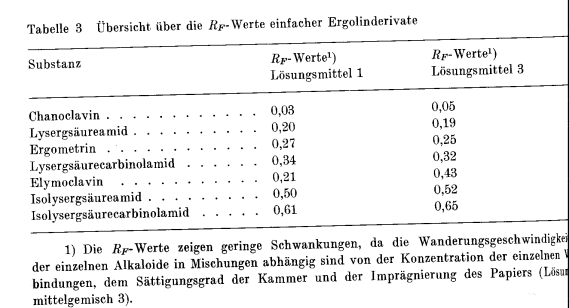
NOTE: Lysergic acid carbinolamide is a synonym for lysergic acid hydroxyethylamide (see GuideChem reference at top of message).
6. easily decomposes in a weak acid solution to form ergine and acetaldehyde.
Stoll, A. and Hofmann, A. (1965) The ergot alkaloids. Located in R.H.F. Manske (ed.), The Alkaloids, Vol. VIII, Academic Press, New York, Chap. 21, p. 747
NOTE: ergine is a synonym for lysergic acid amide.
7. ready cleavage under hot aqueous conditions, yielding D-lysergamide and acetaldehyde.
N. Castagnoli, jun., K. Corbett, E.B. Chain, and R. Thomas, (1970) Biosynthesis of N-(a-Hydroxyethyl)lysergamide, a Metabolite of Claviceps paspali, Biochem. J., 117, 451
Note: lysergamide is a synonym for lysergic acid amide.
8. The α-hydroxyethylamide spontaneously decomposes to lysergic acid amide, and the naturally-occurring amide may arise by this process.
Heinz G. Floss & John A. Anderson. 'Biosynthesis of Ergot Toxins' (1980) in The Biosynthesis of Mycotoxins (Pieter S. Steyn, ed.), Elsevier, p. 21 (2012)
9. this material is quite unstable and is easily converted in the process of isolation.
TiHKAL (part 1). Alexander Shulgin. 1997. P. 313
10. These compounds,* although well documented as components in the Convolvulaceae, are possibly lost in several of the analyses of alkaloid composition. They are extremely unstable, and are very readily degraded into acetaldehyde and the corresponding amide, ergine or isoergine. In these instances their presence will be measured only by the elevated levels of the derived amides.
Alexander Shulgin. Psychopharmacological Agents, Vol. 4 (ed. Maxwell Gordon), Elsevier, Dec 2, 2012
*lysergic acid hydroxyethylamide & isolysergic acid hydroxyethylamide
11. https://www.youtube.com/watch?v=NJS25nEcdZg
12. Solanaceae and Convolvulaceae: Secondary Metabolites: Biosynthesis, Chemotaxonomy, Biological and Economics Significance (a Handbook). Eckart Eich. 2008. pp. 241–245.
13. Sacred Mushrooms of the Goddess and the Secrets of Eleusis. Carl A.P. Ruck (editor). 2006. pp. 178–179.
NOTE: The above publication contains a transcription of Webster's speech at the 2006 LSD symposum (reference #11).
14. Shroomery member, i_was_the_walrus. Personal correspondence. Mar. 22, 2015.
-
Bruce Eisner: Well, people could say the same thing about LSD, they could say there’s sassafras and there’s nutmeg in nature, and there is morning glories and ergot in nature, but you have to do the chemistry in order to make something that’s effective.
Owsley: No, that’s not true. Ergot contains many natural, highly psychedelic alkaloids. Iso-ergine is one of them, hydroxyethyl-lysergamide* is another one, and in fact, is considered nearly identical to LSD in effect. Albert Hoffman told me so himself. They believe that it was this derivative contained in extracts of c.paspalum that was used in the Eleusian Mysteries.
Eisner, Bruce. "Interview with an Alchemist: Bear Owsley Interview." Bruce Eisner's Writings DOWNLOAD
-
Original article says hydroxy-methyl-lysergamide in place of hydroxyethyl-lysergamide. The latter is obviously a type-o of the former. Hydroxyethyl-lysergamide is a synonym of lysergic acid hydroxyethylamide:
lysergic acid alpha-hydroxyethylamide
lysergic acid methyl carbinolamide
N-(alpha-Hydroxyethyl)lysergamide
(S)-9,10-Didehydro-N-(1-hydroxyethyl)-6-methylergoline-8beta-carboxamide
Ergoline-8-carboxamide, 9,10-didehydro-N-(1-hydroxyethyl)-6-methyl-, (8-beta)-
Lysergamide, N-(1-hydroxyethyl)- (7CI)
(8beta)-N-(1-hydroxyethyl)-6-methyl-9,10-didehydroergoline-8-carboxamide
Source: http://www.guidechem.com/reference/dic-628998.html
There are other minor issues with the above quote. Why did Owsley reference isoergine, but not ergine? Nichols says the iso epimers of lysergamides are generally inactive.[1] And "many natural, highly psychedelic alakloids?" More like one or two. Ergonovine has been found to be psychedelic,[2][3] but Bigwood et al (ref. # 3) found that unnaturally high doses were needed to achieve good effects. I think a typical ergot or morning glory seeds preparation contains pretty low numbers of ergonovine; I still need to do calculations on the chemical analyses to see... Off the bat, I can say that Hofmann says this: "We were able to isolate the active principles responsible for the effect of these seeds and I was quite astonished to find out that these seeds contained as the active principles monoamide and hydroxyethylamide of lysergic acid and a bit of ergonovine."[4]
Gröger 1963[5] found lysergic acid hydroxyethylamide ("LAH") to be in greater quantity than ergine. Other analyses have found LAH to be in only small amounts. This could indicate LAH quickly decomposes simply when sitting in morning glory seeds; fresh seeds may only contain significant quantities of LAH. A web search will show that there is a rumor that only fresh morning glory seeds are truly psychedelic.
One issue with lysergic acid hydroxyethylamide is that it may simply convert to ergine in the body.[6][7][8][9][10] One Peter Webster pointed out at the 2006 LSD Symposium that ergine is unique in that it exists in three different forms.[11] He feels that only an equilibrium of the three different forms of ergine produce maximal psychedelic effects. wesbter doesn't acknowledge the presence of LAH, but I will add to his hypothesis that if lysergic acid hydroxyethylamide decomoses in the body, the ergine(s) that arise as such may be different than the ergine(s) found in a batch of seeds in which the LAH had decomposed.
This is a list of all the ergoline alkaloids that have been found in morning glory seeds. Note that many of these have only been found in small amounts.
chanoclavine-I
chanoclavine-II
rac. chanoclavine-II
agroclavine
festuclavine
dihydrolysergol-I (α-dihydrolysergol)
elymoclavine
lysergol
isolysergol
setoclavine
isosetoclavine
penniclavine
molliclavine
ergine
lysergic acid α-hydroxyethylamide
ergonovine
ergosine
Source: Solanaceae and Convolvulaceae: Secondary Metabolites: Biosynthesis, Chemotaxonomy, Biological and Economics Significance (a Handbook). Eckart Eich. 2008. pp. 241–245.[12]
These pages present tables showing all known ergoline-containing morning glory plants and all known ergolines contained in said plants. This selection can be downloaded here.
Chanoclavine is a prominent alkaloid found in these seeds, however Peter Webster has criticized its capability of being a contributor to the activity of these seeds:
Even the seldom faulted Merck Index lists chanoclavine as a possible active principle of ololiuhqui, a lysergic acid related alkaloid present in minor quantities in some samples of ololiuhqui and ergot as well, although no reports of its psychoactive nature have ever been reported. And indeed, if we believe the testimony of those who have told us how the Central American shamans prepare ololiuhqui, namely by cold water extraction of finely powdered seeds, then chanoclavine must be ruled out as it is almost totally insoluble in water. Chanoclavine is not even an amide. Nor has anyone shown any other chemical species in ololiuhqui to be suitably psychoactive.[12]
Shroomery member, i_was_the_walrus commented on the above quote:
And I really doubt chanoclavine would be active. Of all the 4 isomers of LSD, only 1 is active. It seems to rely quite heavily on the optical specificity. With chanoclavine, the carbon (8 on LSD) is unsaturated and achiral. If it has any biological activity, I'm betting it would be well into the milligram range. (Mar. 22, 2015)[13]
End for now.
1. 2006 LSD Symposium. See quote here: http://www.bluelight.org/vb/entries...er-Webster-at-the-2006-LSD-Symposium-(ergine)
2. Albert Hofmann in The Road to Eleusis: Unveiling the Secret of the Mysteries. R. G. Wasson, Albert Hofmann, and Carl A. P. Ruck, 1978. DOWNLOAD
See bottom of first column on page 10.
3. Entheogenic Effects of Ergonovine. Jeremy Bigwood, Jonathan Ott, Catherine Thompson, Patricia Neely. The Journal of Psychedelic Drugs, 11(1-2), Jan-Jun. 1979. DOWNLOAD
4. Stanislav Grof Interviews Dr. Albert Hofmann (1984). MAPS Bulletin 9.2 (Fall 2001): 22–35. http://www.maps.org/news-letters/v11n2/11222gro.html
5. Gröger D. Über das Vorkommen von Ergolinderivaten in Ipomoea-Arten. Flora 153:373-382. 1963. DOWNLOAD
NOTE: Lysergic acid carbinolamide is a synonym for lysergic acid hydroxyethylamide (see GuideChem reference at top of message).
6. easily decomposes in a weak acid solution to form ergine and acetaldehyde.
Stoll, A. and Hofmann, A. (1965) The ergot alkaloids. Located in R.H.F. Manske (ed.), The Alkaloids, Vol. VIII, Academic Press, New York, Chap. 21, p. 747
NOTE: ergine is a synonym for lysergic acid amide.
7. ready cleavage under hot aqueous conditions, yielding D-lysergamide and acetaldehyde.
N. Castagnoli, jun., K. Corbett, E.B. Chain, and R. Thomas, (1970) Biosynthesis of N-(a-Hydroxyethyl)lysergamide, a Metabolite of Claviceps paspali, Biochem. J., 117, 451
Note: lysergamide is a synonym for lysergic acid amide.
8. The α-hydroxyethylamide spontaneously decomposes to lysergic acid amide, and the naturally-occurring amide may arise by this process.
Heinz G. Floss & John A. Anderson. 'Biosynthesis of Ergot Toxins' (1980) in The Biosynthesis of Mycotoxins (Pieter S. Steyn, ed.), Elsevier, p. 21 (2012)
9. this material is quite unstable and is easily converted in the process of isolation.
TiHKAL (part 1). Alexander Shulgin. 1997. P. 313
10. These compounds,* although well documented as components in the Convolvulaceae, are possibly lost in several of the analyses of alkaloid composition. They are extremely unstable, and are very readily degraded into acetaldehyde and the corresponding amide, ergine or isoergine. In these instances their presence will be measured only by the elevated levels of the derived amides.
Alexander Shulgin. Psychopharmacological Agents, Vol. 4 (ed. Maxwell Gordon), Elsevier, Dec 2, 2012
*lysergic acid hydroxyethylamide & isolysergic acid hydroxyethylamide
11. https://www.youtube.com/watch?v=NJS25nEcdZg
12. Solanaceae and Convolvulaceae: Secondary Metabolites: Biosynthesis, Chemotaxonomy, Biological and Economics Significance (a Handbook). Eckart Eich. 2008. pp. 241–245.
13. Sacred Mushrooms of the Goddess and the Secrets of Eleusis. Carl A.P. Ruck (editor). 2006. pp. 178–179.
NOTE: The above publication contains a transcription of Webster's speech at the 2006 LSD symposum (reference #11).
14. Shroomery member, i_was_the_walrus. Personal correspondence. Mar. 22, 2015.



