• N&PD Moderators: Skorpio

A question to all our metabolic pathway expects (or even those with a basic know-how)

Nagelfar

Bluelight Crew
Joined
Nov 23, 2007
Messages
2,527
Location
Vancouver, Washington USA
A question to all our metabolic pathway experts (or even those with a basic know-how)

200px-2%27-Acetoxycocaine.svg.png


How would the acetoxy group on the above be metabolized in-vivo (humans)? I know an acetyl group is rapidly cleaved; (a la heroin being a pro-drug and yet more strong due to lipophilicity and quick cleavage through metabolism of the constituent) but would acetoxy do the same? Would 2-ortho-hydroxy me an immediate metabolite or just cocaine? And is the acetoxy likely to be the first metabolized constituent over benzoyl branch / tropane skeleton separation, carbmethoxy heptatic de-methylation and/or nitrogen demethylation?

Thanks.

I think this being "among the first" semi-synthetics of cocaine on WP may be the most promising for giving a better euphoric "burst" than cocaine (however a question of intrinsic 'safety' remains)
 
Last edited:

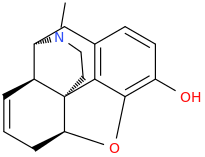
Mhm, unfortunately I don't think this will do well as a cocaine "semi-synthetic" as heroin does to morphine. Consider the structures of morphine and heroin respectively below:

(5%CE%B1%2C6%CE%B1)-7%2C8-didehydro-%204%2C5-epoxy-17-methylmorphinan-3%2C6-diol.png


(5%CE%B1%2C6%CE%B1)-7%2C8-didehydro-4%2C5-epoxy-17-methylmorphinan-3%2C6-diol%20diacetate.png


Morphine already has 2 hydroxy groups (on the 3 and 6 positions) meaning conversion of these groups into acetyl groups will lead to increased logP and increased BBB penetration. However, that is not to say that the following compound (didehydrodesomorphine) will be less potent than morphine or heroin (in fact, it is more potent than both, due to much increased logP).

7%2C8-didehydro-4%2C5%CE%B1-epoxy-17-methylmorphinan-3-ol.png


Coming back to the original question, replacement of a hydrogen with an acetoxy will reduce logP and thus slow down BBB penetration. The order of substitutions on say a benzene ring with fastest BBB penetration first is the following: Bromine > Chlorine > Fluorine > H > acetoxy ~= alkyl ester > hydroxy > carboxylic acid > nitro. Note the increasing polarity as the group descends. A compound must have a logP of approximately 2 to 3 to penetrate the BBB well.

Cocaine will by no means be a metabolite of the compound you posted itself; liver enzymes that turn phenols into benzene rings would've been eliminated by natural selection a long time ago as they do not help but rather hinder in the excretion process of these kinds of compounds (benzene is harder to excrete than phenol because it is more lipophilic; more lipophilic compounds are generally harder to excrete because they can cross back into the bloodstream from the collecting duct walls in the nephron). 2-ortho-hydroxycocaine would however be an intermediate.

Nitrogen demethylation would probably be the last metabolic event to happen, and I doubt it happens to great extent. What is likely to happen is breakage of the 3 ester bonds in OP molecule. Each of these products are very easy to excrete and thus the liver would not require/get a chance to further metabolise.
 
Last edited:
Coming back to the original question, replacement of a hydrogen with an acetoxy will reduce logP and thus slow down BBB penetration. The order of substitutions on say a benzene ring with fastest BBB penetration first is the following: Bromine > Chlorine > Fluorine > H > acetoxy ~= alkyl ester > hydroxy > carboxylic acid > nitro. Note the increasing polarity as the group descends. A compound must have a logP of approximately 2 to 3 to penetrate the BBB well.

Strange, the reference Neuroreport 8 (16): 3571–5. doi:10.1097/00001756-199711100-00030. PMID 9427328 Seale et al. claims it is a cocaine analog "with a quicker effect onset than cocaine" itself. Why would that be, then?

would change from 2-acetoxy to 2-hydroxy be rapid? (at least enough to be first likely change?)
 
Last edited:
http://www.molinspiration.com/cgi-bin/properties

The above program calculates cocaine logP as 2.62. The compound listed above is generated a logP of 2.01. A logP of 2 is optimum for crossing the BBB, lipophilic enough to cross it easily, but not too lipophilic such that it accumulates in fatty tissue etc (like benzodiazepines - very lipophilic - IV administration still has a slightly delayed onset for this reason).

I did not think this to initially be the case as I had a feeling cocaine itself would have a logP of around 2 closer to 2.62. Note that logP is a logarithmic scale, so cocaine is approximately 4 times more lipophilic than the listed compound.

Nevertheless, low logP compounds in general will be excreted faster.
 
http://www.molinspiration.com/cgi-bin/properties

The above program calculates cocaine logP as 2.62. The compound listed above is generated a logP of 2.01. A logP of 2 is optimum for crossing the BBB, lipophilic enough to cross it easily, but not too lipophilic such that it accumulates in fatty tissue etc (like benzodiazepines - very lipophilic - IV administration still has a slightly delayed onset for this reason).

I did not think this to initially be the case as I had a feeling cocaine itself would have a logP of around 2 closer to 2.62. Note that logP is a logarithmic scale, so cocaine is approximately 4 times more lipophilic than the listed compound.

Nevertheless, low logP compounds in general will be excreted faster.

So would the acetoxy, after crossing the BBB with its 2.01 (almost perfect) logP, allow its 2-hydroxy metabolite to be more readily accessed to its transporter site despite its 2.89 logP (worse than cocaine itself?) and again, how rapid would this change occur?
 
The program is predicting a higher log P for the 2-hydroxy metabolite than cocaine (2.64 & 2.62 respectively); this shouldn't be the case and the program does make mistakes often. http://www.molinspiration.com/services/logp.html for error analysis.

Benzene logP (ether/water) is 2.43 whereas phenol is 1.12, a significant decrease. Something similar should happen here. I wouldn't expect the 2-ortho-hydroxy metabolite to cross the brain really. http://www.rsc.org/suppdata/nj/b3/b303016d/b303016d.pdf

Also, metabolism wouldn't take place in the brain, it takes place within the liver, in hepatocytes.

Once the molecule is in the brain and near its target cells (i.e. pharmacokinetic challenges have been surpassed), then logP matters a lot less than binding interactions. Of course a high logP compound would be important if the binding pocket of the target protein had many lipophilic amino acid residues (like valine, leucine, phenylalanine etc).

If the 2-hydroxy metabolite were to enter the brain and get near dopaminergic neurons, you would have to look at the binding pocket of the transporter protein to see what kinds of interactions it will form. I think the aromatic part of cocaine forms an interaction with a tyrosine residue in DAT, so the phenolic group could possibly form a hydrogen bond with the nearby phenolic group of tyrosine itself. I'm not too certain however.
 
Indeed, 2'-hydroxy- and 2'-acetoxy-cocaine are very potent at DAT. It is a good bet that the acetoxy compound would show better CNS penetration than the OH compound, and that acetoxy would be metabolized to OH.

If the 2-hydroxy metabolite were to enter the brain and get near dopaminergic neurons, you would have to look at the binding pocket of the transporter protein to see what kinds of interactions it will form. I think the aromatic part of cocaine forms an interaction with a tyrosine residue in DAT, so the phenolic group could possibly form a hydrogen bond with the nearby phenolic group of tyrosine itself. I'm not too certain however.

H-bonds only form at specific angles and it is unlikely that the same residue could form an H-bond and a van der Waals interaction with 2'-OH-cocaine. But it is a good guess that the OH is H-bonding to some residue in DAT.
 
Last edited:
H-bonds only form at specific angles and it is unlikely that the same residue could form an H-bond and a van der Waals interaction with 2'-OH-cocaine. But it is a good guess that the OH is H-bonding to some residue in DAT.

According to Singh's antagonist paper the 2'-hydroxy analog shows increased behavioral stimulation on par with the phenyltropanes, likely due to the hydroxy interacting at the binding pocket differently with how far the phenyl is out from the target on cocaine.

Also, metabolism wouldn't take place in the brain, it takes place within the liver, in hepatocytes.

De-acetylation wouldn't? Isn't what you say only so-called *first pass* metabolism? If that's the case, why does heroin work how it does being a pro-drug and inactive with its 3-position acetylation?
 
De-acetylation wouldn't? Isn't what you say only so-called *first pass* metabolism? If that's the case, why does heroin work how it does being a pro-drug and inactive with its 3-position acetylation?

First pass metabolism occurs because when a drug (or any substance really) enters the stomach and eventually the intestines, once it gets absorbed into the bloodstream, it is taken directly through to the liver via the hepatic portal vein. This doesn't happen with other administration routes like IV, rectal & intranasal, which is why in a lot of cases a higher bioavailability can be achieved using these sorts of ROAs.

However, once the drug has gone through the liver, it enters circulation and then goes to the brain. But only a small amount of the drug actually crosses the brain. The rest will then cycle back round to the liver again, to be attacked by metabolic enzymes again. The cycle continues. There aren't many metabolic enzymes in the brain, and the ones that are there are for regulation of the brain, not removal of xenobiotic compounds.

Heroin works because some of heroin in the liver will be metabolised to 6-MAM. This compound is very potent and once it crosses the brain it can fully agonise mu receptors with high affinity. However, any heroin converted to 3-MAM by the liver will cross the brain, but it will not bind to mu receptors strongly. This is because a 3-hydroxy group is very important for opioid activity. It acts as a crucial H-bond donor, and if it is replaced with anything else, such as a methoxy (codeine) or acetoxy (3-MAM), affinity for receptors drops.

On the other hand, the 6 position tolerates many substitutions, even accommodating large alkyl substituents, suggesting a lipophilic pocket exists near carbon 6 when the opioid is bound to the receptor. Thus 6-MAM will not only cross the BBB better, but it might actually increase affinity itself (I haven't seen the values, maybe someone can expand on this).
 
On the other hand, the 6 position tolerates many substitutions, even accommodating large alkyl substituents, suggesting a lipophilic pocket exists near carbon 6 when the opioid is bound to the receptor. Thus 6-MAM will not only cross the BBB better, but it might actually increase affinity itself (I haven't seen the values, maybe someone can expand on this).

Yes I have elucidated myself on the above. On this specific quoted point, however, I remember reading that 6 position additions had affinity for the mu3 subtype, which others have said, I think, is present just in immune cells.

Anyhow, what I really wanted to know was how much the 2-hydroxy metabolite would add-to/affect the in vivo dynamics of the 2-acetoxy cocaine analog. I've yet to be able to glean a good estimation from the responses I've read thus far.
 
Yes I have elucidated myself on the above. On this specific quoted point, however, I remember reading that 6 position additions had affinity for the mu3 subtype, which others have said, I think, is present just in immune cells.

Anyhow, what I really wanted to know was how much the 2-hydroxy metabolite would add-to/affect the in vivo dynamics of the 2-acetoxy cocaine analog. I've yet to be able to glean a good estimation from the responses I've read thus far.

It wouldn't play a big role if the acetoxy compound was administered first. Because as the 2-hydroxy metabolite is formed, roughly equal concetrations of other metabolites with the ester bonds being broken will form. So as a very rough estimate, the maximum concentrations of the 2-hydroxy metabolite you could get is 1/3 of the original acetoxy molecule. It's much likely to be much less than this value. Furthermore, the hydroxy metabolites generated won't be able to cross the brain well. Only if it is maybe an order of magnitude+ more effective than the acetoxy compound could you then start to consider it playing a role in its effects.
 
I thought many enzymatic processes (e.g ester bond breakage) could occur in the brain as well. If what you're saying is correct, aced, then wouldn't a big portion of unmetabolized IV heroin travel to the brain and just get stuck there, thereby decreasing the overall mu opioid binding of a given dose as opposed to the same dose of morphine? I was under the impression that IV heroin's main deacetylation occured in the brain.
 
Everything is in equilibrium; the unmetabolized heroin will cross the brain, sure. But it will start to pass back out of the brain once the bloodstream concentration falls. There'll be a ratio of heroin in the brain: heroin in the blood which will equilibrate and stay constant.
 
That of course, sorry I may have worded my point poorly. IV heroin provides more of a rush/kick than morphine, but with the "slow" deacetylation that wouldn't be the case, would it?

E: unless 6-MAM is sufficiently more potent than morphine. Anyway if you say that the deacetylation doesn't happen in the brain, I'll take your word for it.
 
I'm pretty sure deacetylation doesn't happen in the brain, but of course I can't be 100% sure. Esterases (eg acetylcholinesterase) do exist in the brain (not for removal of xenobiotic compounds but rather regulation of neurotransmitters), but I think the majority of deacetylation will take place in the liver.

Nevertheless for the argument that heroin provides more of a rush than morphine, possible esterases in the brain would have to deacetylate it really quickly. This is unlikely because the esterases in the brain would have specific sites for specific substrates, and not substrates like heroin. There will be esterases in the liver however which are designed for xenobiotic compound metabolism and they will have a much more generous active site.

Heroin might just provide a greater rush than morphine because it is indeed deacetylated very quickly in the liver. I'm not too sure but I've heard a lot of people say morphine and heroin IV shots compare similarly on an mg to mg ratio. Although if the 3 position is deacetylated quickly that would imply the 6 position would be as well (giving morphine) suggesting that a big part of heroin's effects are due to metabolic conversion to morphine.
 
unless 6-MAM is sufficiently more potent than morphine.

it is, I thought by a factor of 2-4x

because the esterases in the brain would have specific sites for specific substrates, and not substrates like heroin.

except for the presence of nonspecific esterases e.g. butyrylcholinesterase and the fact that heroin will hydrolyse on its own in aqueous soln's. It's not like the brain is devoid of enzymes that can break ester bonds.

I'm not too sure but I've heard a lot of people say morphine and heroin IV shots compare similarly on an mg to mg ratio.

The experience is quite similar if you adjust for the relative potencies, I remember reading the average user can't tell the difference...


To answer the parent question, I'd expect 2-AcO cocaine to be fairly rapidly hydrolysed to 2-OH-cocaine. Whether or not it works as a prodrug or if it sticks around remains to be seen.

Either way I'd bet it's a fun compound. Shame it would be a bastard to make, just like any of the other BzEcgonines...
 
I'm pretty sure deacetylation doesn't happen in the brain, but of course I can't be 100% sure. Esterases (eg acetylcholinesterase) do exist in the brain (not for removal of xenobiotic compounds but rather regulation of neurotransmitters), but I think the majority of deacetylation will take place in the liver.

I find your statements very contradictory: the brain contains esterases but could not hydrolyze acetoxycocaine? In fact, esterases in the brain play an important role in detoxifying many exogenous compounds, including esters.

Most of the deacetylation would probably occur in plasma, which contains several enzymes that can hydrolyze esters -- acetylcholinesterase, butyrylcholinesterase, paraoxonase. Red blood cell membrane also contain carboxylesterase, which is one of the enzymes that hydrolyzes cocaine. Those hydrolytic enzymes are also found in many tissues throughout the body, including in the brain, intestines and liver.
 
I meant to say that brain esterases would be specific to a certain substrate and not heroin or the cocaine analogue. If that's not true then fair enough.

Butyrylcholinesterase is a non-specific enzyme which hydrolyses choline based molecules. I'm sceptical that these other molecules will be metabolised by this enzyme.

My point anyway was that most of the molecule would be hydrolysed outside of the brain, and the little amount that is hydrolysed in the brain would likely not play a big role in the drug's mode of action unless it has a much higher binding affinity than the parent ester molecule.

@sekio the ester molecule will hydrolyse in aqueous media but body pH is around neutral therefore the rate of reaction is slow.
 
On a different note would ester drugs taken orally suffer from hydrolysis while in the stomach? Eg a lot of ritalin will hydrolyse into ritalinic acid in the stomach; water and ester is in excess while acid is there for catalysis.
 
On a different note would ester drugs taken orally suffer from hydrolysis while in the stomach?

Yes, this is why cocaine/methylphenidate have rather lower oral BA than is ideal.

Butyrylcholinesterase is a non-specific enzyme which hydrolyses choline based molecules. I'm sceptical that these other molecules will be metabolised by this enzyme.

Well, do some reading - it's one of the major enzymes that degrades xenobiotic anesthetics like cocaine.[ref] Don't judge enzymes exclusively by their names, so to speak...
 
Top