
Ham-milton
Bluelighter
- Joined
- Jul 20, 2007
- Messages
- 5,738
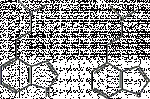
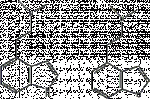
I was wondering if any ultra-short duration PEAs have been synthesized or tested. Would either of these two modified peas be active?





N&PD Moderators: Skorpio
You are using an out of date browser. It may not display this or other websites correctly.
You should upgrade or use an alternative browser.
A PEA version of DMT?
Ham-milton
Bluelighter
I was wondering if any ultra-short duration PEAs have been synthesized or tested. Would either of these two modified peas be active?

Ham-milton said:
I was wondering if any ultra-short duration PEAs have been synthesized or tested. Would either of these two modified peas be active?
what logic drew you to draw those structures?
either way I would suggest caution given where the furan is substituted.
V
Ham-milton
Bluelighter
less than no logic. stoned inspiration? the dry spell was over

Morninggloryseed
Bluelight Crew
If I recall, benzodifuran analogues with a side-chain are dangerous/heptatotoxic.

ChemicalSmiles
Ex-Bluelighter
Say whaaaaa? I feel stupid.
Ham-milton
Bluelighter
Easily? I'm not sure what you're getting at. I'm not sure that 'analogue' is the correct term (homologue?), but it's the one I see used most often for this type of thing. Neither of the structures I posted above are truly a PEA analogue of DMT- more of a hemifly-DMT, I suppose.
You're thinking like 5-MeO-DMT being an analogue of DMT, and DiPT being an analogue of MiPT, that sort of way, I think. In a legal sense, a PEA analogue of DMT wouldn't be considered an analogue of DMT. They'd be too structurally diverse, but in a sense, they are structural analogues of eachother.
I think this is an issue of terminology issues. I'm probably using the wrong terms. I don't have a formal background in this field, and have essentially taught myself everything, so I've certainly got some gaps in my education.
The reason I went with the ring the way I did was because I thought it'd work better to have a chain like the 2C's all do, and that I didn't think the longer side chain would be very stable. I redrew it the way I was originally thinking. I imagine that that chain would be eaten up internally pretty rapidly. But then again, so is DMT.
This is a truer PEA analogue of DMT:
 Last edited:
Ham-milton
Bluelighter
I think you're right, but there's also the desire to keep it really short acting and intense (though actually a 10 minute mushroom-intensity trip would be pretty sweet)- so using an MAOI + this PEA might be a good idea.
then again, PEAs are potentially dangerous in conjunction with MAOIs.

Reminisant B
Greenlighter
^I don't think you can really claim an exact structure from "the PEA of DMT" as that description is too vague but I know what you mean.
Surely the following would be more logical as it keeps with the dragonfly/lsd theory of 5ht2a receptors.
Most likely inactive (The dimethyls won't work the same amongst other reasons?) but to me if we're discussing it would be the most logical molecule for "the PEA of DMT" ignoring potential activity.
Attachments
Last edited:
Ham-milton
Bluelighter
which following molecule are you talking about? Sorry, I'm a little confused.
That was the reason I used the benzodifuran, but if, with side-chains they're hepatoxic, they're probably a bad idea.
Reminisant B
Greenlighter
I don't know about the benzofuran side chain hepatotoxicity but even ignoring that adding another long alyklamine group (so you have two in total in the molecules above) is going to greatly overcomplicate the molecule and most likely add others mechanism of action or inhibit its binding due to steric hindrance.
The non-substitued benzofuran series is known (the hemifly) and to me either that or the indole version I have shown would be a more logical compound for "the PEA of DMT" as it roughly follows the bromo-dragonfly/lsd similarity logic.
The only problem being the dimethyl substitution doesn't work well with PEA's so for that reason alone might not work.
Attachments
Last edited:
Reminisant B
Greenlighter

From left to right: DMT, Phenethylamine, DMT/Phenethylamine "hybrid"
That seems like a suitable analogue for both. Plus, the 3,4 positions on the "phenethylamine" are covered by the "tryptamine" thus, allowing for greater chances of it not being broken down into nothing before it's active. Now, let's work on some substitution points!
In theory, isnt this like 5-Ethanamine-DMT? 5-EA-DMT? 5-EthA-DMT? Any takers?
Reminisant B
Greenlighter
^your structure is remarkably close to sumatriptan...
http://en.wikipedia.org/wiki/Sumatriptan
minus SO2 + methyl group.
doubt it would be similar in effects to DMT
[Zolmitriptan contains the exact structure + extra ring system]
http://en.wikipedia.org/wiki/Zolmitriptan
Ham-milton
Bluelighter
No, I'm afraid it wouldn't. Would probably be a great vasodilator.
What's known about the benzo[di]isoxazoles?
Reminisant B
Greenlighter
your compound otb01 as it is similar to triptans - although I think ham-milton means vasoconstriction as that's what occurs with triptans in the cranial and basilar arteries (brain) => good for headaches
The logic for benzo[di]isoxazoles is risperidone, paliperidone and similar compounds are benzo[di]isoxazoles and are very potent 5ht2a antagonists. If you look at the structures however they look as though the 4-Methyl-piperidine is acting as the antagonist part. Very similar to other molecules which change from being an agonist to an antagonist by such modifications.
Also the benzo[di]isoxazole group will share many of the physicochemical properties of the indole group.
Maybe modification of the structure of the compound I have proposed could be beneficial. Zolmitriptan contains modifications on the "phenethylamine" side and it does not have vasoconstriction listed as a side effect. (Unless the side effect of "feelings of tightness" is just a codeword for vasoconstriction)
Ham-milton
Bluelighter
yeah, I meant vasoconstrictor. Thanks for fixing that for me.
It's not listed as a side effect because it's not a side effect- it's the intended effect. That's how it gets rid of the migraine.
![Benzo[d]isoxazole.gif](/community/data/attachments/2/2940-96f0832d767545c9038bff3901c91689.jpg?hash=lvCDLXZ1Rc)