• N&PD Moderators: Skorpio

A few molecule-structure opioid questions.

Nagelfar

Bluelight Crew
Joined
Nov 23, 2007
Messages
2,527
Location
Vancouver, Washington USA
1) Is it possible to acetylate oxycodone or any other such similar drug to morphine to make a prodrug form like heroin is to morphine? Acetylated oxycodone etc.

2) Does anyone know what structure to the basic opioid molecular structure expresses the difference in histamine reaction; and was this purposesly removed in some of the (semi-)synthetics? Could it theoretically be recreated to have a more intense histamine reaction in a synthesized drug (i.e. for the purposes of reaching the body high, itchiness, that draws so many to the naturals before the synthetics)

3) If fentanyl is a full synthetic, and the histamine reaction is supposed to cause the rush when IV'ing the drug, why do so many say they experience a very intense rush from fentanyl, but a 'cold' non-histamine-reaction like euphoria? Other drugs with a greatly lessened histamine reaction like oxycodone have "no" rush, no red spot at the injection site, no fuzzy feeling, etc. Is histamine not as tied to the rush as some believe?

 
I believe the extreme histamine response is caused by phenanthrene opioids alklyated at the 3-position.

That's why shooting codeine, dihydrocodeine, ethylmorphine, hydrocodone etc. is a big no-no. Oxycodone is exempt because of the extra hydroxy group which doesn't allow it to interact with mast cells.

Morphine & heroin also cause a histamine response, but not nearly as dramatic as iv codeine.
 
Also I'm sure it's possible to acetylate oxycodone but since you're acetylating an oxygen attached to a very stable & sterically hindered tertiary carbon, I'm not sure your esterase enzymes would be able to chew it off.

Oxycodone.png
 
Thank you for the responses.

wungchow said:
Also I'm sure it's possible to acetylate oxycodone but since you're acetylating an oxygen attached to a very stable & sterically hindered tertiary carbon, I'm not sure your esterase enzymes would be able to chew it off.

Oxycodone.png

So actylated oxycodone is likely to be inactive and never metabolized into an active compound before being excreted in some manner?
 
Nope...not 'never', but it is likely that the ester hydrolysis happens quite slowly.

From the chemical point of view, the synthesis of such an ester is indeed possible.
 
Ethoxy group at the 14-position was found to increase potency dramatically on methopon. Which is just hydromorphone with a methyl in a very odd position, was it 5 or something.
 
So, and not actually discussing synthesis here, would the method to acetylate oxycodone be the same as acetylating morphine theoretically, or due to the different 'edges' of the chemical would an entirely new process have to be devised?
 
The enol tautomer of oxycodone can be acylated and this would have better BBB penetration. There's a similar version with acetyldihydrocodeinone (acetylated enol tautomer of hydrocodone).

For maximum 'clout', they propionyl esters are better (dipropionylmorphine is more potent than heroin/diacetylmorphine)
 
fastandbulbous said:
The enol tautomer of oxycodone can be acylated and this would have better BBB penetration.

So here's a pertinent question. If something crosses the blood-brain-barrier quickly, but takes longer to metabolize into an active constituent molecule, as this proposed substance would, do those effects cancel out each other? or once something crosses the BBB does it stay in the brain and not leave back into the blood stream etc?

Also no one has touched on my #3 question really.
 
The rush is from the active opioid rapidly penetrating the BBB and activating mu-opioid receptors... the side-effect of histamine release causes additional effects such as the "Pins and needles" and warm fuzzy feeling, but it's not solely responsible for the rush.

I imagine if you shot a low dose of a compound with low intrinsic opioid activity such as ethylmorphine, you'd feel only the massive histamine release.
 
wungchow said:
The rush is from the active opioid rapidly penetrating the BBB and activating mu-opioid receptors... the side-effect of histamine release causes additional effects such as the "Pins and needles" and warm fuzzy feeling, but it's not solely responsible for the rush.

I imagine if you shot a low dose of a compound with low intrinsic opioid activity such as ethylmorphine, you'd feel only the massive histamine release.

So doesn't this mean oxycodone should deliver the rush when IV'd as well? Many say it does not, or does it not cross the BBB quickly enough?
 
dread said:
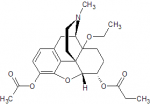
I have it now... the perfect opioid.

View attachment 6359

Except the H at the 5 postn should be a methyl group (ALA metropon). Not sure if esterase enzymes would cleave the propinoyl being so sterically hindered though
Also substituting the ethoxy at 14 for something like phenylpropoxy makes it stronger, but then again stronger aint always better. But interestingly enough, substution of N-cyclopropyl and/or N-allyl does not make for antagonists as one would expect. Strange. Obviously it has to do with the phenylpropoxy but In winder how that works...
 
Nagelfar said:
Also no one has touched on my #3 question really.

Rush is a function of drug plasma levels with time. And as such (as posted above), the quicker the mu receptors are activated, the bigger the rush is percieved to be
 
djsim, if we were only looking for potency, then a N-furylethyl-group would be the way to go. Anyway potency is not necessary a good thing, too much and dosing will become too inconvenient...
 
dread said:
djsim, if we were only looking for potency, then a N-furylethyl-group would be the way to go. Anyway potency is not necessary a good thing, too much and dosing will become too inconvenient...

Yeh I understand. I'm not an opioid user anymore, and have never done H, but I would imagine most users people would rather 1kg of H over 1-2g pure fentanyl, so yeah, point taken, potency isn't the best indcator of a good opioid/opiate since we'd be stuck on IV etorphine or intra-spinal 14methoxy-metopon.
Didnt know that about furylethyl... very interesting.
 
Hammilton said:
IIRC, 3,6-propionylmorphine was tops with the monkeys (over heroin)

which gets converted to morphine ALA diacetylmorphine yes? I'd imagine the increased lipid solubility would be at play...
PS. what happened to your old account Hammilton?
 
djsim said:
Yeh I understand. I'm not an opioid user anymore, and have never done H, but I would imagine most users people would rather 1kg of H over 1-2g pure fentanyl, so yeah, point taken, potency isn't the best indcator of a good opioid/opiate since we'd be stuck on IV etorphine or intra-spinal 14methoxy-metopon.
Didnt know that about furylethyl... very interesting.

N-furylethyl > N-thienylethyl > N-phenethyl. I think almost any aromatic ring + ethyl connected to the nitrogen would increase potency in morphine-derivates.
 
Here's a question- on open chain opiates like methadone, is there any known reason why alcohol groups on the quaternary carbon render them inactive (or is this not always true?). I'm thinking of trihexyphenidyl and why it's inactive.
Also...
Where the tertiary nitrogen is contained in a piperidine ring is it always true that it is only active where the 2-carbon chain at least partly composed of that ring (instead of connecting to the nitrogen and being seperate, as in trihexyphenidyl)?
 
Top