Anyone have any experience with 8-OH-DPAT? Its a full agonist at the 5-HT1A receptor, which not only stimulates DA but also Oxytocin release. Buspar (Buspirone) and its analogues seem to be only shitty partial agonists and nearly useless. Would it be possible however to have a drug that would give the pleasant emotional bonding effects without the related neurotoxicity issues of MDMA? It seems it would be needed to be taken sublingually as it has rather poor bioavailability. Apparently there are some intriguing studies with mice on PubMed but no data available on humans.




-
Neuroscience & Pharmacology Discussion Welcome Guest
Posting Rules Bluelight Rules Recent Journal Articles Chemistry Mega-Thread FREE Chemistry Databases! Self-Education Guide -
N&PD Moderators: Skorpio
You are using an out of date browser. It may not display this or other websites correctly.
You should upgrade or use an alternative browser.8-OH-DPAT, 5-HT1A Full Agonists
- Thread starter kendoka
- Start date


melange
Bluelighter
it is not fully selective
one day I will get a custom synth of thiswould this be a more interesting HT1A agonist?
http://en.wikipedia.org/wiki/LY-293,284
Structurally similar, and it sounds like it's cleaner.PsychedelicPeptide
Greenlighter
- Joined
- Jul 28, 2008
- Messages
- 721
Damn I really like the look of the LY-293,284 structure. That would be a fun one to get a hold of.
I came across a Nichols paper comparing Aripiprazole with LY-293,284, saying that Arip. could substitute for the LY compound in an in vivo test. Turns out Arip. is a high potency agonist at 5HT1A (see: http://en.wikipedia.org/wiki/Aripiprazole).
You could potentially get an idea for what a pure 5HT1A agonist could do based on possibly some of Arip's effects/"side effects" in vivo (for which there are many human studies), but certainly this is complicated by the broad pharmacological profile of Arip (see wiki link) and partial agonist aspect of things. There is probably too much noise there to pull anything out but who knows...
Psychopharmacology (Berl). 2004 Apr;172(4):415-21.
Aripiprazole (OPC-14597) fully substitutes for the 5-HT1A receptor agonist LY293284 in the drug discrimination assay in rats.
Marona-Lewicka D, Nichols DE.
Department of Medicinal Chemistry and Molecular Pharmacology, School of Pharmacy-RHPH, Purdue University, 575 Stadium Mall Drive, West Lafayette, IN 47907-2091, USA.
Abstract
RATIONALE: Aripiprazole (OPC-14597) is a novel atypical antipsychotic drug with a low incidence of side effects. The therapeutic action of aripiprazole has been attributed to its unique agonist/antagonist effects at D(2) dopamine receptors; however, aripiprazole also has significant in vitro affinity at 5-HT(1A) receptors.
OBJECTIVES: The 5-HT(1A) agonist property of aripiprazole has so far not been evaluated in any in vivo assay.
METHODS: Thirteen male Sprague Dawley rats trained to discriminate the 5-HT(1A) agonist LY 293284 (75 nmol/kg) from saline, using a fixed ratio (FR) 50 schedule of food-reinforcement in a two-lever operant-conditioning task, were used to evaluate the behavioral effect of aripiprazole at 5-HT(1A) receptors.
RESULTS: Aripiprazole fully mimicked LY 293284 in a drug-discrimination assay with an ED(50) of 1.39 micromol/kg (0.62 mg/kg). In combination tests, aripiprazole did not block the LY 293284 cue but at 8.92 micromol/kg (4 mg/kg) significantly reduced the response rate by lowering the threshold for induction of the 5-HT syndrome produced by the training dose of LY 293284. Moreover, the selective 5HT(1A) receptor antagonist WAY 100635 was able to block the substitution of aripiprazole in LY-293284 trained rats.
CONCLUSION: Although the efficacy of aripiprazole against the positive symptoms of schizophrenia may be related to its dopamine receptor interactions, it seems possible that its atypical profile may derive, at least in part, from its 5-HT(1A) agonist effect, rather than from unusual D(2) receptor properties.Last edited:
atara
Bluelighter
5-MeO-MiPT has a high 5-ht1a affinity. It produces entactogenic effects at low doses, but a strong, unpleasant bodyload at higher doses possibly linked to activation of 5-ht3 or 5-ht2c.
Synaps3
Bluelighter
- Joined
- Sep 14, 2011
- Messages
- 260
I'm thinking about ordering some of this from china. Do you think it would be worth it? What do you think the dosing would be? I want to know how much I would need to get a good idea of effects. I am not expecting something psychedelic, more of just a mood enhancement.
SKL
Bluelight Crew
- Joined
- Sep 15, 2007
- Messages
- 14,629
bumped because I really like the potential of the this class of chemicals
I'd been discussing a few possible variations on this theme in the random molecules thread, here
8-OH-DPAT
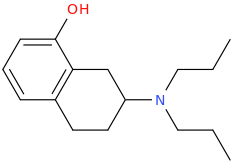
a fancy of mine, DPATscaline( ), recalls Nichols' jimscaline

more later but just wanted to get in here as this is a molecule that really tickles my fancy
I think there is some psychiatric potential here (in 8-oh-dpat)
also some potential as a sex drug
or as a treatment for sexual difficulties 2/t, e.g., psych meds
see: flibanserin, very diff structure but some similarities in pharmacology
derivatives (c.f. mescaline/2Cx, even mephedrone) might prove quite recreational
the thing itself, I'd be curious to try
but has some red-flagging side effects, e.g. bradycardia and hypotension IIRCserotonin2A
Bluelighter
- Joined
- Sep 13, 2014
- Messages
- 1,341
I don't think any of these would produce the effects that folks here are seeking. Psilocybin obviously is a full 5-HT1A agonist. When psilocybin is administered in combination with a 5-HT2A antagonist, subjects reported sedative effects/cognitive impairment, but they didn't find it especially enjoyable. 5-HT1A activation is probably not interesting if you are looking for recreational effects. There are some rodent studies suggesting 8-OH-DPAT produces MDMA-like effects, but that probably occurs due to the fact that it has some affinity for SERT and acts as a weak 5-HT releaser. You can get exactly the same effect from TFMPP.
Hiltoniano
Bluelighter
So has anyone taken, or know someone else who's taken any off these very selective agonists; i.e. 'Arip' and the odd looking molecule LY-293,284 ???? These seem interesting and I'm very curious what these kind of drugs feel like and whetherr it's similar to any other drug, as a point of reference . Sounds pretty unique? I have journal access but can't find much regarding the actual nature of the drugs effect.serotonin2A
Bluelighter
- Joined
- Sep 13, 2014
- Messages
- 1,341
People probably haven't tried them.
I think you should consider the fact that 5-MeO-DMT, one of the most potent 5-HT1A agonists that people routinely ingest, is not very fun. Rats treated with DPAT show exactly the same "serotonin syndrome" symptoms as rats given 5-MeO-DMT. The serotonin syndrome symptoms induced by 5-MeO are probably the rodent version of the uncomfortable physical symptoms experienced by human users of 5-MeO.Last edited:Neuroprotection
Bluelighter
- Joined
- Apr 18, 2015
- Messages
- 1,265
I agree with you there. I have long pondered over what it would be like to take a purely 5ht1A agonist compound. However I eventually came to the conclusion that this wouldn't give a particularly enjoyable experience. Its like the case of dopamine, selective D2 agonists e.g. apomorphine and bromocriptine are rather disphoric and strongly anxiogenic, despite the role of D2 receptors in reward.Neuroprotection
Bluelighter
- Joined
- Apr 18, 2015
- Messages
- 1,265
what do you think it is about 5ht1A activation that causes the unpleasant physical symptoms? Is it their vasoconstrictive or cardiac affects. Also, could it be that these compounds stimulate other serotonin receptors causing the side affectsserotonin2A
Bluelighter
- Joined
- Sep 13, 2014
- Messages
- 1,341
The serotonin syndrome symptoms are definitely caused by 5-HT1A -- they can be blocked by selective antagonists, and the effects do not occur if the 5-HT1A gene is deleted.
One of the roles of the 5-HT system is to regulate motor behavior. There are high levels of 5-HT1A receptors in motor neurons in the brain and spinal cord.Last edited:
TheBlackPirate
Bluelighter
- Joined
- Dec 16, 2015
- Messages
- 680
... because consuming the hyper-selective full 5HT2A agonists 25X-NBOMe was very successful, if you ignore the fatalities of course. I think I learned my lesson. The classic psychedelics effects and safety are dependent upon agonizing multiple receptors. These selective 5HT1A agoinsts could have fatal results, they could cause long-term problems, taking these is gambling. I will pass.Last edited:Neuroprotection
Bluelighter
- Joined
- Apr 18, 2015
- Messages
- 1,265
One of the roles of the 5-HT system is to regulate motor behavior. There are high levels of 5-HT1A receptors in motor neurons in the brain and spinal cord.[/QUOTE]
Does this explain why serotonin is currently being studied as an alternative target for parkinsons disease, after the discovery that MDMA temperaly eliminated all disease symptoms, more strongly than would be expected for just a dopaminergic stimulant.The serotonin syndrome symptoms are definitely caused by 5-HT1A -- they can be blocked by selective antagonists, and the effects do not occur if the 5-HT1A gene is deleted.
One of the roles of the 5-HT system is to regulate motor behavior. There are high levels of 5-HT1A receptors in motor neurons in the brain and spinal cord.
Is it really? From everything I've read, full 5HT1A agonists lower the body temperature and one of the major effects of serotonin syndrome is hyperthermia. I had also read that 2B played a role in preventing hyperthermia with MDMA but can't find a source for that. Plus there's all the exciting heart valve issues with that receptor
https://en.wikipedia.org/wiki/Eptapirone
http://www.nature.com/npp/journal/v31/n10/full/1301088a.html
There are a number of 5-HT1A agonists in some clinical stage or research as antidepressants as of now like: https://en.wikipedia.org/wiki/Osemozotan
Most of them can just be found on the wikipedia entry for the 5-HT1A receptor.
Interestingly methylphenidate/dexmethylphenidate have an affinity for the aforementioned receptor. This affinity may also play a role in the dopamine release by methylphenidate which is somewhat unexplained since it lacks the TAAR1 agonism of amphetamine. I am prescribed the latter and can definitely feel some of the familiar effects of 5-HT1A agonism in comparison to other stimulants which has made it a far more therapeutic agent for myself. http://www.ncbi.nlm.nih.gov/pubmed/19322953
And as mentioned before Buspirone is complete and utter trash. I would be interesting to model the difference in receptor conformations docking BuSpar vs something effective.serotonin2A
Bluelighter
- Joined
- Sep 13, 2014
- Messages
- 1,341
Is it really? From everything I've read, full 5HT1A agonists lower the body temperature and one of the major effects of serotonin syndrome is hyperthermia. I had also read that 2B played a role in preventing hyperthermia with MDMA but can't find a source for that. Plus there's all the exciting heart valve issues with that receptor
https://en.wikipedia.org/wiki/Eptapirone
http://www.nature.com/npp/journal/v31/n10/full/1301088a.html
There are a number of 5-HT1A agonists in some clinical stage or research as antidepressants as of now like: https://en.wikipedia.org/wiki/Osemozotan
Most of them can just be found on the wikipedia entry for the 5-HT1A receptor.
Interestingly methylphenidate/dexmethylphenidate have an affinity for the aforementioned receptor. This affinity may also play a role in the dopamine release by methylphenidate which is somewhat unexplained since it lacks the TAAR1 agonism of amphetamine. I am prescribed the latter and can definitely feel some of the familiar effects of 5-HT1A agonism in comparison to other stimulants which has made it a far more therapeutic agent for myself. http://www.ncbi.nlm.nih.gov/pubmed/19322953
And as mentioned before Buspirone is complete and utter trash. I would be interesting to model the difference in receptor conformations docking BuSpar vs something effective.
You are confusing two different things. I was talking about the behavioral syndrome in rodents, not the toxidrome in humans. They are not the same thing. There is a serotonin syndrome in rodents that is induced by 5-HT1A activation. It consists of behaviors such as flat body posture, lateral head weaving, tremor, and hindlimb abduction. That is why I said that I was talking about the serotonin syndrome in rats.You are confusing two different things. I was talking about the behavioral syndrome in rodents, not the toxidrome in humans. They are not the same thing. There is a serotonin syndrome in rodents that is induced by 5-HT1A activation. It consists of behaviors such as flat body posture, lateral head weaving, tremor, and hindlimb abduction. That is why I said that I was talking about the serotonin syndrome in rats.
This is not the case in human though correct? From what I gather the mechanism in humans is not entirely understood. I've read cases where people simply being on an SSRI exhibiting symptoms of serotonin syndrome.serotonin2A
Bluelighter
- Joined
- Sep 13, 2014
- Messages
- 1,341
They are entirely different things.
Serotonin syndrome in humans isn't something that you can have symptoms of, without having the full syndrome -- you either have the syndrome or you don't. Having the syndrome means that you are severly ill, and you would have to be hospitalized. Other than clonus, all the other symptoms of serotonin syndrome are non-specific, and are common responses to serotonin receptor activation.