23536
Bluelight Crew
Oxygens in furan rings are not considered hydrogen bond acceptors to my knowledge.
the bottom slide on page 20 of this very cool power point seems to agree with you.




N&PD Moderators: Skorpio
You are using an out of date browser. It may not display this or other websites correctly.
You should upgrade or use an alternative browser.
6-(1H-indol-3-yl)ethanamine
23536
Bluelight Crew
Oxygens in furan rings are not considered hydrogen bond acceptors to my knowledge.
the bottom slide on page 20 of this very cool power point seems to agree with you.


atara
Bluelighter
If this is true, why does 5-APB show MDMA like properties? The oxygen in 5-APB is in a benzofuran ring. Oxygens in furan rings are not considered hydrogen bond acceptors to my knowledge.
'cuz SAR is hard. AET also has MDMA like properties, so does indeloxazine (or so we think).
When I said "ideal" I was just noting a common trend. In particular, 6-APDB has the meta-H-bond-acceptor, while 5-APDB lacks it (and is more of an antidepressant than an entactogen!). Many active entactogens -- 3-MeO-A, MMA, MDMA, MDA, MADAM-2, MADAM-5, MMDA-3a, MMDA-2, 3-FA, 3-FMC, metaescaline -- share the feature. That doesn't mean it's a law, nor does it mean compounds which don't follow the rule shouldn't be explored. As with most rules, the exceptions are what make it interesting.
What's interesting is that it seems to mostly increase 5-HT agonism, but in a pro-entactogenic way. 3-ethoxyamphetamine might be a think to explore.
Last edited:

Hyperthesis
Bluelighter
If this is true, why does 5-APB show MDMA like properties? The oxygen in 5-APB is in a benzofuran ring. Oxygens in furan rings are not considered hydrogen bond acceptors to my knowledge.
While I appreciate Hugo Kubinyi to be a luminary in this field, the power point presentation isn't exhaustive though. The oxygen in benzodioxolanes, benzo(dihydro)furanes and related ring systems is actually a hydrogen bond acceptor!
the bottom slide on page 20 of this very cool power point seems to agree with you.
23536
Bluelight Crew
While I appreciate Hugo Kubinyi to be a luminary in this field, the power point presentation isn't exhaustive though. The oxygen in benzodioxolanes, benzo(dihydro)furanes and related ring systems is actually a hydrogen bond acceptor!
I am learning quite a bit in this thread. Thanks.
atara
Bluelighter
Feel free to correct me, but while NH is an H-bond donor, it is also an acceptor. No?
I think so, yes, or else ammonia's bp would be much lower.
Donor and acceptor is not quite equivalent to acceptor, so I'd still prefer NMe indole..
Hyperthesis
Bluelighter
We are derailing this thread somehow; apologies for that...

Anyway, some quick facts about hydrogen bonds:
1. As prerequisite for a hydrogen bond to be formed there's on the one hand a moiety needed, in which a hydrogen is bound covalently (R-H) but with a decent polarity in the bond. This excludes practically all C-H bonds, because the difference in electronegativity (Δχ) is only 0.3. Typical examples are all kind of groups containing OH (Δχ = 1.3), NH (Δχ = 0.87) or SH (Δχ = 0.22). Don't be confused by the actually smaller value for SH vs. CH; the proton is nonetheless less tight bound to sulfur than to carbon, but that has other reasons, which I won't comment right now. For the instance, believe me 
This part is the hydrogen bond donor (HBD, donor).
2. As second prerequisite a (hetero)atom with a lone electron pair is needed, e.g. O, N, S or a halogen (to name the most prevalent ones). This is the hydrogen bond acceptor (HBA, acceptor). As rule of thumb, the higher the value for χ, the better can an atom act as acceptor.
3. Donor and acceptor have to be positioned in the correct distance, somewhere between 1.2 to 3.2 Å. The longer the distance, the weaker the H-bond*:
1.2-1.5 Å: strong H-bond
1.5-2.2 Å: moderate H-bond
2.2-3.2 Å: weak H-bond
4. Donor and acceptor have to be positioned in the correct angle. While the R-H bond is straight, the proton has to point more or less directly towards the lone electron pair of the HBA. Thus, the sheer presence of an acceptor nearby is not sufficient! If the angle is not appropriate no H-bond will be formed. Allowed are angles between 90 and 180°; the higher the value, the stronger the H-bond*:
175-180°: strong H-bondPlease note that for a strong H-bond the allowed range is only 5°, while for the moderate resp. weak version its 50 resp. 60°! That's what I meant with "the proton has to point more or less directly towards the lone electron pair".
130-180°: moderate H-bond
90-150°: weak H-bond
* Values were taken from G. A. Jeffrey's "An Introduction of Hydrogen Bonding".
The transition from covalent bond → hydrogen bond → ionic bond is a smooth one, and the values above shouldn't be taken too strictly.
Some examples:
* The O in benzodioxolane (eg. MDMA) and benzodioxane (eg. MDMC) is a HBA.
* The N in pyridine and pyrimidine is/are a HBA.
* The NH in piperidine is both a HBA and HBD.
* The OH in any alcohol is both a HBA and HBD.
* The NH in indole is a HBD, but not a HBA! Remember that the lone electron pair of the nitrogen takes part in indole's aromaticity, and therefore, isn't available for H-bonding.
Mr Chemist
Greenlighter
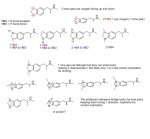
Going off of what Ive read in this thread thus far:
two HBA are needed and NOT a HBA & HBD.......
Take a look at the attached picture as see if you can follow my logic....
(My adderall made me way more into this than I wanted, I should be doing work. But I would really like to see a non "neuro toxic" mdma derivative one day. I can speculate on structure all day long but I have no idea on metabolism. If this is just retarded, say so)
Attachments
Hyperthesis
Bluelighter
The moiety -NH-CH2-NH- is an aminal, which are usually quite unstable. In other words: The double exchange O→N from MDMA to the proposed structures won't work.

^Xayo
Bluelighter
wow that was really in depth, thanks for that

mysticgreen
Greenlighter
The moiety -NH-CH2-NH- is an aminal, which are usually quite unstable. In other words: The double exchange O→N from MDMA to the proposed structures won't work.
full agree, this one would probably be hydrolyzed straight away.

ebola?
Bluelight Crew
hyperthesis: that was fucking epic, and quite readable by us laypeople.
ebola