• N&PD Moderators: Skorpio

5-Bromotryptamines

Dr.Heckyll

Bluelighter
Joined
Sep 16, 2006
Messages
138
Does anyone have infomation on the 5-HT2A receptor and psychedlic activity of 5-bromotryptamines, i.e. 5-bromo-dimethyltrptamine and 1-(5-bromo-1H-indol-3-yl)propan-2-amine etc.? Any information, and particularly literature references and Ki values would be much appreciated. Thanks!
 
It completely bewilders me why, up till now, no one seems to have cared about shulgin's comment that some seaweed was confirmed to contain 5-Br-DMT and that it is active!

To be honest I am not sure if it is 5-Br, but I know for sure that he mentioned a naturally-occuring brominated DMT, and that it is active.
 
Amongst 3-(tetrahydropyridin-4-yl)indole derivatives, the 5-Br has the highest affinity for 5-HT2 receptors, higher than the 5-MeO. (Journal of Medicinal Chemistry, 1993, Vol. 36, No. 25, 4006.) Not sure if that has any meaning for tryptamines.
 
WikiP

5-Bromo-DMT (5-bromo-N,N-dimethyltryptamine) is a brominated indole alkaloid found in certain marine invertebrates. It is the 5-bromo analogue of DMT, a hallucinogen found in many plants and animals. Other naturally occurring 5-substituted analogues of DMT include bufotenin and 5-MeO-DMT, both of which, like DMT, are psychoactive and found in plants and animals.

References
Djura, Peter et al. (1980). Some Metabolites of the Marine Sponges Smenospongia aurea and Smenospongia (= Polyfibrospongia) echina. Journal of Organic Chemistry 45(8), 1435-1441


also this may have some insights:

Synthetic Studies of Psilocin Analogs Having Either a Formyl Group or Bromine Atom at the 5- or 7-Position

Fumio Yamada1), Mayumi Tamura1), Atsuko Hasegawa1) and Masanori Somei1)

1) Faculty of Pharmaceutical Sciences, Kanazawa University

(Received August 29, 2001)
(Accepted October 2, 2001)


Psilocin analogs having either a formyl group (9—12) or a bromine atom (13—18) at the 5- or 7-position have been prepared for the first time. Syntheses of 5- and 7-bromo derivatives of 4-hydroxy- (23, 24, 28) and 4-benzyloxyindole-3-carbaldehyde (19, 25, 29, 30), 4-benzyloxyindole-3-acetonitriles (20, 31), and 4-benzyloxy-N, N-dimethyltryptamine (32, 34, 35) have also been established.

 
Jamshyd said:
It completely bewilders me why, up till now, no one seems to have cared about shulgin's comment that some seaweed was confirmed to contain 5-Br-DMT and that it is active!

To be honest I am not sure if it is 5-Br, but I know for sure that he mentioned a naturally-occuring brominated DMT, and that it is active.

There was a recall on a certain brand of seaweed used in sushi rolls here in australia because of "hallucinogenic content" :D :D :D some little girl ate it and tripped out, then mummy gets on the phone and gets them recalled. I wonder, are these things related?!

*goes and collects some seaweed*
 
It does seem like there is much more potential for substitution on the aromatic ring of tryptamines than just 5-MeO and 4-HO.

Shulgin made 5-methylthio-DMT and it was active, but he never even tested it up to a full dose, just up to 20mg from which he commented maybe 30mg might be properly active. He also speculated that 5-EtO-DMT would probably be active.

And 5-methyl-DMT is active as well, so probably 5-ethyl would be too. 5-cyano-DMT is a known compound as well although no idea if that would be active, CN groups tend to act like halogens though so if 5-Br-DMT is active then 5-CN-DMT might be too...

So how much 5-Br-DMT is there in those seaweeds then, just trace amounts, or are they like the DMT-bearing plants that actually contain enough to extract it out?
 
I've read story of some hippies smoking some sponges to have psychedelic trips... I dont remember where I've read this story (Tihkal? ) but it's probably a fake...

I think 5-EtS-T's are less potent than 5-MeO's because the thioether are worse H-bond donnors than oxygens atom but perhaps sulfur-atoms are an IMAO effect like in the case of 2C-T-x ?

5-EtO-T's are a sort of Tryptamine-tweetos... Probably similar to 5-MeO's

If I had a better lab, I would do more research on 4-Alkyloxy-tryptamine (4-MeO-DIPT,4-MeO-DMT, 4-BnO-T's, 4-EtO-T's...)

And I'd love to see a tryptamine with a FLY-structure ! 5-MeO-DMT-FLY, a winner for me !!!
 
Shulgin never said it was active...just that he believed it would be. There is no data that I am aware of regarding its psychedelic potential.

Jamshyd said:
It completely bewilders me why, up till now, no one seems to have cared about shulgin's comment that some seaweed was confirmed to contain 5-Br-DMT and that it is active!

To be honest I am not sure if it is 5-Br, but I know for sure that he mentioned a naturally-occuring brominated DMT, and that it is active.
 
Loop the 5-MeO back to the benzene ring in a furan ring, like the PEA FLY's.
 
there is no true FLY structure as such

at least not that i can see

if you can diagram it LMK...as i see it a tryptamine can not have a true FLY "appendaged"
 
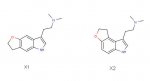
There are actually two possibilities actually. THe one on the right is the "FLY" compound of 5-MeO-DMT, the one on the left is psilofly. :)

tryptofly.bmp
 
OH, yes you are correct. I guess one could have called them 'hemifly' but then..it is obvious that you cannot have two furan rings (as you pointed out) on a tryptamine backbone, so it seemed redundant to do so. I guess this was just a mix-up in semantics.
 
certainly though as i stated elsewhere prior, any ring such as a MD or furan would be interesting on the 4,5 of a tryptamine structure

one could have a trypto-FLY i guess though in a sense by having a 4,5 and 6,7 difuranyl structure which also like Br-FLY saturates the benzyl at all possible conjugatable positions i believe (though not really comparable)

obviously though it is hard to say what that would do....and the FLY structure made inherent sense off of known 2,5-dimethoxy, 4-substituted structures...
 
Last edited:
morninggloryseed said:
There are actually two possibilities actually. THe one on the right is the "FLY" compound of 5-MeO-DMT, the one on the left is psilofly. :)

psilofly ! Woow I love this name !

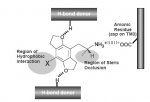
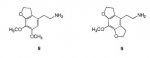
I thing that the structure of X1 is better than X2 : The binding electron-pair of oxygen atome is in the right side of the dihydrobenzofuran ring (look the second schema). In the case of mescaline-fly the electron-pair of oxygen is in the wrong side ofe the TH-benzofuran ring, therefore this is probably why mescaline-fly is less potent than regular mescaline (??)

We believe that the loss of LSD-like activity in the
drug discrimination assay for compounds 8 and 9 may
lie in their reduced 5-HT2A agonist efficacies, compared
to 1. This point is particularly emphasized by the
lowered degree of substitution of 9 relative to 8, and
the parallel reduction of agonist efficacy. These results
support the current hypothesis that hallucinogens are
agonists at 5-HT2A receptors.

compound 1= regular mescaline

source : Dihydrobenzofuran Analogues of Hallucinogens. 4.1 Mescaline Derivatives

Aaron P. Monte,† Steve R. Waldman, Danuta Marona-Lewicka, David B. Wainscott,‡ David L. Nelson,‡
Elaine Sanders-Bush,§ and David E. Nichols*
 

Attachments

  • 5-meo-dmt-fly.jpg
    5-meo-dmt-fly.jpg
    9.8 KB · Views: 112
  • Phenethylamine-brain.jpg
    Phenethylamine-brain.jpg
    17 KB · Views: 93
  • mescaline-fly.jpg
    mescaline-fly.jpg
    7.8 KB · Views: 98
The closest thing to a mescaline/fly hybrid maintaining the "correct" electron pair oxygen configuration is 2C-O-FLY
Being 2C-O is not centrally active on its own, but has been shown to potentiate mescaline i wonder what this FLY configuration would reveal in effect and potency
 
Vanadium said:
I've read story of some hippies smoking some sponges to have psychedelic trips... I dont remember where I've read this story (Tihkal? ) but it's probably a fake...

As I recall, Shulgin was joking about hippies smoking sponges. Funny idea, though. :D
 
Top