fastandbulbous
Bluelight Crew
A while ago, on a different forum, I suggested that the compound 5-(2-aminopropyl)-2,3-dihydrobenzofuran hydrochloride might just have a really promising entactogenic activity based on SAR studies from Dave Nichols on MDA/MDMA & analogues. After much headscratching & conversations with friends who have impressive synthetic skills, I eventually have a real bioassay of this particular compound; it's damn nice when you're sort of proved right in these matters!
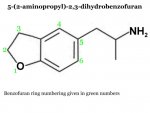
Jpeg attached at bottom for easier identification of compound in question
Anyway, the bit you've been waiting for...
5-(2-aminopropyl)-2,3-dihydrobenzofuran hydrochloride compares favorably to MDMA at an oral dose of 150 mg - 225 mg.
The chronology of the compound: first signs of activity noted at about T+1h, smoothly developing into a deeply hedonic plateau from T+2 to T+4, then gently tapering off over the next several hours. No adverse effects noted other than mild nystagmus; sleep possible at any point after the plateau.
The effects are similar to those of MDMA but do not appear to involve the same degree of dopaminergic edge. There is increased empathy and profound contentment, and a luxurious sense of tactile enhancement. However, unlike with MDMA, there is no drive towards speech or locomotor activity -- even though I would not characterize the compound as sedative in any way.
One last interesting note: upon waking up at T+20 there are still feelings of being off-baseline: some lingering mood elevation, alteration of the visual field, and faint suggestions of a psychedelic effect. These feelings are pleasant (although not very distinct).
All in all, pretty much as I anticipated it would be from extrapolating SAR data for related entactogens. The next obvious step(s) would be a) the N-methyl derivative (analogous to the jump from MDA to MDMA) & b) moving the 2-aminopropyl side chain to the 6 position as this would give a compound which should be a lot more dopaminergic/MDA-like activity than this compound (and it's subsequent N-methylation).
Obviously, if someone else has actually synthesized the compounds mentioned in the above 'next steps', don't be shy - tell us about it and any possible human psychopharmacology .
.
substancecode_obscure
Jpeg attached at bottom for easier identification of compound in question
Anyway, the bit you've been waiting for...
5-(2-aminopropyl)-2,3-dihydrobenzofuran hydrochloride compares favorably to MDMA at an oral dose of 150 mg - 225 mg.
The chronology of the compound: first signs of activity noted at about T+1h, smoothly developing into a deeply hedonic plateau from T+2 to T+4, then gently tapering off over the next several hours. No adverse effects noted other than mild nystagmus; sleep possible at any point after the plateau.
The effects are similar to those of MDMA but do not appear to involve the same degree of dopaminergic edge. There is increased empathy and profound contentment, and a luxurious sense of tactile enhancement. However, unlike with MDMA, there is no drive towards speech or locomotor activity -- even though I would not characterize the compound as sedative in any way.
One last interesting note: upon waking up at T+20 there are still feelings of being off-baseline: some lingering mood elevation, alteration of the visual field, and faint suggestions of a psychedelic effect. These feelings are pleasant (although not very distinct).
All in all, pretty much as I anticipated it would be from extrapolating SAR data for related entactogens. The next obvious step(s) would be a) the N-methyl derivative (analogous to the jump from MDA to MDMA) & b) moving the 2-aminopropyl side chain to the 6 position as this would give a compound which should be a lot more dopaminergic/MDA-like activity than this compound (and it's subsequent N-methylation).
Obviously, if someone else has actually synthesized the compounds mentioned in the above 'next steps', don't be shy - tell us about it and any possible human psychopharmacology
.substancecode_obscure
Attachments
Last edited by a moderator: