-
Neuroscience & Pharmacology Discussion Welcome Guest
Posting Rules Bluelight Rules Recent Journal Articles Chemistry Mega-Thread FREE Chemistry Databases! Self-Education Guide -
N&PD Moderators: Skorpio
You are using an out of date browser. It may not display this or other websites correctly.
You should upgrade or use an alternative browser.4-AcO-DMT stability, other variations of DMT?
- Thread starter yaesutom
- Start date

 Hey, ok, what about 4-methyl-DMT? I haven't a clue if a synthesis would be difficult or not but, then what about taking something like 4-HO-MiPT and replacing the hydroxyl with a methyl?
Something thats feasable to stick on that 4 position of DMT, to make it orally active, not get eaten by MAO so fast, "somewhat" legal, and hoping that altering the molecule over on that side and not the DMT side would retain the "DMT goodness" would be really nice to discover...
fastandbulbous
Bluelight Crew
Something thats feasable to stick on that 4 position of DMT, to make it orally active, not get eaten by MAO so fast, "somewhat" legal, and hoping that altering the molecule over on that side and not the DMT side would retain the "DMT goodness" would be really nice to discover...
4-Amino/methylamino/dimethylamino DMT. Has the lone pair electrons of an OH group to do all the 'right' receptor interactions. My money would actually be on the 4-amino DMTOk got caught up in reading/scanning here,
http://webdoc.sub.gwdg.de/diss/2004/jensen/jensen.pdf
From what i'm seeing throughout, does it look possible that just plain 5-MeO-T is active? ...or does something anyway.. Also looks like 5-MeO-NMT is just as potent as 5-MeO-DMT or near equal at least (but i dont know enough about these things)..
5-HT2A receptor binding data
The simple parent compounds tryptamine (5), NMT (212), and DMT (45) displayed low affinities
between 1 μM and 2 μM for the ketanserin (48) labeled 5-HT2A receptor. By 5-methoxy
lation affinity could be increased to 150 nM for 5-MeO-tryptamine (358) and to about 550 nM
for 5-MeO-NMT (208) and 5-MeO-DMT (15). 5-HT (6) itself had an affinity of 140 nM, comparable
to that of 5-MeO-tryptamine (358).
The tested N-benzylated NMT derivatives 210 and 207 exhibited affinities between 800 nM
and 900 nM, independent of 5-methoxylation. 5-MeO-N-(4-Br-benzyl)-tryptamine (19) had an
affinity of only 530 nM, not different to that of 5-MeO-NMT (208) and only 1/4 that of 5-HT (6)
and the N-unsubstituted 5-MeO-tryptamine (358). This result will be discussed in detail
below.
Binding affinities at the 5-HT1A compared to the 5-HT2A receptor
Not a single compound from this project showed more than a five-fold selectivity for the
5-HT2A over the 5-HT1A receptor, while a few compounds with greater than 50-fold selectivity
for the 5-HT1A over the 5-HT2A receptor could be identified. The latter are the simple tryptamines
5-MeO-tryptamine (358) (95-fold), 5-MeO-NMT (208) (275-fold), and 5-MeO-DMT
(15) (134-fold), the alkyl substituted ligands n-butyl-5-MeO-NMT (332) (72-fold), n-pentyl-
5-MeO-NMT (338) (69-fold), n-octyl-5-MeO-NMT (344) (479-fold), cyclopentylmethyl-5-MeONMT
(216) (62-fold), cyclohexylmethyl-5-MeO-NMT (218) (65-fold), isobutyl-5-MeO-NMT
(310) (96-fold), allyl-5-MeO-NMT (306) (108-fold), cyclohexylpropyl-5-MeO-NMT (314)
(177-fold), and cyanoethyl-5-MeO-NMT (294) (43-fold), as well as the aromatic ring
That was just a couple snippits from that PDF. Anyway anyone with some 5-meo-tryptamine laying around wanna smoke/IM/snort it and see what happens? Looks about equal to 5-HT to 2A binding, and way above DMT. Interesting that 5-MeO-NMT seems about the same as -DMT (in a lot of those binding numbers and discussion, but there's also info for 1A and 2C receptors and comparisons)
There's a lot of stuff in that PDF, some about mushroom biosynthesis and just a fuckload of other tryptamine testing and binding data and shizzle. Some of the molecules i'd punch into chemdraw and JESUS how huge.
Dondante
Bluelighter
- Joined
- Dec 6, 2005
- Messages
- 1,638
In answer to the original question in this thread, I found that 4-aco-dmt is indeed more stable than psilocin.
http://www.erowid.org/references/refs_view.php?A=ShowDocPartFrame&ID=6535&DocPartID=6064
I hope I'm not repeating anything ... I didn't go over the thread with a fine-toothed comb.
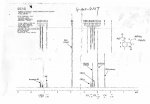
Anybody find this appealing?:
Edit (thanks Hugo): the NH peak is actually the fumarate peak. The NH peak may be located off the scale at 10.8 ppm.Attachments
Last edited:mythic quest
Greenlighter
- Joined
- Jul 27, 2008
- Messages
- 3
I was wondering, two or so years on, if any of you lot who still have their original supply of 4-aco-dmt could comment on any loss of potency. Specifically, I'm wondering if stored in a cool dark place, how long the chemical will last without a significant deterioration based not on theory but experiences.
bluedolphin
Bluelight Crew
- Joined
- Feb 19, 2003
- Messages
- 6,062
I saw some of the original batch recently. It had turned brown and clumpy like brown sugar.
Upon last human trial no real difference was noted from it's original, slightly off-white state in terms of potency or overall feel.
Much like some 4-aco-MiPT I once had, which turned brown and clumpy after a while, but still worked just fine.
These fumerate salts were really a good idea. I have to wonder, if this guy had kept his 4-aco-DMT in a freezer and air tight, instead of in a baggie at room temperature over the last three years, if it would have held up much better?
fastandbulbous
Bluelight Crew
Most reagent bottles for 4-hydroxyindole compounds advise storing at -4'C as they're somewhat flakey at room temp. 4-hydroxtryptamines are no different - just indole with a ethylamino chain stuck on. The bottles generally have airtight seals as well, so that goes without saying as a requirement
I'm still curious as to all the different colours the different 4-hydroxytryptamines oxidize to (they are oxidized to an intense isatin/indigo related dye like structure). Psilocin oxidizes to a blue colour and one of the others to a green if I remember correctly (might have been iprocin)
sekio
Bluelight Crew
Pretty much any ester should. Psilocin O-sulfate would, acetate, proprionate, etc.