• N&PD Moderators: Skorpio

3,4-methylenedioxyphenyl-sec-butylamine

Limpet_Chicken

Bluelighter
Joined
Oct 13, 2005
Messages
6,322
Location
UK
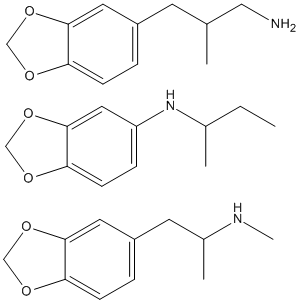
3-(3,4-methylenedioxyphenyl)-2-methylpropanamine

So, this lil bugger isn't in PIHKAL.

I am guessing, just guessing, that it may not be a classical empathogenic stimulant ala MDA/MDMA, but I only have the SAR of the 2,5-MeO and the 3,4,5-MeO to go on, as to weather it follows that pattern for the methylenedioxy compounds.

Is it active at all? we are specifically talking the 4-carbon homolog of MDA, with the amine function stuck on the gamma-carbon, the primary amine derivative of helional.

Has it been tested in man, and is there any specific toxicity not shared by the MDx family that is attatched to this compound?

Edit-Have I got my nomenclature correct? is it correct to name the 2-methyl-n-propyl chains 2-position carbon the gamma? or does it follow that one counts right to left down the straight chain and comes to the 2-position carbon last?
 
Last edited:

Completely so? because the 2,5-dimethoxy derivatives, ARIADNE and the like, are active, just not in typical psychedelic fashion.
 
Do you mean:

http://en.wikipedia.org/wiki/MBDB this?

Or the compound described here: http://www.erowid.org/library/books_online/pihkal/pihkal109.shtml

A word of caution is in order concerning the intermediate 3,4-methylene-dioxyphenylacetone, which has also been called piperonylacetone. A devilish ambiguity appeared in the commercial market for this compound, centered about its name. The controversy focused on the meaning of the prefix, piperonyl, which has two separate chemical definitions. Let me try to explain this fascinating chaos in non-chemical terms. Piperonyl is a term that has been used for a two-ring system (the methylenedioxyphenyl group) either without, or with, an extra carbon atom sticking off of the side of it. Thus, piperonylacetone can be piperonyl (the two-ring thing without the extra carbon atom attached) plus acetone (a three carbon chain thing); the total number of carbons sticking out, three. Or, piperonylacetone can be piperonyl (the two-ring thing but with the extra carbon atom attached) plus acetone (a three carbon chain thing); the total number of carbons sticking out, four.

Does this make sense?

The three carbon sticking out job gives rise to MDA and to MDMA and to many homologues that are interesting materials discussed at length in these Book II comments. This is the usual item of commerce, available from both domestic and foreign suppliers. But the four-carbon sticking out job will produce totally weird stuff without any apparent relationship to psychedelics, psychoactives or psychotropics whatsoever. I know of one chemical supply house which supplied the weird compound, and they never did acknowledge their unusual use of the term piperonyl. There is a simple difference of properties which might be of value. The three carbon (correct) ketone is an oil with a sassafras smell that is always yellow colored. The four carbon (incorrect) ketone has a weak terpene smell and is white and crystalline. There should be no difficulties in distinguishing these two compounds. But unprincipled charlatans can always add mineral oil and butter yellow to otherwise white solids to make them into yellow oils. Caveat emptor.

In the former compound, the known active psychedelic MBDB, the amine moiety is separated from the benzodioxolyl by two carbons, with an alpha-ethyl side chain. In the latter compound, the amine moiety is separated from the benzodioxolyl by three carbons, with an alpha-methyl side chain. Both have been tested in man; the former is active and the latter is not.
 
AFAIK there are 4-5 types of 4-carbon analogs... Butyl,sec-Butyl,tert-Butyl,isobutyl and i guess cyclobutyl right? My chem knowledge is limited but I'm assuming 3,4-MDO-Phenylbutylamine is MBDB but I have no idea what tert and sec are...

This wouldn't be the MD-phenetermine analog would it?
 
Last edited:
I am talking of 3-(3,4-methylenedioxyphenyl)-2-methylpropanamine

Can't predict activity if nobody knows what the hell compound I actually mean, can we now=D

But from that, it looks like an inactive compound? no idea what the ketone smells like, the aldehyde smells pretty fucking hideous though. Might just test it out of sheer boredom.
 
I have no decent chem-sketch type software. Anyone know where I could get chemdraw for fuck all?

To cheat and get it the easy way, Astavats...

<img>http://www.ricercaitaliana.it/images/rif/PRIN/2004032015_004/imm_0002.jpg</img>

That is helional.

Think oxime reduction to amine.

There you have the compound in question, 3,4-methylenedioxyphenyl-sec-butylamine.

If nobody comes up with anything, I might just decide to go find out first hand.
 
34mdiba.png
 
Can't get that image to work either, get into MS paint.

Edit: thanks dread
 
Last edited:
Appreciate it Dread!

"3-(3,4-methylenedioxyphenyl)-2-methylpropanamine" makes sense after seeing the molecule. The sec-butylamine was a mistake then I assume, or else I don't see how it'd work.

@Limpet
If ACD ChemSketch (freeware) isn't compatible with your computer for some reason you can try MarvinSketch (online freeware) instead.
 
Astavats, can you link me to a download for chemsketch?

Anybody know how to look a CAS number for a compound? I want to see if I can find some data on the aldoxime of helional.

If I get no specific 'completely fucking inactive'-s I might have a look at this later when I am not so tired.
 
Last edited:
Oh, and is there any information about the positional isomer with the primary amine located at the carbon nearest the phenyl ring? I very much doubt it is active, I wouldn't think the amine will be located in the right place, since it looks like phenethylamines with the 2-carbon spacing at least, is required to stick it far enough to bind 5HT2a....that said, I really do not know what the requirements for SERT or DAT activity.

Gut says bugger all though.
 
1YljC.png

Top: the first compound in this thread, the second is from the above post, and the third is MDMA for comparison.

I think the primary amine is too close to the phenyl group to retain any activity. (for the above post)
 
Slapdragon unless I am misunderstanding the post is about the benzylamine derivative not aniline one you drew out. Shouldn't it be this;

2mi2d5h.jpg


is there any information about the positional isomer with the primary amine located at the carbon nearest the phenyl ring?

I wrote this before the confusion.

It might not be all without activity, the U.S. patent from 1978 "Piperonylamine derivatives" mentions "N-propargyl-piperonylamine [...] and its addition salts are useful in reducing appetite, fatigue, and aggression." I haven't read through it yet but it's sounds active.

2jfysmo.jpg


PDF of patent with images
 
Last edited:
Interesting.

Looks like out there wierd stuff though from helional...bugger.

Athough rearrangement to the benzylamine...I wonder....
 
propargylpiperonylamine sounds like an MAOI, maybe that's it's primary activity?
 
Top