• N&PD Moderators: Skorpio

2'-Hydroxycocaine...

There are two different IC50 values that would come into play: (1) IC50 for binding to DAT (measured by displacing the binding of another ligand), which is used to calculate the Ki for binding to DAT; and (2) the IC50 for inhibiting dopamine uptake.

The former is the same as Ki, unless i'm mistaken. Ki, definitionally, is a dissociation constant, not measure of activity.

wiki said:
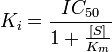
IC50 is not a direct indicator of affinity although the two can be related at least for competitive agonists and antagonists by the Cheng-Prusoff equation.[4] For enzymatic reactions, this equation is:

1504611269ebb94adfb0ebffed40bf85.png

where Ki is the binding affinity of the inhibitor, IC50 is the functional strength of the inhibitor, is fixed substrate concentration and Km is the concentration of substrate at which enzyme activity is at half maximal (but is frequently confused with substrate affinity for the enzyme, which it is not).
 
Last edited:
The former is the same as Ki, unless i'm mistaken. Ki, definitionally, is a dissociation constant, not measure of activity.

They are not the same, otherwise the formula would be IC50 = Ki. IC50 does not give a direct estimate of Ki unless the ligand concentration is low.

The formula for Ki is as follows:

Ki = (IC50 * KL)/(KL + [L])

where KL = dissociation equilibrium constant of the radio ligand, and [L] = radioligand concentration.

The other thing to remember is that the Ki and IC50 for blockade of radioligand binding to DAT is not a direct measure of effects on dopamine uptake. It is only a measure of binding to DAT. You can potentially bind to DAT with high affinity but only have weak effects on uptake.
 
Last edited:
The former is the same as Ki, unless i'm mistaken. Ki, definitionally, is a dissociation constant, not measure of activity.

IC50 depends on the concentration of the substrate and its rate of uptake (or rate of conversion if you're talking about a metabolic enzyme), whereas Ki should be the same regardless of those factors. So at DAT Cocaine will have different IC50's if you change the levels of dopamine that DAT can uptake, or if you're measuring dextroamphetamine uptake instead of dopamine or something. Cocaine should have the same Ki in all of those scenarios though.
 
IC50 depends on the concentration of the substrate and its rate of uptake (or rate of conversion if you're talking about a metabolic enzyme), whereas Ki should be the same regardless of those factors. So at DAT Cocaine will have different IC50's if you change the levels of dopamine that DAT can uptake, or if you're measuring dextroamphetamine uptake instead of dopamine or something. Cocaine should have the same Ki in all of those scenarios though.

I'm sorry to keep posting here but I feel like there is a fundamental misunderstanding of how DAT affinity is measured and what it reflects. If you are talking about DAT affinity then the IC50 would have nothing to do with the level of dopamine. "Affinity" for DAT is not based on measurement of dopamine uptake, it is measured as displacement of radiolableled cocaine or another DAT ligand. So the Ki of cocaine for DAT only measures the interaction of cocaine with DAT, not effects on transport.

The affinity of cocaine for DAT is not a direct measure of effects on dopamine uptake, because uptake inhibition is not just a function of binding to the transporter. The mechanism by which cocaine and other DAT uptake blockers work is extremely complex. There has been disagreement as to whether cocaine binds to the same site dopamine binds to (the transport site) or a different site. This is probably due to the fact that there are several steps involved in dopamine transport, and the binding sites for dopamine and cocaine may overlap for some steps and be seperate for other transport steps. Also, cocaine may have other complex effects on DAT function (changing the mode of action of DAT, phosphorylation) that are not directly caused by binding to DAT. And there are also allosteric binding sites on DAT, so not all DAT inhibitors bind to the same site. So in general, if a study measures the Ki or the IC50 of cocaine for DAT, that is not a measurement of effects on dopamine uptake, only a measure of binding to the cocaine site on DAT.

To measure effects on dopamine uptake, typically a study would express DAT in cultured cells, and then you can measure the rate of dopamine uptake in the cell and whether uptake is altered by a test agent. The IC50 obtained from that experiment is completely different from the affinity for DAT. And that is probably a better measure of drug psychopharmacology then DAT binding since it is more of a "functional" measure.

Note that for amphetamine the situation is even more complicated because there is reverse transport, effects on vesicles, ion gradients, etc. So there will potentially be even more of a gap between DAT binding and effects on dopamine reuptake (and release).

So when I was saying that IC50 values are probably more relevant then Ki values, I was referring to the Ki for DAT binding and the IC50 for dopamine uptake.

 
Last edited:
I think we're basically agreeing on everything serotonin2A.

To measure effects on dopamine uptake, typically a study would express DAT in cultured cells, and then you can measure the rate of dopamine uptake in the cell and whether uptake is altered by a test agent. The IC50 obtained from that experiment is completely different from the affinity for DAT. And that is probably a better measure of drug psychopharmacology then DAT binding since it is more of a "functional" measure.

The equation sekio linked and I responded to would apply to this sort of uptake experiment, whereas the equation you described applies to radioligand competition. I think we just need to be careful when we use a term like IC50 to specify what exactly we're inhibiting 50% of. Like when you say this:

So in general, if a study measures the Ki or the IC50 of cocaine for DAT, that is not a measurement of effects on dopamine uptake, only a measure of binding to the cocaine site on DAT.

You mean that the IC50 obtained from a radioligand binding experiment wouldn't give you a measurement of effects on dopmaine uptake, because the IC50 from an uptake experiment would give you exactly that.


Long and short of all this the best way to compare potency of different DAT inhibitors is to compare IC50 values from dopamine uptake experiments.
 
Afaik the more proper term to be used for the concentration that causes 50% inhibition of DA reuptake is EC50 and not IC50, which also resolves the question why you can't use the Cheng-Prusoff-equitation to calculate the Ki for DA reuptake inhibition with IC50.
And if i remember correctly Ki is just defined as the concentration at which it occupies 50% of the target. As the IC50 is dependent on the Kd and concentration of the radioligand, you have to use the Cheng-Prusoff-equitation in order to get absolute values.
 
Last edited:
Afaik the more proper term to be used for the concentration that causes 50% inhibition of DA reuptake is EC50 and not IC50, which also resolves the question why you can't use the Cheng-Prusoff-equitation to calculate the Ki for DA reuptake inhibition with IC50.
IC50 is the usual terminology, but whether you call it EC50 or IC50 is really just semantics. Is a glass half full or half empty? You are measuring something at baseline (dopamine uptake) and then testing to find the drug concentration that reduces uptake by 50%, so IC50 is appropriate. It is more common to use EC50 for agonist responses. You usually wouldn't calculate the Ki based on the IC50 for an uptake inhibition experiment because that requires a competitive interaction.
And if i remember correctly Ki is just defined as the concentration at which it occupies 50% of the target. As the IC50 is dependent on the Kd and concentration of the radioligand, you have to use the Cheng-Prusoff-equitation in order to get absolute values.
That's what we've been saying.
 
Top