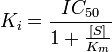
IC50 depends on the concentration of the substrate and its rate of uptake (or rate of conversion if you're talking about a metabolic enzyme), whereas Ki should be the same regardless of those factors. So at DAT Cocaine will have different IC50's if you change the levels of dopamine that DAT can uptake, or if you're measuring dextroamphetamine uptake instead of dopamine or something. Cocaine should have the same Ki in all of those scenarios though.
I'm sorry to keep posting here but I feel like there is a fundamental misunderstanding of how DAT affinity is measured and what it reflects. If you are talking about DAT affinity then the IC50 would have nothing to do with the level of dopamine. "Affinity" for DAT is not based on measurement of dopamine uptake, it is measured as displacement of radiolableled cocaine or another DAT ligand. So the Ki of cocaine for DAT only measures the interaction of cocaine with DAT, not effects on transport.
The affinity of cocaine for DAT is not a direct measure of effects on dopamine uptake, because uptake inhibition is not just a function of binding to the transporter. The mechanism by which cocaine and other DAT uptake blockers work is extremely complex. There has been disagreement as to whether cocaine binds to the same site dopamine binds to (the transport site) or a different site. This is probably due to the fact that there are several steps involved in dopamine transport, and the binding sites for dopamine and cocaine may overlap for some steps and be seperate for other transport steps. Also, cocaine may have other complex effects on DAT function (changing the mode of action of DAT, phosphorylation) that are not directly caused by binding to DAT. And there are also allosteric binding sites on DAT, so not all DAT inhibitors bind to the same site. So in general, if a study measures the Ki or the IC50 of cocaine for DAT, that is not a measurement of effects on dopamine uptake, only a measure of binding to the cocaine site on DAT.
To measure effects on dopamine uptake, typically a study would express DAT in cultured cells, and then you can measure the rate of dopamine uptake in the cell and whether uptake is altered by a test agent. The IC50 obtained from that experiment is completely different from the affinity for DAT. And that is probably a better measure of drug psychopharmacology then DAT binding since it is more of a "functional" measure.
Note that for amphetamine the situation is even more complicated because there is reverse transport, effects on vesicles, ion gradients, etc. So there will potentially be even more of a gap between DAT binding and effects on dopamine reuptake (and release).
So when I was saying that IC50 values are probably more relevant then Ki values, I was referring to the Ki for DAT binding and the IC50 for dopamine uptake.