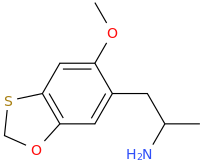
Has anyone come across the title compound? It does turn up on both Reaxys and ChemSpider but with no synthesis. It just turns up in a ligand database. The primary amine (CAS 1895361-23-5) is known.
VSEPR calculations suggest it is as stable as it's benzodioxy counterpart and I'm prepared to bet that it doesn't have the MAOI issues of it's p-MeO & p-MeS counterparts because of it's metabolism. It MAY be neurotoxic (thiophenol) so I wouldn't be keen on trying it but I'm just interested to know why it doesn't seem to have surfaced. It seems likely that the synthesis is rather more involved (enough to stop clandestine producers) but not being controlled under the MoDA (depending on interpretation of the act) but would obviously be covered by the PDA.
I'm not looking at this as a street drug. I'm interested to know if it would be of value in psychotherapy, especially in people suffering from PTSD. I'm sure those blessed with Reaxys can figure out several route - none of them amenable to the 'bucket brigade' or anything outside a well stocked lab.
On reflection, 1-(1,3-benzoxathiol-5-yl)-N-methylpropan-2-amine (primary amine CAS 1891286-82-0) would possibly be the first of class to try on the basis that the me-S is assuredly NOT going to lend any MAOI activity BUT in either case, the thiophenolate moiety is the possible neurotoxic species BUT in the meta position it COULD well undergo oxidation dropping the LogP thus it will exit more gracefully. That the indane rigid analogues are not neurotoxic in animal models fails to convince me. 1 adverse reaction is still 1 too many. Be it acute or chronic - designing benign agents should be first, last and always in medicinal chemistry. It isn't... but it should be.
I'm just wondering if it's seeming absence is toxicity (unlikely), synthetic complexity (possible) and/or lack of stability calculations (Well, the C-S-C-bonds are longer but ring-strain is lower).
BTW - you can throw the IUPAC into any appropriate to view the ligands.... but it's nothing more than an MD ring.... but with an S replacing an O... so certainly close to known agents (a very good thing) but close to other known agents (a bad thing). I presume Dr. Dave has done all of this but I also presume Cayman will steal the idea and attempt to profit from it. Frankly, this latter group is more than happy to supply all and every manner of poisons so if it appears, do NOT presume it IS harmless.
Suspicious - https://www.molinstincts.com/chemic...2-methylpropan-2-amine-cstr-CT1066367990.html
Anyone considering 'sneaking up' on the class might do well to look into 1-(1-benzothiophen-5-yl)propan-2-amine & 1-(1-benzothiophen-6-yl)propan-2-amine in an analogous manner to the self-proclaimed genius behind 'Benzo Fury' who in fact did no more than glance at a patent... and managed to get that wrong for a couple of years. There are 2 kinds of people in the world, those who do the work and those who take credit. I recommend belonging to the former group - there really is far, far less competition. That methedrone turned up on Russian Hyperlab a good 7 years before it was 'invented' is a case in point. Likewise nethiopropamine, ethylphenidate and so on. The Russian guys did all the work....
VSEPR calculations suggest it is as stable as it's benzodioxy counterpart and I'm prepared to bet that it doesn't have the MAOI issues of it's p-MeO & p-MeS counterparts because of it's metabolism. It MAY be neurotoxic (thiophenol) so I wouldn't be keen on trying it but I'm just interested to know why it doesn't seem to have surfaced. It seems likely that the synthesis is rather more involved (enough to stop clandestine producers) but not being controlled under the MoDA (depending on interpretation of the act) but would obviously be covered by the PDA.
I'm not looking at this as a street drug. I'm interested to know if it would be of value in psychotherapy, especially in people suffering from PTSD. I'm sure those blessed with Reaxys can figure out several route - none of them amenable to the 'bucket brigade' or anything outside a well stocked lab.
On reflection, 1-(1,3-benzoxathiol-5-yl)-N-methylpropan-2-amine (primary amine CAS 1891286-82-0) would possibly be the first of class to try on the basis that the me-S is assuredly NOT going to lend any MAOI activity BUT in either case, the thiophenolate moiety is the possible neurotoxic species BUT in the meta position it COULD well undergo oxidation dropping the LogP thus it will exit more gracefully. That the indane rigid analogues are not neurotoxic in animal models fails to convince me. 1 adverse reaction is still 1 too many. Be it acute or chronic - designing benign agents should be first, last and always in medicinal chemistry. It isn't... but it should be.
I'm just wondering if it's seeming absence is toxicity (unlikely), synthetic complexity (possible) and/or lack of stability calculations (Well, the C-S-C-bonds are longer but ring-strain is lower).
BTW - you can throw the IUPAC into any appropriate to view the ligands.... but it's nothing more than an MD ring.... but with an S replacing an O... so certainly close to known agents (a very good thing) but close to other known agents (a bad thing). I presume Dr. Dave has done all of this but I also presume Cayman will steal the idea and attempt to profit from it. Frankly, this latter group is more than happy to supply all and every manner of poisons so if it appears, do NOT presume it IS harmless.
Suspicious - https://www.molinstincts.com/chemic...2-methylpropan-2-amine-cstr-CT1066367990.html
Anyone considering 'sneaking up' on the class might do well to look into 1-(1-benzothiophen-5-yl)propan-2-amine & 1-(1-benzothiophen-6-yl)propan-2-amine in an analogous manner to the self-proclaimed genius behind 'Benzo Fury' who in fact did no more than glance at a patent... and managed to get that wrong for a couple of years. There are 2 kinds of people in the world, those who do the work and those who take credit. I recommend belonging to the former group - there really is far, far less competition. That methedrone turned up on Russian Hyperlab a good 7 years before it was 'invented' is a case in point. Likewise nethiopropamine, ethylphenidate and so on. The Russian guys did all the work....
Last edited: