• N&PD Moderators: Skorpio

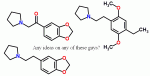
1-(1,3-Benzodioxol-5-yl)-2-(1-pyrrolidinyl)ethanone any info about this?

blowjay

Bluelighter
Joined
Jan 7, 2010
Messages
372
Is this known at all?

Cas # 745718-78-9

h:170


http://www.chemspider.com/Chemical-Structure.20572167.html#pred

Just got bored and wondered how this might turn out, is there any info on this at all? Surely there has to be some reason I haven't heard about this?

Edit:

wiki article says potential, hooray for my efforts!

http://en.wikipedia.org/wiki/Phenylethylpyrrolidine
 
Last edited:

What exactly would make it inactive, the lack of a chain coming off of? MDPPP is active which is closest relative to it, does it have to have alpha substitution to be active if its got the Pyrrolidino on it?
 
and what effect would putting other substitutions on the phenyl group do? Could this be a base to build off of as phenylethylamine is? How about, say, trying to go with 2,5-Dimethoxy-4-ethyl substitution on instead of the DMO?
 
1-(2,5-Dimethoxy-4-ethyl)phenethyl-pyrrolidine

sorry for using this thread as a drawing board, comments on this would be liked
 
For the 1-(2,5-Dimethoxy-4-ethyl)phenethyl-pyrrolidine, I guess you could call it 2C-E PEP lol, hell of a time for vendors marketing these if these work, phenethyl pyrrolidine as a base so they would be the "PEP" family, ha ha

I hope I stumbled onto something fun here
 
Last edited:
Score! Feel proud now, did all this just off guess work then found a wiki article that feeds my curiosity.

These guys are ripe for the picking, if substitution activity corresponds to anything in PIHKAL, I need a fuckin medal.
 
What reason do you have to believe that these compounds would be active, and active in regard to which systems of receptors?

We discourage people from throwing out molecular structures without any rationale.

ebola
 
And I didn't notice the post above me, could you expand more on the effects profile of MDPPP? I can't find much about it.

I don't know about alpha-desmethyl-mdppp as the name, wouldn't bk-MDPEP be a better name?

I believe the first one mentioned is likely dopaminergic and noradrenergic by itself but with ring substitution could possibly act on 5-HT2A due to no alpha substitution. The phenethyl part of the structures and their relations to pyrovalerone,MDPV, and related compounds are what I am basing the possible activity on.

My curiosity came when I was actually looking into methylone and butylone and noticed how the alpha chain length influenced the stimulant vs empathogen profile. Butylone is more stimulating that methylone and this increased stimulation seems to grow as the alpha chain grows, as the limited info on pentylone also suggest.

Not much data was found on pentylone, but I remembered MDPV and its buddies and applied the chain shrinking trend due to pentylone and MDPV having structures that don't look dissimilar.

I was thinking that making the chain smaller reduced the stimulant properties and increased the empathogenic properties possibly. MDPPP is supposed to have a dose range about 4 times higher as described on other boards. The smallest alpha sub is MDPPP so I thought about taking it off and debating what would come out of it.
 
Last edited:
I am not trying to pretend like I know anything about the activity of any of this stuff, just hypothesizing. I do, however, see possibilities in future efforts with PEP modification as evidenced by the PEP compounds that have been researched so far.

For the 2C-E PEP vision I had, I was going off of the possibility that PEP could be inactive without substitution in the same way that PEA is inactive without substitution, but was very interesting with substitution.

I am really interested to see opinions on this family. I think my assumptions getting this far are fairly reasonable.

The MDO substitution on pyrovalerone certainly proved to be interesting, why wouldn't other substitutions on the ring give other interesting compounds?

Removing the alpha substitution seemed reasonable to reduce stimulant effects which would be needed if one where searching for something more 'interesting'.

I would be moreso interested in the effects of ring substitutions on PEP ala PIHKAL than the corresponding bk-PEP substitution compounds, but that is just me.
 
Last edited:
I would start by asking if there are any similar DRI/NRI compounds with a tertiary amine at the end of a 2-carbon chain...
 
great, another chemical masturbation thread. starting with a name and a CAS # and fuck all else, at least you didn't end your post with ....discuss

the receptor profile of these compounds especially those without a keto is really not what you would expect, I suggest you look at what Johnson and Johnson did.
 
great, another chemical masturbation thread. starting with a name and a CAS # and fuck all else, at least you didn't end your post with ....discuss

the receptor profile of these compounds especially those without a keto is really not what you would expect, I suggest you look at what Johnson and Johnson did.

I really don't see why these type of threads are that annoying, some of us have ideas and even if they are stupid ones, we can learn from why they are stupid. I mean shit, I am not asking how to make something out of nutmeg, this is at least partially intelligent.

Sorry if this is annoying to you but I am curious about the phenethyl pyrrolidine class and if any other substitutions besides methyl, methoxy and MDO have been studied on the ring.

If there are other links you could send me, it would be appreciated, I am just curious about this class in general.

http://www.ncbi.nlm.nih.gov/pmc/articles/PMC2602954/table/T2/

http://www.ncbi.nlm.nih.gov/pmc/articles/PMC2602954/?tool=pmcentrez
 
Last edited:
The BOx compounds in TIhKAL retain psychedelic activity, but with greater adrenal push, suggesting that your bk-phenethylamines could be active but shitty, but probably are not active. We know that bulky (let alone ring-based) nitrogen substitutions abolish monoamine transporter affinity. From there, we don't know how the pyrilodine ring would affect interaction with the 5ht2a receptor.

ebola
 
Top