-
Neuroscience & Pharmacology Discussion Welcome Guest
Posting Rules Bluelight Rules Recent Journal Articles Chemistry Mega-Thread FREE Chemistry Databases! Self-Education Guide -
N&PD Moderators: Skorpio
You are using an out of date browser. It may not display this or other websites correctly.
You should upgrade or use an alternative browser.6-(1H-indol-3-yl)ethanamine
- Thread starter ingo_1978
- Start date



tryp2fun
Bluelighter
- Joined
- Dec 24, 2008
- Messages
- 253
I was wondering whether moving the side chain to the benzene ring on trypatime could produce some novel drugs when substitued in different places?
There is an error in your nomenclature. The number in front is the position of attachment of the indole ring to the ethanamine side chain. Thus, tryptamine is 2-(1H-indol-3-yl)ethanamine. What I think you mean is 2-(1H-indol-6-yl)ethanamine. Compounds based on this structure might be stimulants, but I doubt they would be psychedelics, since the indole NH has a specific hydrogen bond formed when tryptamines bind to the 5HT-2a receptor.Xamkou
Bluelighter
I wouldn't mind some new entactogens...
Bluelighter
Come on OP, you are speculating on a positional isomer of tryptamine without having any justification.
Ethanamine only has carbons 1 and 2.
Hammilton
Bluelighter
- Joined
- Sep 2, 2008
- Messages
- 3,435
^ I don't think he's going to understand what you mean by that.
The way you've named it, it says that the amine is on the 6 carbon of the ethyl. Since ethyl has two carbons it cannot work. I assume you're talking about 1-(1H-indol-3-yl)ethanamine
Hyperthesis
Bluelighter
What the heck is so difficult about posting a picture of the structure in question? ISIS resp. SymexDraw are free, add ImageShack, and you're done. This constant confusion and threads which start with several posts who have to deal out what we are actually supposed to discuss about are severly annoying....
Bluelighter
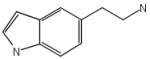
The OP obviously means this:
Which is 2-(1H-indol-6-yl)ethanamine.
But more importantly: so what? It's not like the brain is gonna be like, "Well the little tail is in the wrong place but I'm sure I can cram it in somewhere."The OP obviously means this:
Which is 2-(1H-indol-6-yl)ethanamine.
But more importantly: so what? It's not like the brain is gonna be like, "Well the little tail is in the wrong place but I'm sure I can cram it in somewhere."
That is the chemical I was talking about. I thought it could be the basis of some interesting stimulants or entacogens? or is the nitrogen on the ring going to cause problems?
^Xayo
Bluelighter
Mr Chemist
Greenlighter
- Joined
- Nov 11, 2010
- Messages
- 8
Hello, I am a big time lurker. I have pondered this molecule for a long long time. Glad someone else discovered it as well and inspired me post. I've checked the literature a while ago and nothing turned up. This molecule should be something interesting considering 6-APB is active. I'm not quite sure how to post pictures, but i've attached the comparison to mdma. Any additional information would be greatly appreciatedAttachments
^Xayo
Bluelighter
In some old post from f&b (i think) I read that the Oxygens in MDMA cause H Bonding with some receptor residue, NH having an H sticking out..wouldnt that imrpove h bondig propertys even?
23536
Bluelight Crew
In some old post from f&b (i think) I read that the Oxygens in MDMA cause H Bonding with some receptor residue, NH having an H sticking out..wouldnt that imrpove h bondig propertys even?
no: indole is aromatic, so the H isn't sticking out and the free electron pair is committed to the pi ring
I think
Hyperthesis
Bluelighter
While the lone electron pair takes indeed part in indole's aromaticity, the proton is nonetheless "sticking out" and, thus, is capable of acting as hydrogen bond donor.
sekio
Bluelight Crew
I wonder if this compound would be anything similar to 5-AminoPropylIndole?
23536
Bluelight Crew
In some old post from f&b (i think) I read that the Oxygens in MDMA cause H Bonding with some receptor residue, NH having an H sticking out..wouldnt that imrpove h bondig propertys even?
yes 8(
atara
Bluelighter
That is the chemical I was talking about. I thought it could be the basis of some interesting stimulants or entacogens? or is the nitrogen on the ring going to cause problems?
The NH is a hydrogen bond donor. That will significantly affect binding, I think. The ether linkages in benzodioxole (MDMA's ring system) are hydrogen bond acceptors, which is quite a bit different from a hydrogen bond donor, y'hear?
You're better off with 1-(1-methyl-1H-indol-6-yl)-propan-2-amine. I'm still not sure: my understanding of the pharmacophore says that a hydrogen bond acceptor meta to the alkylamine (on the benzene ring) is ideal, e.g. 3-methoxy, 3-fluoro, or 3,4-methylenedioxy.Mr Chemist
Greenlighter
- Joined
- Nov 11, 2010
- Messages
- 8
The NH is a hydrogen bond donor. That will significantly affect binding, I think. The ether linkages in benzodioxole (MDMA's ring system) are hydrogen bond acceptors, which is quite a bit different from a hydrogen bond donor, y'hear?
You're better off with 1-(1-methyl-1H-indol-6-yl)-propan-2-amine. I'm still not sure: my understanding of the pharmacophore says that a hydrogen bond acceptor meta to the alkylamine (on the benzene ring) is ideal, e.g. 3-methoxy, 3-fluoro, or 3,4-methylenedioxy.
If this is true, why does 5-APB show MDMA like properties? The oxygen in 5-APB is in a benzofuran ring. Oxygens in furan rings are not considered hydrogen bond acceptors to my knowledge.