• N&PD Moderators: Skorpio

Psychedelics: how far can we go?

I think it could be possible, but you would need to get really tricky to do it.

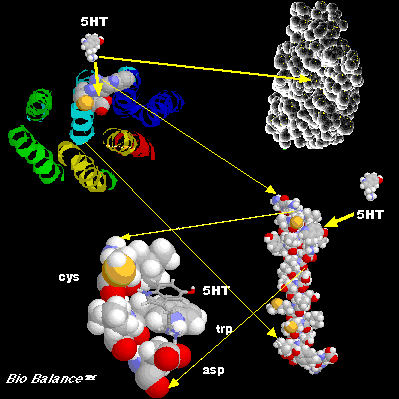
You might be looking at needing a larger small molecule than most of the compounds discussed, so that it covers a greater receptor surface area than molecules like LSD (which is "only" 2-3X bigger than the native ligand serotonin). More contact surface area will translate to increased affinity, if you hit the right sites (which may not even exist for the 5HT receptor...).

So throw in a total understanding of the 5HT receptor active site and binding mechanism required to elicit the special mode of G protein activation that psychedelics induce as well as some novel receptor motifs or amino acids outside the active site to target for increased affinity, and put that all in your "larger molecule" (which would also need exceptional bioavailability to keep the in vivo potency at a maximum level)...

Voila! 1 ug or less dose. Probably intranasal because it might just get sucked up by the stomach serotonin receptors if you do oral. Just don't drop it in your eye, please. =)

 
Hammy said:
Yeah, why not try to make chemical weapons out of psychedelics.

Exactly. Hell, even if we concede to be evil for a second, we already more effective chemical weapons with such dosage-ranges.

ebola
 
I thought the NBOMe-compounds were interesting for their selectivity at 2a over other receptors, but at the same time they're limited by this selectivity. Once you've tried one 5-ht2a full agonist with no action at any other receptor, you've pretty much tried them all -- and 25C-NBOMe was great, but beyond that the N-aryl pharmacophore doesn't appear to offer much that's interesting.

LSD affects a number of receptors with similar affinity to 5-ht2a, in particular 5-ht1a, and 5-ht6, and I'd like to see more research into novel ergolines that may affect these receptors differently.

A major advantage of the ergoline/tryptamine psychedelic family over the phenethylamines is that the latter seem to have much less affinity for 5-ht2c, and that one seems like an undesirable target, while the tryptamines retain affinity for the "interesting" 5-ht1a and 5-ht6 receptors.

Some lucigenol analogs would be cool, in particular. Perhaps 4-desoxylucigenol, or N-ethylnorlucigenol.
 
Once you've tried one 5-ht2a full agonist with no action at any other receptor, you've pretty much tried them all

Atara I think you're too heavily generalizing the individuality (pharmacologically) of these compounds. The way I've understood it, and anyone feel free to correct me, is two compounds with equal; selectivity, affinity, and efficacy may still be very unique (within limits) in their effects due to preference of signalling pathways. There is a chart showing the general preference of phenethylamine and tryptamine pathways, though I don't think it was ever published. If anyone knows that it was please direct me.

It's like inquiring if an atom bomb is possible, without the intent of doing one.

This is exactly how I read your post but after a wave of misunderstanding I didn't bother posting. I absolutely disagree with those users who feel it's unnecessary on all fronts - scientifically it's necessary for further exploration and understanding. The same way certain researchers create selective neurotoxic compounds to study certain diseases/disorders for science - not to support bioterrorists or such.

I think the phrase "the ultimate psychedelic" was the center of the misunderstanding for some. They assumed you're interested in a super-potent psychedelic for the purpose of personal use.

However, it such compound would exist, in which chemical family would one search for them? Phenylethylamines, Lysergamides? Also would the N-alkyl substitutions on Phens be the way to go? Or perhaps, further substitution testing in lysergic compounds?

If Dr Nichols was a member of this forum he could perhaps provide some valuable insight!

This is a difficult question for anyone to answer, the easy bet is on the dFLY and lysergic acid derivatives because they are so potent but do to their bulky nature it may prove to be difficult to add more without 'going backwards'. Last I've heard Nichols is working on a LSD metabolite (13-OH-LSD) he suspects is active. Not sure if he'll go with this but there's that for you.
 
I thought the NBOMe-compounds were interesting for their selectivity at 2a over other receptors

You still have fairly high affinity at 2C and (probably less) at 2B though. Only 25I-NBMD or 25I-NBDHF have been shown to have high selectivity over 2C (25I-NBOMe is only around 10x) and nobody knows anything about 2B.

And yeah there's the second messenger pathways, as Astavats said. I'm kinda curious how specific you can get, in terms of mechanism of action.
 
Personally if we're talking NBOMe-PEA's (which as one helpful member pointed out are apparently called bomamines) and similar N-substituted very potent ones I think there is definitely an upside to consider which is that with the right affinity profile they are very transparent on the body - please correct me if I'm wrong.

There are very potent psychedelics that do have a heavy body load so I am interested to find out what it seems to be that plays a role in this.
2C-N is not one of those potent ones, quite the contrary, but what the hell is happening with body load with that one?
I find bodyloads a remarkable subject, the right bodyloads are ones that feel like energy that can be channeled and made into an ecstatic body high or sometimes it doesn't even have to be channeled (consider popular entactogens or empathogens), but the wrong bodyloads seem almost impossible to channel and weigh on you like a granite dinosaur.

I find it interesting by the way that 25H-NBOMe is not such a great one while I thought that the most effective ones were the ones with the most modest 4-substitutions... So bulky is not good but completely lacking is no good either? Hm whats optimal?

Just to be clear: I am having trouble like many here with the availability of psychedelics and narcotics that are potent and available in pure form and without the therapeutic index LSD has (not that it would be a good idea to accidentally ingest that in crystal form), they are just potential overdose disasters and it's certainly worrisome;
but for people who know what they are doing it seems fine to me to use the volumetric method after mg weighing - best maybe with a mouthcap and gloves, and keeping your liquid away from pets and children etc.

Such a solution may be smaller in volume because of solubility limits of less potent compounds but at that point there really isn't much difference between that and a 2C-X solution if we account for the difference in concentration.
Tiny volumes are not practical anyway, instead they can be downright dangerous - again liquid acid is an exception when it comes to threat of physical overdose (vasoconstriction, etc).

Oh by the way I wonder what Nichols' actual idea is doing this research. I am very interested in it and am absolutely pro psychedelics research, but what would be the goal in application? Is that kind of unclear yet but farther in the future when receptor activities are more elucidated we could be able to make effective psychiatric medicines? It just doesn't seem like he likes to develop a medicine... unless we're talking soul medicine. :)

25I-NBOMe has an incredibly potent affinity too by the way I was interested to read, 0.087 nM is not that much higher of that of the NBDHF
 
Last edited:
Well Nichols does mention a few times that functionally selective (non-psychedelic) agonists might be medically useful and not cause unwanted 'side-effects' :) I guess they could act as anti-depressants or some kind of stimulant by disinhibiting dopamine and norepinephrine release, but downregulation/desensitisation seems to happen pretty quickly so they probably wouldn't be effective long term.

Oh and I don't think there's any reason a pure 5-HT2A agonist shouldn't have a similar or even greater therapeutic index than LSD.
 
LSD is a partial agonist with a somewhat low intrinsic efficacy -- I think around 30% for phospholipase C and close to 70% for arachidonic acid.

I had been under the impression that the NBOMes were full agonists or very nearly so at both pathways of 5-ht2a. That may not be the case as I haven't done my homework very well, so I retract my previous statement in that regard.
 
Regarding my earlier question or contemplation about the 'ideal' 4-substitution on NBOMe-DMPEA's, from the 3-FMC topic I get that a moiety like a fluoro there is too small to adequately interact with the 5-HT receptors but if N-benzyl substitutions or elaborations thereof only inhibit / to some extent prevent enzymatic deamination, then what exactly is the problem with bulky 4-substitutions? Does it make the whole thing unlikely to pass the BBB anymore?
So the small or absent 4-subsitutions make sense now as less potent, but big substitutions.... why, what has changed?

Tryp2fun mentioned they are more sensitive to steric hindrance, it may be a question too difficult to answer without receptor computer simulations but I can't help but wonder.
So iodine is basically ideal middleground, as is expected of trifluoromethyl, OK.

Have similar N-substitutions been tried with known psychedelic tryptamines by the way? Oh wait more bulky N-substitutions have not been proven successful I believe, going past DAlT is probably not going to give us anything useful.
 
Last edited:
That's really not an option, it seems like a restraining order from the receptor,
look at the bottom left where the indole nitrogen is:

Rcpt.comp.gif
 
LSD is a partial agonist with a somewhat low intrinsic efficacy -- I think around 30% for phospholipase C and close to 70% for arachidonic acid.

I had been under the impression that the NBOMes were full agonists or very nearly so at both pathways of 5-ht2a. That may not be the case as I haven't done my homework very well, so I retract my previous statement in that regard.

Yeah that sounds like it's from Nichols 2003 - 22% IA at PLC and 56% at PLA2, but that was with 3T3 cells expressing the r5-HT2A receptor. With HEK cells and h5-HT2A, LSD has an IA of 84% and 25I-NBOMe 89%.

Solipsis, Cl really seems to be the ideal middle ground, in human potency at least. And Ralf Heim, who discovered these compounds, tried it with tryptamines too (on the side-chain N). It seems to not work so well - 5-MeO-T-NBOH had 3x the potency of 5-HT while 2C-B was potentiated 245x by addition of the NBOMe.
 
I was thinking about bringing this up, there's some contradictory evidence...

Firstly, Gonzalez-Maeso et al found differences in gene expression regulated by LSD and lisuride (Neuron 2007, 439). Both LSD and lisuride caused upregulation of c-fos, but LSD also causes upregulation of egr-1 and 2. Co-administration of LSD and lisuride blocked the LSD specific response on gene expression and the head-twitch response, and this is not due to lisurides activity at dopamine or 5-HT1A receptors. The pathway responsible for the specific effect of LSD appears to begin with activation of Gi/o, as it is blocked to some extent by inhibition with pertussis toxin, and blocked almost completely by inhibition of Src (downstream of Gi/o - Kurrasch-Orbaugh et al, J. Neurochem 2003, 980).

The contradictory part is that 2C-BCB selectively activates the PLC (Gq/11) pathway, yet still induces the head-twitch response in rodents (Fox et al, Psychopharmacology 2010, 13) at doses comparable to DOI (affinity is about the same for both), and appears to be active in humans as a hallucinogen (I've only seen maybe a couple of reports on this).

So I guess I/we are still missing something. Oh, and lisuride also causes the head-twitch response in rodents and PPI of startle, but these effects seem to be mediated by dopamine rather than its activity at 5-HT2A. The receptor binding profile of 2C-BCB, however, is completely unknown...
 
Last edited:
Has the king just been dethroned?

According to this

http://www.bluelight.ru/vb/showpost.php?p=8984528&postcount=200

the potency of 25C-NBOMe is already higher than LSD. At threshold dosages of 30 ug and +++ experiences at 100 ug, we are getting closer to my theoretical assumption of 1 ug per dose. I do believe that the quest (if one can call it such) for the strongest psychedelic is probably most successful in N-alkyl substitutions of phenylethyamines.
 
Last edited:
What is the structure of NBDHF, or 25I-NBDHF ... does the B also stand for benzyl here (then what is the position??), I am talking about the compound with the superlow Ki.

And, is it the current known recordholder of lowest 5-HT Ki ? If not, what is?
 
25I-NBDHF or 25I-NDHF? The latter was done by Nichols, it's N-methyldihydrofuran; not sure if NBDHF exists, I don't recall it.
 
Last edited:
Thanks, that makes sense - now I would only like to know the positions, is the N of the amine attached at the 2-position and the methyl at either the 3 or the 5? or something else?

Some article links would be deeply appreciated, I am working on a writing about this.
At the moment I can't check structure search engines myself or anything but I got a friend who is still enrolled at chem.
Still, if someone could get me going?

The lowest Ki may not mean any type of holy grail per se but it's something of interest nonetheless.
 
Thanks, that makes sense - now I would only like to know the positions, is the N of the amine attached at the 2-position and the methyl at either the 3 or the 5? or something else?

Some article links would be deeply appreciated, I am working on a writing about this.

Structure: http://oi51.tinypic.com/10h7u5s.jpg

I'll PM you the article in full, not sure if the person hosting it minds if it's publicly available or not. Here's the abstract if anyone else is wondering: Towards a biophysical understanding of hallucinogen action, M.R. Braden, D.E. Nichols, et al.
 
Last edited:
Top