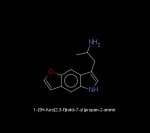
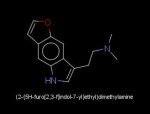
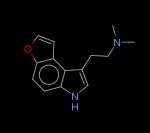
-
Neuroscience & Pharmacology Discussion Welcome Guest
Posting Rules Bluelight Rules Recent Journal Articles Chemistry Mega-Thread FREE Chemistry Databases! Self-Education Guide -
N&PD Moderators: Skorpio
You are using an out of date browser. It may not display this or other websites correctly.
You should upgrade or use an alternative browser.Furo-Indole (Dragonfly-Tryptamine Hybrid
- Thread starter Morninggloryseed
- Start date




dread
Bluelighter
The oxygen would be in the wrong position, because tryptamines bind differently from phenethylamines.
There was a good picture about the differences between trypt/phen binding, in another thread... let me see if I can find it...
here:

So as you can see, if you wanted to make a furoindole, the furan ring should connect to the 4,5 positions instead of 5,6.
- on a related note, here's something I've been thinking about:

Morninggloryseed
Bluelight Crew
What about the corresponding furoindol-8-yl) (ie.e the furan on the corresponding '4' and '5' where oxygen is at the 4.)
dread
Bluelighter
What about the corresponding furoindol-8-yl) (ie.e the furan on the corresponding '4' and '5' where oxygen is at the 4.)
So you'd have the furan in 4,5 with the oxygen in the 4? Well... who knows what would happen, but I suspect it wouldn't be very active: both 5-methyl-DMT and 4-Meo-DMT were of low activity IIRC, so if anything can be extrapolated from that... then again who knows.
Really, I think a dihydrofuran in 4,5 with the oxygen in the 5 would be the optimal choice here. This way the lone pairs will be in the right position to form a hydrogen bond with the serine residue.
One other thing I've been thinking about is the quinoline analogues of various tryptamines. That is, you replace the indole with a quinoline, and the aminoethyl chain would be para to the aromatic nitrogen... As far as I can tell they should be able to fit in the receptor and bind just as well as the indole counterparts.helium-4
Bluelight Crew
Would this be the correct nomenclature for a quinoline DMT, 2-(quinolin-4-yl)-n,n-dimethylethaneamineThe Smoking Man
Bluelighter
5-Me-DMT is about 4 times as potent as DMT, did you mean to say 4-Me-DMT?both 5-methyl-DMT and 4-Meo-DMT were of low activity IIRC
dread
Bluelighter
Would this be the correct nomenclature for a quinoline DMT, 2-(quinolin-4-yl)-n,n-dimethylethaneamine
I think so yes. But I'll show it as a picture, to be sure.
Quinoline analogues of DMT, 4-aco, and AMT:

helium-4
Bluelight Crew
Since there is only an addition of a carbon, and the location of both the Nitrogen on the quinoline and the ethylamine chain match up how could there be much of a change in effects from plain ol DMT and the quinoline dmt? According to tryp binding profile of 5-MeO-dmt there isn't anything interacting with the indole ring besides the nitrogen. Though I guess because it is a tertiary amine it will effect the binding, therefore changing the effects profile.Last edited:
dread
Bluelighter
According to tryp binding profile of 5-MeO-dmt there isn't anything interacting with the indole ring besides the nitrogen.
Well there's pi-pi interaction with the benzene part of the indole and a phenylalanine residue... I'm not sure if changing indole to quinoline will hinder or improve this.
And yeah, the lack of the hydrogen on the quinoline's aromatic N might change the binding somehow... But it shouldn't matter because it should act as a H-bond acceptor anyway, right?
dread
Bluelighter
5-Me-DMT is about 4 times as potent as DMT, did you mean to say 4-Me-DMT?
I meant in comparison to 5-meo-DMT. 5-me is less potent than 5-meo...MurphyClox
Bluelighter
- Joined
- Mar 26, 2008
- Messages
- 1,416
With respect to the bioisosteric replacement of the indole-core in tryptamines with a naphthalene/quinoline-moiety, you maybe like to have a look at agomelatine. It is an already marketed example for such a bioisosteric replacement, which tells us that in principle it is indeed possible to change indole--->naphthalene. A quinoline should be even more similar to the original. Receptor subtype specifity might change though.
Interesting enough, 4-(2-(dimethylamino)ethyl)quinolin-5-ol (i.e. the quinoline-analogue of psilocin) is not known in the literature. Shouldn't be too difficult to make.
Remember that replacement of the benzene-ring in DMT with a thiophene lead to inactive compounds, although thiophene usually works as bioisosteric substitute for benzene (J Med Chem 1999, 42(6), p.1106).
PEACE! - Murphy
P.S. With reagrd to the opening post, neither 2-(5H-furo[2,3-f]indol-7-yl)-N,N-dimethylethanamine nor 1-(5H-furo[2,3-f]indol-7-yl)propan-2-amine are known in the literature.Last edited:MurphyClox
Bluelighter
- Joined
- Mar 26, 2008
- Messages
- 1,416
If so, then the results were not published in any reasonably reputated journal or book. From a scientific point of view this means that they never existed. I couldn't even find a single mentioning in the patent literature.
I understand what you said, but I'm afraid that for practical reasons, one can consider anything that does not show up on SciFinder or Beilstein Reaxxys as "unknown". Results that remain hidden in the file collections of pharma company are of no public importance.
- Murphy
Morninggloryseed
Bluelight Crew
dread
Bluelighter
^ I'd rather see the one with the non-aromatic furan substitution. Think about the difference between FLY and DFLY compounds, the FLY compounds are far less sketchy...
dread
Bluelighter
With respect to the bioisosteric replacement of the indole-core in tryptamines with a naphthalene/quinoline-moiety, you maybe like to have a look at agomelatine. It is an already marketed example for such a bioisosteric replacement, which tells us that in principle it is indeed possible to change indole--->naphthalene. A quinoline should be even more similar to the original. Receptor subtype specifity might change though.
Agomelatine was the one that gave me the idea, actually
I just thought quinoline would be better than naphtalene, for the h-bonding...
hugo24
Bluelighter
- Joined
- Mar 23, 2005
- Messages
- 867
Agomelatin, hmm, I'm thinking on the G compounds now (particularly 2C-G-N), they're active and could serve as a starting point to move the substituents around respectively remove them one at atime. Just a brainstorming for a potential fruitful new research bone...Waterwalker
Greenlighter