
nAON
Bluelight Crew
Coming from a very amateur chemist, do drugs with a structure similar to this one already exist, and if they don't and they prove to be fruitful, can they be named after me?





N&PD Moderators: Skorpio
You are using an out of date browser. It may not display this or other websites correctly.
You should upgrade or use an alternative browser.
Dioxolane on tryptamine
nAON
Bluelight Crew
Coming from a very amateur chemist, do drugs with a structure similar to this one already exist, and if they don't and they prove to be fruitful, can they be named after me?



dread
Bluelighter
An n,n-dialkylated version can be found in tihkal. Forget if it was dimethyl or diisopropyl.
nAON
Bluelight Crew
Know of any programs that give an IUPAC name for a drawn structure and vice versa? Would make flickign through tihkal a lot easier
dread
Bluelighter
Can't remember... try google.
I think the one you want is 5,6-MDO-DIPT or 5,6-MDO-DMT.
e: 5,6-MDO-DMT http://www.erowid.org/library/books_online/tihkal/tihkal31.shtml
5,6-MDO-MIPT http://www.erowid.org/library/books_online/tihkal/tihkal32.shtml
5,6-MDO-DIPT http://www.erowid.org/library/books_online/tihkal/tihkal29.shtml
Only the MIPT compound seems to have been assayed:
QUALITATIVE COMMENTS : (with 35 mgs, orally) "Some paresthesia noted. Nothing else."
(with 50 mgs, orally) "Maybe a trace of activity after an hour. Certainly nothing at three hours."
(with 60 mgs, orally) "There is something going on there, but I can't tell what it is. Very vague."
(with 75 mgs, orally) "Just a teasing smell of light-headedness in twenty minutes, and maybe a bit more light-headedness in an hour. I can suspect the chronology, but the character of the effects remains nebulous. It is certainly less dramatic than the 5-methoxy-compound."

any major dude
Bluelight Crew
seems like i remember one of the methylene dioxy tryptamines being quite active, though i don't think it was a 5,6 one.... *flips through tihkal*

/navarone/
Bluelighter
In my opionion, with all the respect to shulgin, it was a bit foolish to send so much time investigating on 5,6 MD arrangements and not on 4,5 ones (which is a bit more logical considering the activity of 5-MeO-DMT and psylocin).
Yes he made a couple of those but it seems that he hasn't done much testing at all with those compounds.
I have a hard time understanding why there is no experience report on 4,5-MDO-DMT (which IMO would have definetly showed some activity), also the experience results on 4,5-MDO-DiPT have where limited to the first trial (25mg) showing some activity that reminded him of LSD but didnt go further on the testing even if he stated that a bigger dose should be taken.
It woud have been interesting to see some furan and THF analogues too, kind of like BromoDragonly.
dread
Bluelighter
http://en.wikipedia.org/wiki/AL-38022A

This one is close, although it has a pyran instead of furan... Although IIRC there was also one with a furan ring there...
Anyway this seems promising, since "it fully substituted for both DOM and 5-MeO-DMT"... only, it also has high 5ht2c agonism... so it might not be all that fun, but who knows.
Oh, oops, that was the wrong one, I of course meant to post this tryptamine version:
http://en.wikipedia.org/wiki/AL-37350A
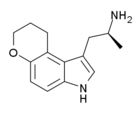
This one seems more promising, since it has a higher selectivity towards 2a over 2c...
/navarone/
Bluelighter
My curiosity about benzoheterocyclics posted on 'stimulants of the future II' applies to tryptamines as well...
/navarone/
Bluelighter
Found this MoFo...
http://pubchem.ncbi.nlm.nih.gov/summary/summary.cgi?cid=126589&loc=ec_rcs

Holy_cow
Bluelighter
It's not a dioxolane (http://en.wikipedia.org/wiki/Dioxolane) attached to the tryptamine, it's a methylenedioxy.
dread
Bluelighter
It's not a dioxolane (http://en.wikipedia.org/wiki/Dioxolane) attached to the tryptamine, it's a methylenedioxy.
Actually it's both. When you attach a cycle to another cycle so that they share two carbons (or heteroatoms) then the names of both cycles are used, thusly:
Benzene + dioxole = benzodioxole or dioxolobenzene (former is commonly used, eg. BDB = benzodioxolyl-butanamine)
Indole + dioxole = indolodioxole or dioxoloindole
Benzene + pyrrole = benzopyrrole = indole
This clear things up for you?
nAON
Bluelight Crew
No point arguing about semantics, i was just intrigued as there are a fair few active phen compounds with dioxolane but don't know many trypts. Cheers dread for all info
Holy_cow
Bluelighter
No. I still can't see a dioxolane moiety on your compounds, only dioxol aka methylenedioxy substituents.
This clear things up for you?

Hammilton
Bluelighter
Actually it's both. When you attach a cycle to another cycle so that they share two carbons (or heteroatoms) then the names of both cycles are used, thusly:
Benzene + dioxole
Indole + dioxole = indolodioxole or dioxoloindole
= indole
This clear things up for you?
You're picking the wrong people to argue with. Argue when they're wrong, not when they're right. Seems rather obvious that it shouldn't even merit saying, but whatever.
There is no attached dioxolane. A dioxolane group refers to the entire group. As you show in your (misplaced) condescention, i't s a combination of benzene and dioxole, not dioxolane. And when you're referring to a tryptamine, you're already referring to an indole, and as such, it is not a dioxolane group, but a methylenedioxy. On a phenethylamine, it is correct to refer to it as a benzodioxole, because that's what it is. To use IUPAC terminology, that's correct. methylenedioxy isn't incorrect there, it's just not "as correct." When referring to tryptamines, it's the only correct form.
a dioxolane is a cyclic acetal with a 3 carbon 'backbone' they are sometimes practically (sometimes only theoretically) formed from 1,2 diols and an aldehyde or ketone
methylenedioxybenzene is a dioxolane, it is the dioxolane made from the aromatic alcohol (phenol) 1,2 dihydroxybenzene (catechol) and formaldehyde although in practice only plants can do this pretty chemistry.
I prefer methylenedioxy but each to their own, this is a pointless discussion.  agreed the methylenedioxy naming is much simpler than the alternatives, this is from the tihkal entry for 5,6-methylenedioxy DMT
TRYPTAMINE, N,N-DIMETHYL-5,6-METHYLENEDIOXY; INDOLE, 3-[2-(DIMETHYLAMINO)ETHYL]-5,6-METHYLENEDIOXY; N,N-DIMETHYL-5,6-METHYLENEDIOXYTRYPTAMINE; 3-[2-(DIMETHYLAMINO)ETHYL]-5,6-METHYLENEDIOXYINDOLE; 5H-1,3-DIOXOLO-[4,5-F]INDOLE-7-ETHANEAMINE, N,N-DIMETHYL
the last systematic naming is nuts

Rectify
Bluelighter
It's really quite simple.
A 5 membered saturated ring with 2 oxygens is a dioxolane while a 5 membered unsatured ring with 2 oxygens is a dioxole. I only know that because I passed heterocyclic chemistry.
The thing on 5,6-MDO-DMT is a 1,3-dioxole, not a 1,3-dioxolane.
