• N&PD Moderators: Skorpio

AL-38022A: A structurally novel serotonin agonist that fully substitutes for DOM

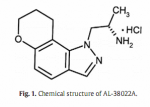
AL-38022A is (S)-2-(8,9-dihydro-7H-pyrano[2,3-g]indazol-1-yl)-1-methylethylamine.

Herein is the data for binding affinities and drug discrimination studies as published in Pharmacology, Biochemistry and Behavior 91 (2009) 307–314. I am unsure of the toxicity of the indazole ring system in humans. This compound represents a potent possible psychedelic without any international scheduling provisions. The mechanics of the binding into the 5HT2A and 5HT2C receptor are currently not known.
 

Attachments

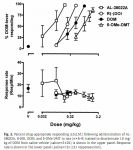
  • AL in rats.png
    AL in rats.png
    30.2 KB · Views: 98
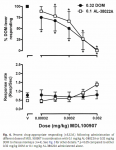
  • AL in rhesus monkeys.png
    AL in rhesus monkeys.png
    34.4 KB · Views: 93
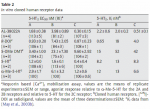
  • humanreceptor.png
    humanreceptor.png
    34.7 KB · Views: 101
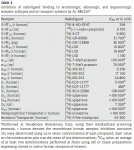
  • other receptors.png
    other receptors.png
    64.1 KB · Views: 98
  • structure.png
    structure.png
    8.7 KB · Views: 124
And in fact it does not have a hugely high efficacy at 5HT2B, it's only twice as potent an agonist as DOI.
 
The Ki values show a very similar ratio of 5HTC:B for both DOI and this

also as to safety such agents are usually not taken often and thus there is likely no impact on the heart from acute occasional use
 
There was a lot of discussion of these indazole derivatives on the other site. I don't remember any this potent though (but I didn't get too deep into it either)
 
The only thing is that this molecule tended to be a very strong agonist, even stronger DOI at the 5HT2A if I recall correctly from memory. The full agonists scare me slightly, as even the very strong LSD only a weak partial agonist at 5HT2A. It's about 3 times as potent compared to DOM in rhesus monkeys, so the active dose may lie around 1-3mg in humans.
 
shows that the heterocyclic amine of the indolealkylamines is unimportant eh? kinda takes a big dump on a lot of classic theory with the dragonflys and all that, IMO.
 
shows that the heterocyclic amine of the indolealkylamines is unimportant eh? kinda takes a big dump on a lot of classic theory with the dragonflys and all that, IMO.

The dragonflies bind via the 2c-X/DOX-type orientations in the binding region of 5HT2A... The verdict is still out on how the tryptamines bind exactly. 8-OH-DPAT for instance has a very high affinity for 5HT1A (the tryptamines generally have agonistic capabilities here) but has a bicyclic hydrocarbon phenethylamine-like system. It would be interesting to establish the way say 4-HO-DMT binds to 5HT1A, 5HT2A and 5HT2C.
 
fair enough. it does however go pretty strongly against of another thread in here thats been kicking around for a few years
 
I wonder what effect the cyclic alkoxy group has on this compound. How would the corresponding direct analog of DMT behave?
 
woah, an 5ht1a (anxiogenic) 2b (cardiotoxic) and 2a (psychedelic) all in one?! how to do I get me some?....remind me, why wouldnt I just take LSD or DOB instead....who the hell puts the money and effort into synthing this stuff?
 
woah, an 5ht1a (anxiogenic) 2b (cardiotoxic) and 2a (psychedelic) all in one?! how to do I get me some?....remind me, why wouldnt I just take LSD or DOB instead....who the hell puts the money and effort into synthing this stuff?

5HT1A agonists are anxiolytic (buspirone, 8-OH-DPAT, psilocin). Maybe you're thinking of 5HT2C agonists. As has already been stated, it doesn't appear to be an inherently strong agonist at the 5HT2B receptor.
 
nuke said:
5HT1A agonists are anxiolytic (buspirone, 8-OH-DPAT, psilocin).

Although buspirone is a really poor anxiolytic (I'm not sure if it should even be on the market), and psilocin is 'dirty' enough that I'd say that anxiogenic effects at other receptors outweigh any anxiolysis. Not especially familiar with 8-OH-DPAT.

I think that it is rather telling, though, that any oxytocin release effected by MDMA is mediated by SERT efflux at 5ht1a.

ebola
 
Top