• N&PD Moderators: Skorpio

Meth neurotoxicity avoidable with infrequant use?

Not neccessarily, though generally, the stronger the 5HT releaser it is, the more likely it's going to be neurotoxic. pCA, for example.

Methamphetamine is many, many times more potent than MDMA. I'd need to double check, but I think that methamphetamine IS the stronger 5HT releaser, but the ratio of 5HT to DA is in DA's favor.
 
Not neccessarily, though generally, the stronger the 5HT releaser it is, the more likely it's going to be neurotoxic. pCA, for example.

I don't think it's that simple, as indanylamphetamine is stated to be a very strong SE releaser(maybe one of the strongest), yet its relatively non toxic. I believe it has has most to do with the presence of its metabolites, and if they are toxic or not. Also I think another huge factor to neurotoxicity is whether the drug causes hyperthermia, which is strongly meditated through strong SE and/or DA activity.
 
I've seen this said, but I've never seen a reference. Does anyone have numbers? I doubt it's even in the range of MDMA for some reason. It is a decent dopaminergic though.
 
Indanylamphetamine has large hydrophobic groups in the 3,4-position and therefore may be a poor DAT inhibitor/releaser. The combination of both dopamine and serotonin release appears to be required for neurotoxic effect. This is probably the reason why 4-Fluoroamphetamine is not neurotoxic (being mostly only a selective dopamine releaser) and TFMPP is also not neurotoxic (being mostly a selective serotonin releaser).
 
If indanylamphetamine were a decent DA releaser too you would expect it to be claimed to be even a little neurotoxic, but then again it may not have any toxic metabolites.

Maybe DA activity ain't essential for severe toxicity if the SE releaser is also a MAO inhibitor?? Because it may be strong enough to lead to serotonin syndrome causing a hyperthermic reaction.
 
Last edited:
Also as far as IAP/monoamine release:
Compounds 2a,b are particularly interesting in that
they are more potent as serotonin-releasing agents than
most other compounds previously tested in these labo-
ratories. 6,7,16 The only compounds that have shown
higher activity than 2a,b are p-iodoamphetamine (PIA),
20 p-(methylthio)amphetamine (MTA), 21 and 1-(5-indanyl)-
2-aminopropane (IAP). 16 As can be seen in Table 1,
although PIA, MTA, and IAP are slightly more potent
than 2a,b, the latter two compounds greatly surpass
them in selectivity for 5-HT versus DA release, exhibit-
ing a preference of more than 100-fold for the 5-HT
carrier versus the DA carrier, while still retaining a
moderate selectivity versus the NE carrier.
https://erowid.org/references/refs_view.php?A=ShowDoc1&ID=6536

I can't find much as to the specific toxicity of the drug, though. It may still be neurotoxic as far as I know.

Further reading:

(16) Monte, A. P.; Marona-Lewicka, D.; Cozzi, N. V.; Nichols, D. E.
Synthesis and Pharmacological Examination of Benzofuran,
Indan, and Tetralin Analogues of 3,4-(Methylenedioxy)amphet-
amine. J. Med. Chem. 1993, 36, 3700 3706.
http://www.erowid.org/chemicals/iap/iap_info2.pdf

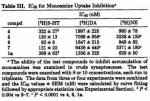
IAP is number 6 on the chart below.
 

Attachments

  • iap.jpg
    iap.jpg
    13.8 KB · Views: 101
Last edited:
Not neccessarily, though generally, the stronger the 5HT releaser it is, the more likely it's going to be neurotoxic. pCA, for example.

Methamphetamine is many, many times more potent than MDMA. I'd need to double check, but I think that methamphetamine IS the stronger 5HT releaser, but the ratio of 5HT to DA is in DA's favor.

But without tolerance to both, the average dosages of MDMA are far greater than meth, so that'ld compensate for potency, leaving the ratio of DA to 5-HT release, correct?
 
Meth and MDMA are also different in the neurotoxicities they produce. Meth is associated with both dopaminergic and serotonergic neurons while MDMA is usually only associated with serotonergic neurotoxicity.
 
I'm very curious as to what non-neurotoxic drugs the OP is referring to. I am also very conscious about the potential cognitive decline (I mean ANY sort of it) associated with drug use, and am looking for an alternative outlet.

Which drugs, specifically, are non-neurotoxic (I'm using this term much more generally than it's intended; I think my previous paragraph outlined my point perfectly, though)?
 
^ Even if the drug or the use patterns were non neurotoxic, you could still potentially experience cognitive decline due to neuro adaptation during your use. I would expect this to return back to normal after prolonged absence. A good example of this is smoking pot.
 
Hm. Well, I'm merely asking about the potential for permanent decline from a drug's actual alteration, not necessarily an adaptation from using drugs over an extended period. I do appreciate the input, though, as you have shown me something I find quite fascinating. : )

I'm essentially asking what you all consider the safest drugs; that is, for me, those drugs that do not have a permanent negative impact on cognitive function.
 
i'm very concerned about this as well. i don't meth very often but i'm on amphetamine for my ADD/Dyslexia and fatigue which i take daily..if i don't, well i have little energy. :\ i really wish i could just take a couple days off or sth during the week but i don't really know how to do that since my tolerance is going up...or maybe just half/quarter my doses on days that i'm not as active?

anyway..didn't mean to derail this thread...i heard magnesium is quite good for meth/amphetamine use but i'm not sure if it prevents neurotoxicity. and i'm sure vitamins and amino acids simply keep the body in good shape..besides maybe eating away at some of the meth/amphetamine so it isn't in the body quite as long. anything acidic/with anti-oxidants will do that.
 
Referring to this chart above.... How does the factor 82 for 5-HT reuptake inhibition relate to IAP's SE release potency?

Oh, it doesn't aside from the fact that I don't have any other data to go on (data on measured serotonin release). But the high affinity for the transporter would likely mean that it would have a much greater chance of being able to cause SERT reversal and subsequently 5HT release.
 
anyway..didn't mean to derail this thread...i heard magnesium is quite good for meth/amphetamine use but i'm not sure if it prevents neurotoxicity.

It has tolerance-combating effects. Some people use magnesium supplements and NMDA-antagonists (the latter in small doses) as something as close to a cure for tolerance to amphetamines I think one can get. I've tried it twice, with surprising results, once with ketamine and once with DXM, both times I used the NMDA-antagonist for four days between moderate 'binges' (not sure if I'm using this term correct, I'm refering to a few days of tweaking in a row).

and i'm sure vitamins and amino acids simply keep the body in good shape..besides maybe eating away at some of the meth/amphetamine so it isn't in the body quite as long. anything acidic/with anti-oxidants will do that.

Well, at least in most recreational users I've met, any loss in effect due to faster clearance would immediately be compensated with redose and redose, perhaps with some redose to top it off. :D

If one were to take a supplement of sorts aiming for a (non-health-compromising) raise of pH in the bodily fluids, with improved bioavailability and molecular longevity in vivo as sought results, how would this affect amphetamine's and methamphetamine's respective unhealthy potential?

If that same unspecified one were to administer with sodiumbicarbonate (I'm having baking soda in mind, not sure if that's the correct name for the baking soda-substance in english) trying to get a bit more bang per buck out of amphetaminesulphate-preparations bought on the street, is one then increasing the risks for neurological damage? Would such a practice change peripheral and central effects differently?

To me it seems unlikely that eating sodiumbicarbonate to neutralise stomach acids would be harmful, lots and lots of people use this substance this way, but how about mainlining it? I have a friend who's not what I'd call a responsible user, who puts some sodiumbicarbonate in the mix when preparing IV-fixes of amphetamine, and apparently still lives, but is this dangerous in itself, or does it add to (or increase) the dangers that follows recreational use of stimulants?

If my post is unintelligible to you at some point, please complain and I'll try to explain what I meant, and if it actually is partly or wholly unintelligible (I'm capable to read it, tried and succeeded I did) it's because english isn't my native tounge combined with a bit of sleep deprivation and that I'm a few inches or similar above baseline due to doing some amphetamine.

 
Top